

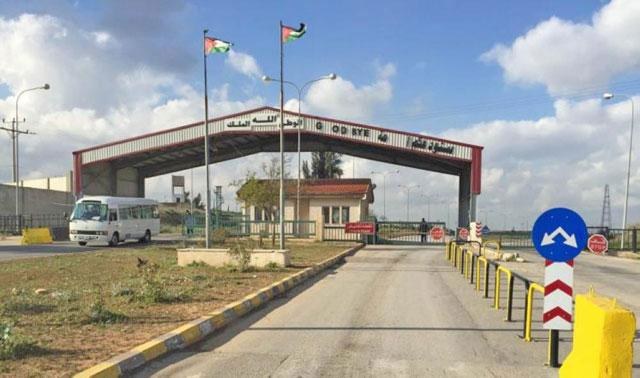
Jordan re-closes crossing with Syria after security situation escalation on Syrian side

This photo taken in 2015 shows the Jaber border crossing with Syria, some 90 kilometres north of Amman. (AFP/File Photo)
Short Url
Updated 31 July 2021
Follow

Jordan re-closes crossing with Syria after security situation escalation on Syrian side

  • The number of arrivals through the border crossing will be increased
  • All nationalities will be allowed to leave Jordan through the crossing

AMMAN: The Jaber border crossing between Jordan and Syria will be temporarily closed for the movement of goods and passengers as a result of the developments in the security situation on the Syrian side, Petra News Agency reported an official source in the Ministry of Interior as saying.

The source added that the crossing will be reopened if the “appropriate conditions” are in place.

The crossing was set to operate at full capacity from Aug. 1, following almost 10 years of complete and partial closure due to rising violence in Syria and the coronavirus pandemic.

Jordanian Interior Minister Mazen Al-Faraya recently announced that the Jaber-Nasib crossing would operate at full capacity after all technical and administrative arrangements were completed with the Syrian side.

Al-Faraya said that the decision came after directives from Prime Minister Bishr Khasawneh following his field visit to the crossing on July 8.

The minister added that a set of new measures will be implemented at the border crossing — located about 90 kilometers north of Amman — to increase passenger and cargo traffic between Jordan and Syria, including the cancellation of the back-to-back shipment protocol.

“This means that the Syrian trucks will continue their way to Saudi Arabia and other the Arab Gulf countries without anymore needing a Jordanian freight forwarder,” he said.

Al-Faraya added that the number of arrivals through the border crossing will be increased and that all nationalities will be allowed to leave Jordan through the border crossing with no prior approval from the interior ministry.

In April 2015, Jordan completely closed its border crossing with Syria as a result of escalating violence in the Syrian bordering town of Nasib, which, at the time, was reportedly captured by the Syrian rebels and fighters from the Al-Qaeda-affiliated Nusra Front.

With Syrian government forces recapturing the southern regions and raising the country’s red-white-and-black flag above Nasib, Jordan reopened the crossing with Syria in October 2018, but only partially, and for a limited number of passengers and cargo traffic.

Following concerns of the crossing becoming a coronavirus hot spot, Jordanian authorities closed the country’s sole gateway into Syria in August 2020 to reopen it shortly afterward, but also at a limited capacity.

The Nasib crossing is the only functioning crossing between Jordan and Syria and is considered a vital economic artery for Jordanian, Syrian and Lebanese traders and merchants.

Strategic analyst Amer Sabaileh said that Jordan “getting closer” to Syria has to do with Amman’s frustration with the international community’s inaction on Syria and its failure to resolve the ongoing crisis.

“After 10 years of crisis, nobody is offering solutions for the Syrian conflict and this puts more pressure on Jordan to start at least exploring for new opportunities to put an end to this crisis, because it is the most affected by its ongoing consequences, be they economic, security or social,” Sabaileh told Arab News.

Jordan is home to about 650,000 registered Syrian refugees, according to the UNHCR.

Asked whether Jordan’s emerging activism on Syria was approved by the US following King Abdullah’s visit to Washington, Sabaileh said: “These attempt were before his visit to the US, but the activism became more active after he returned home. If there was no green light given from the US, at least there was no rejection.”

Political commentator Shaqfiq Obeidat hailed Jordan’s decision to reopen the border crossing with Syria as “wise and historic,” and reflective of “brotherly ties” between Amman and Damascus.

Obeidat said that the reopening of the Jaber border crossing with Syria is in line with Jordan’s “unaltered position” on Syria which, he said, had always been to promote a comprehensive political solution to the ongoing conflict there.

Describing Syria as “Jordan’s northern gateway” to the world, Obeidat said that the reopening of the border crossing at full capacity will generate “immeasurable” contributions towards enhancing bilateral trade and increasing Jordanian exports to Syria, Lebanon and eastern Europe.


Trump says Iran government change ‘best thing that could happen’

Updated 14 February 2026
Follow

Trump says Iran government change ‘best thing that could happen’

  • US president's comments come after he ordered a second aircraft carrier to head to the Middle East

FORT BRAGG, United States: US President Donald Trump said a change of government in Iran would be the “best thing that could happen,” as he ordered a second aircraft carrier to head to the Middle East.
“Seems like that would be the best thing that could happen,” Trump told reporters at the Fort Bragg military base in North Carolina when a journalist asked if he wanted “regime change” in Iran.
“For 47 years, they’ve been talking and talking and talking. In the meantime, we’ve lost a lot of lives while they talk,” he told reporters.

Trump declined to say who he would want to take over in Iran from supreme leader Ayatollah Ali Khamenei, but he added that “there are people.”
He has previously backed off full-throated calls for a change of government in Iran, warning that it could cause chaos, although he has made threats toward Khamenei in the past.
Speaking earlier at the White House, Trump said that the USS Gerald R. Ford — the world’s largest warship — would be “leaving very soon” for the Middle East to up the pressure on Iran.
“In case we don’t make a deal, we’ll need it,” Trump said.
The giant vessel is currently in the Caribbean following the US overthrow of Venezuela’s Nicolas Maduro. Another carrier, the USS Abraham Lincoln, is one of 12 US ships already in the Middle East.

When Iran began its crackdown on protests last month — which rights groups say killed thousands — Trump initially said that the United States was “locked and loaded” to help demonstrators.
But he has recently focused his military threats on Tehran’s nuclear program, which US forces struck last July during Israel’s unprecedented 12-day war with Iran.
The protests have subsided for now but US-based Reza Pahlavi, the son of Iran’s last shah, urged international intervention to support the Iranian people.
“We are asking for a humanitarian intervention to prevent more innocent lives being killed in the process,” he told the Munich Security Conference.
It followed a call by the opposition leader, who has not returned to his country since before the revolution, for Iranians at home and abroad to continue demonstrations this weekend.
Iran and the United States, who have had no diplomatic relations since shortly after the revolution, held talks on the nuclear issue last week in Oman. No dates have been set for new talks yet.
The West fears the program is aimed at making a bomb, which Tehran denies.
The head of the UN nuclear watchdog, Rafael Grossi, said Friday that reaching an accord with Iran on inspections of its processing facilities was possible but “terribly difficult.”

Trump said after talks with Israeli Prime Minister Benjamin Netanyahu earlier this week that he wanted to continue talks with Iran, defying pressure from his key ally for a tougher stance.
The Israeli prime minister himself expressed skepticism at the quality of any agreement if it didn’t also cover Iran’s ballistic missiles and support for regional proxies.
According to the US-based Human Rights Activists News Agency, 7,008 people, mostly protesters, were killed in the recent crackdown, although rights groups warn the toll is likely far higher.
More than 53,000 people have also been arrested, it added.
The Norway-based Iran Human Rights (IHR) NGO said “hundreds” of people were facing charges linked to the protests that could see them sentenced to death.
Figures working within the Iranian system have also been arrested, with three politicians detained this week from the so-called reformist wing of Iranian politics supportive of President Masoud Pezeshkian.
The three — Azar Mansouri, Javad Emam and Ebrahim Asgharzadeh — were released on bail Thursday and Friday, their lawyer Hojjat Kermani told the ISNA news agency.