

Pakistani, US national security advisors hold 'positive' meeting in Washington

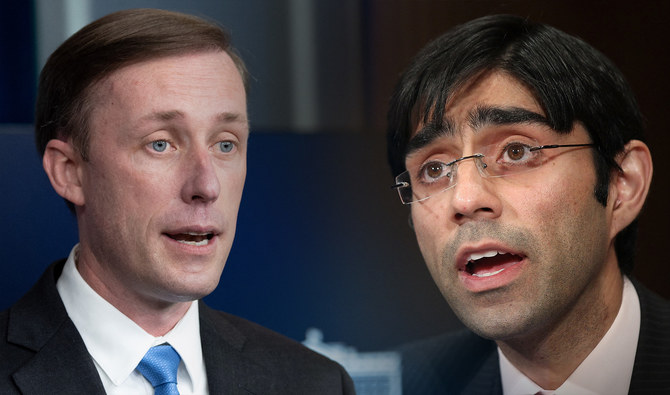
The combination of photos shows US National Security Advisor Jake Sullivan and his Pakistani counterpart Moeed Yusuf. (AFP photos)
Short Url
Updated 30 July 2021
Follow

Pakistani, US national security advisors hold 'positive' meeting in Washington

  • Two sides 'agreed to sustain momentum in Pak-US bilateral cooperation,' says Dr. Moeed Yusuf
  • Jake Sullivan also mentions 'regional connectivity' and 'reduction of violence' in Afghanistan as part of the conversation

ISLAMABAD: The national security advisors (NSAs) of Pakistan and the United States met in Washington on Thursday to discuss a broad spectrum of issues, confirmed the two officials in their Twitter posts, while exclusively focusing on the Pak-US bilateral relations and the situation in Afghanistan.
The two NSAs had previously interacted in Geneva to strengthen the United States-Pakistan cooperation at a time when American troops were beginning their exit from Afghanistan and the international community was pushing various factions in the war-battered country to reach a negotiated and inclusive political settlement.
Pakistan's Dr. Moeed Yusuf left on an official visit to the United States for a follow-up meeting with his American counterpart Jake Sullivan on Monday.
Yusuf described his meeting with the US official as "positive," saying that the two sides had "agreed to sustain the momentum in Pak-US bilateral cooperation."


The US national security advisor was more specific in his Twitter post and noted that the meeting focused on "regional connectivity and security" along with the "need for a reduction in violence in Afghanistan and a negotiated political settlement to the conflict."

Pakistani officials, including Prime Minister Imran Khan, have frequently maintained in recent months that Islamabad wants to broaden and deepen its "transactional relationship" with the US by adding a strong economic dimension to it.
However, official contacts between the two countries have remained somewhat limited since the arrival of President Joe Biden's administration in Washington.
Prime Minister Khan recently accused the United States of "messing things up" in Afghanistan, while US Secretary of State Anthony Blinken emphasized Pakistan's "vital role" in convincing the Taliban not to take over Afghanistan by force.


Pakistan says defense pact with Saudi Arabia elevated brotherly ties to ‘new heights’

Updated 25 February 2026
Follow

Pakistan says defense pact with Saudi Arabia elevated brotherly ties to ‘new heights’

  • Pakistan, Saudi Arabia signed strategic defense pact last year pledging aggression against one will be treated as attack on both
  • Deputy PM Ishaq Dar says enduring bonds with Islamic and Arab nations form vital pillar of Pakistan’s foreign policy 

ISLAMABAD: Deputy Prime Minister Ishaq Dar said on Wednesday that Pakistan’s defense pact with Saudi Arabia elevated its brotherly ties with the Kingdom to “new heights,” stressing that close ties with Arab and Islamic nations form a key pillar of Islamabad’s foreign policy. 

Pakistan and Saudi Arabia signed a Strategic Mutual Defense Agreement on Sept. 17 last year, pledging that aggression against one country would be treated as an attack on both, enhancing joint deterrence and formalizing decades of military and security cooperation.

Both nations agreed in October 2025 to launch an economic cooperation framework to strengthen trade and investment ties. 

“In the Middle East, our landmark Strategic Mutual Defense Agreement with Saudi Arabia has elevated our brotherly ties to new heights,” Dar said while speaking at the Pakistan Governance Forum 2026 event in Islamabad. 

The Pakistani deputy prime minister was speaking on the topic “Navigating International Relations Amidst Changing Geo-Politics.”

Dar noted that Pakistan has reinforced partnerships with other Middle Eastern nations such as the UAE, Qatar, Jordan, Oman, Egypt and Bahrain. He said these partnerships have yielded “concrete agreements” in investment, agriculture, infrastructure, and energy sectors. 

“Our enduring bonds with Islamic and Arab nations form a vital pillar of our foreign policy, and we will continue to expand our partnerships across Asia, Latin America, and Africa,” he said. 

Dar pointed out that the presidents of Kazakhstan, Uzbekistan and Kyrgyzstan have undertaken visits to Pakistan in recent months, reflecting Central Asian nations’ desire to boost cooperation with Islamabad.

On South Asia, the Pakistani deputy PM said Pakistan has successfully transformed its fraternal ties with Bangladesh into “a substantive partnership.”

“Similarly, the trilateral mechanism involving China, Pakistan, and Bangladesh has been launched with a view to expanding and deepening regional cooperation and synergy,” the Pakistani minister said. 

He said Islamabad has strengthened its “all-weather” partnership with China via the second phase of the multi-billion-dollar China-Pakistan Economic Corridor agreement and “unwavering support” from both sides for each other’s core interests. 

Dar said Pakistan had also reinvigorated its partnership with the US, advancing cooperation in trade, technology, investment, and regional stability. 

“This calibrated approach has enhanced our ability to navigate complexity with skill and confidence, ensuring that our national interests are served without compromising our core foreign policy principles,” he said.