


RIYADH: Saudi Arabia on Wednesday ended their stay in Japan as they bowed out of the Tokyo 2020 Olympics football tournament at the end of the group stage.
The Young Falcons made it three defeats out of three with a 3-1 loss to Brazil, but Egypt squeezed through the group stage and into the last eight with an impressive 2-0 win over Australia.
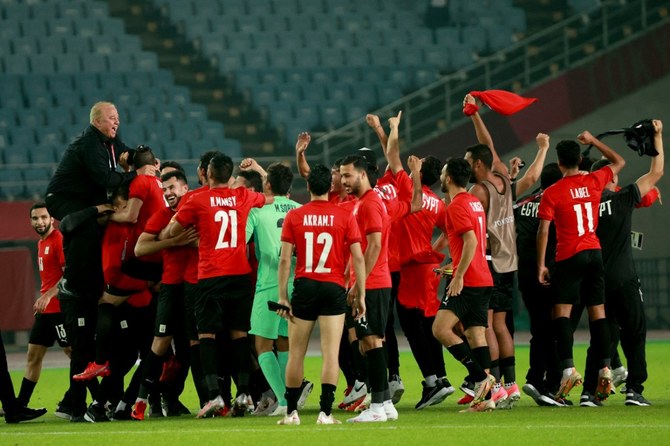
That second-place finish in Group C means an exciting quarterfinal against Brazil on Saturday as the north Africans carry the hopes of the Arab world with them.
Here are five thing we learned from the last round of group matches.
1. Saudi Arabia competitive in a tough group but were too naive
The performances in all three games were far from poor and much better than the results suggested. When head coach Saad Al-Shehri looks back on the three defeats against Ivory Coast, Germany, and Brazil, he will surely think that his team could have got something from all three.
In all, the team fell behind but then managed to get back on level terms before conceding in the second half. There is no shame in losing to any of the three countries individually but after a lot of hard work and some good play, it was frustrating to return home without a point.
The Saudis were just not as street smart as some of their opposition who managed the game better and knew when to slow things down and when to go for the jugular. That comes with experience and these Saudi players need more.
2. Attack was good but defense not so much
Saudi Arabia scored four goals in three games, and only six teams scored more in the group stage. The obvious problem was the eight conceded at the other end.
There did not seem to be much of an understanding between Abdulelah Al-Omari, who seemed to lack a little sharpness after a recent injury, and Abdulbasit Hindi in the middle of defense and this affected the whole of the backline which did not look that organized.
After an intensive preparation period, three training camps, and a number of warm-up games, these are issues that could have been sorted out to a better degree even if some of the attacking talent that they were up against was of high quality.
3. Al-Hamdan has bright future, but work to do
There have been some high hopes for Abdullah Al-Hamdan, including that the Al-Hilal striker may be the successor to Sami Al-Jaber that Saudi Arabia have been waiting for.
That may still be the case for a 21-year-old who continues to learn his trade but there is still some way for him to go if he wants to become one of Asia’s best strikers.
It is not just that he did not find the target or even make any goals, but he struggled to impose himself against international defenders. The best strikers, even when they are not scoring, make life difficult for the opposition, but Al-Hamdan did not manage to do that consistently, failed to really harass defenders, and could not find space or make enough runs for others to take advantage.
It has been a learning experience for Al-Hamdan and, perhaps, a necessary reminder that he still has a lot of work to do and a long way to go. It is to be hoped that this serves as a turning point in a career that has much to offer.
4. Egypt deserved to progress but improvement is needed
The Pharaohs were in a very tough group but handled the situation pretty well. They held tournament favorites Spain to a draw in the opening game and then almost did the same against Argentina but were just unable to stop the South Americans getting the breakthrough.
The final game against Australia was always going to the decider with coach Shawky Gharieb knowing that victory was likely to mean the knockout stage. And victory was deserved though it was not a perfect performance.
Egypt were well on top in the first half and worked hard after the break to stop the Olyroos, who looked like they were looking for the draw, picking up any sustained attacking momentum in the second half but wasted chances meant they were reliant on their goalkeeper.
Still, it all worked out well as Egypt hit Australia on the counter in the second half and sealed the win.
5. El-Shenawy makes the difference for Egypt
Egypt’s progression to the knockout stage was sealed with about eight minutes remaining. Australia had a corner and the header from Thomas Deng was heading into the bottom corner and set to take the Olyroos into the last eight instead of Egypt. Somehow though, Mohammed El-Shenawy got down to claw the ball out.
It was a truly fantastic save and it seemed at that point that Australian shoulders dropped and they knew that this was not to be their day.
That feeling was confirmed shortly after as Ammar Hamdi made it 2-0 and that was that. It was a clinical performance from Egypt but the wild celebrations that could be seen at the end would not have taken place without a super save from their No. 1.


