

Pakistan aims to vaccinate 40% of population next month

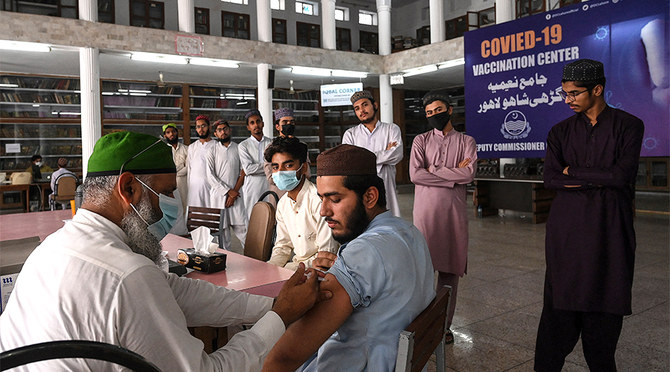
A health worker inoculates a student with a dose of the CanSino Biologics' Covid-19 vaccine at Jamia Naeemia seminary in Lahore, Pakistan, on July 12, 2021. (AFP)
Short Url
Updated 25 July 2021
Follow

Pakistan aims to vaccinate 40% of population next month

  • New push in the vaccination drive comes as infections are increasing due to local transmission of the delta variant
  • Country of 220 million has so far administered COVID-19 vaccine doses to 25 million people

ISLAMABAD: Pakistan is accelerating its coronavirus vaccination drive to have 40 percent of the population inoculated by the end of August, Planning Minister Asad Umar said on Sunday.
The new push in the vaccination campaign comes as infection numbers are now increasing again, after Pakistan started easing wide-ranging coronavirus last month. The surge is blamed on local transmission of the more aggressive delta variant of the coronavirus, which officials have reported is reaching alarming levels in the country’s major cities.
The country of 220 million has so far administered COVID-19 vaccine doses to 25 million people.
“By end August all major cities target is to have at least 40 percent of eligible population vaccinated,” Umar said.

On Sunday, over 2,800 new infections and 45 deaths have been reported in Pakistan, while the test positivity rate increased to 6.32 percent.
Confirmed COVID-19 cases on Friday crossed the one million mark since the beginning of the pandemic last year.


Pakistan issues over $7 billion sukuk in 2025, nears 20 percent Shariah-compliant debt target

Updated 11 sec ago
Follow

Pakistan issues over $7 billion sukuk in 2025, nears 20 percent Shariah-compliant debt target

  • Finance Adviser Khurram Schehzad says this was the highest-ever Sukuk issuance in a single calendar year since 2008
  • Pakistan’s Federal Shariat Court ordered in 2022 the entire banking system to transition to Islamic principles by 2027

ISLAMABAD: Pakistan’s Finance Adviser Khurram Schehzad on Monday said the country achieved a landmark breakthrough in Islamic finance by issuing over Rs2 trillion ($7 billion) sukuk this year, bringing it closer to its 20 percent Shariah-compliant debt target by Fiscal Year 2027-28.

A sukuk is an Islamic financial certificate, similar to a bond, but it complies with Shariah law, which forbids interest. Pakistan’s Federal Shariat Court (FSC) had directed the government in April 2022 to eliminate interest and align the country’s entire banking system with Islamic principles by 2027.

Following the ruling, the government and the State Bank of Pakistan (SBP) have undertaken a series of measures, including legal reforms and the issuance of sukuk to replace interest-based treasury bills and investment bonds.

“In 2025, the Ministry of Finance (MoF) through its Debt Management Office, together with its Joint Financial Advisers (JFAs), successfully issued over PKR 2 trillion in Sukuk,” Schehzad said on X, describing it as “the highest-ever Sukuk issuance in a single calendar year since 2008 by Pakistan.”

Pakistan made a total of 61 issuances across one-, three-, five- and 10-year tenors, according to the finance adviser. The country also successfully launched its first Green Sukuk, a Shariah-compliant bond designed to fund environment-friendly projects.

He said the Green Sukuk was 5.4 times oversubscribed, indicating investor demand was more than five times higher than the amount the government planned to raise, which showed strong market confidence.

“The rising share of Islamic instruments in the government’s domestic securities portfolio (domestic debt) underscores strong momentum, growing from 12.6 percent in June 2025 to around 14.5 percent by December 2025, clearly positioning the MoF to achieve its 20 percent Shariah-compliant debt target by FY28,” Schehzad said.

“This milestone also reflects the structural deepening of Pakistan’s Islamic capital market, sustained investor confidence, and the strengthening of sovereign debt management.”

He said Pakistan was strengthening its government securities market by making it more resilient, diversified, and future-ready, supported by a stabilizing macroeconomic environment, a disciplined debt strategy, and a clear roadmap for Islamic finance.