

Houthis bury 11 fighters after new military setback in Yemen

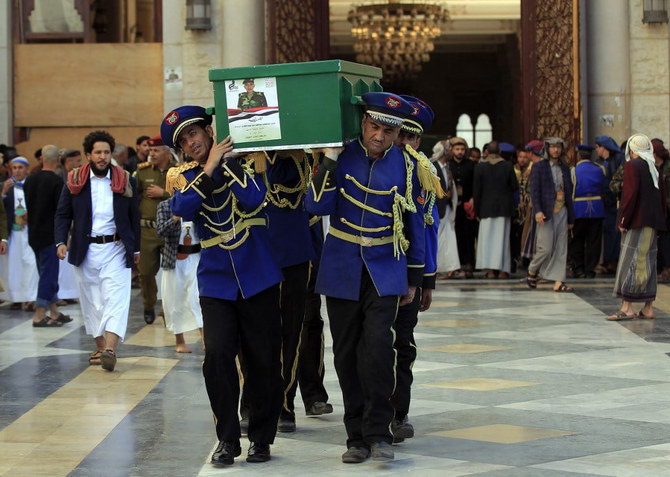
A funeral service is held at the Al-Saleh mosque in Sanaa on February 24, 2021, for Houthi fighters killed in combat. (AFP file photo)
Short Url
Updated 25 July 2021
Follow

Houthis bury 11 fighters after new military setback in Yemen

  • Senior commander among the dead as Iran-backed militia suffer losses in Marib

ALEXANDRIA: The Iran-backed Houthi militia in Yemen held military funerals in Sanaa on Saturday for 11 of their fighters, including a senior commander, who were killed in battle.

Fighters carried the coffins of Brig. Hamer Yahiya Yahiya Al-Fakih, military chief of staff of the capital’s Hamdan district, and 10 others who died in clashes with troops or in Arab coalition airstrikes.

Al-Fakih and other Houthi leaders were killed in key contested areas in Marib, where the Houthis have mounted an offensive to capture the oil-rich city. A local military source told Arab News on Saturday that at least two other senior Houthi leaders had been killed in fighting in Marib in the past 48 hours.

Yemen’s Defense Ministry said the Houthis had escalated their attacks on troops in four provinces, with dozens of combatants dying on both sides.

Troops and allied tribesmen on Saturday pushed back a Houthi assault in the Al-Mashjah area, west of Marib, with the rebels forced into retreating. Many Houthis were killed or wounded and at least seven military vehicles were destroyed in the battle that lasted for several hours, the ministry said.

Other clashes broke out in Al-Kasara, west of Marib, where the Houthis failed to make gains despite their attacks, a military source said.

“We pushed back all of the militia’s waves and they could not move an inch on the ground,” the source told Arab News.

The army also shot down an explosives-rigged drone over a residential area north of Marib city.

In neighboring Al-Bayda, where the Houthis have made major advances in the past couple of weeks, fighting broke out in the Al-Zaher and Al-Souma districts as government troops sought to recapture areas from the group.

Fueled by their gains in Al-Bayda, the Houthis launched new attacks on troops in the southern provinces of Lahj and Shabwa for the first time in years.

Local military sources said a soldier from the Southern Transitional Council was killed in fighting with the Houthis between Al-Bayda and Lahj.

Similar clashes occurred on the borders of Al-Bayda and Shabwa provinces.

Three civilians, including two children, were injured on Saturday in the southern city of Taiz when a mortar shell fired by the Houthis exploded in a residential area.

Also in Taiz, a Houthi sniper shot a 65-year-old woman in the shoulder in the Maqbanah district.

During the last six years, the Houthis have surrounded Taiz, Yemen’s third-largest city, and intensified shelling of the city’s central area in an attempt to force government troops to surrender.


Jailed Turkish Kurd leader calls on government to broker deal for Syrian Kurds

Updated 7 sec ago
Follow

Jailed Turkish Kurd leader calls on government to broker deal for Syrian Kurds

  • Clashes between Syrian forces and the SDF have cast doubt over a deal to integrate the group’s fighters into the army
ANKARA: Jailed Turkish Kurd leader Abdullah Ocalan said Tuesday that it was “crucial” for Turkiye’s government to broker a peace deal between the Kurdish-led Syrian Democratic Forces (SDF) and the Damascus government.
Clashes between Syrian forces and the SDF have cast doubt over a deal to integrate the group’s fighters into the army, which was due to take effect by the end of the year.
Ocalan, founder of the Kurdistan Workers’ Party (PKK) militant group, called on Turkiye to help ensure implementation of the deal announced in March between the SDF and the Syrian government, led by former jihadist Ahmed Al-Sharaa, whose forces ousted longtime ruler Bashar Assad last year.
“It is essential for Turkiye to play a role of facilitator, constructively and aimed at dialogue,” he said in a message released by Turkiye’s pro-Kurdish DEM party.
“This is crucial for both regional peace and to strengthen its own internal peace,” Ocalan, who has been jailed for 26 years, added.
“The fundamental demand made in the agreement signed on March 10 between the SDF and the government in Damascus is for a democratic political model permitting (Syria’s) peoples to govern together,” he added.
“This approach also includes the principle of democratic integration, negotiable with the central authorities. The implementation of the March 10 agreement will facilitate and accelerate that process.”
The backbone of the US-backed SDF is the YPG, a Kurdish militant group seen by Turkiye as an extension of the PKK.
Turkiye and Syria both face long-running unrest in their Kurdish-majority regions, which span their shared border.
In Turkiye, the PKK agreed this year at Ocalan’s urging to end its four-decade armed struggle.
In Syria, Sharaa has agreed to merge the Kurds’ semi-autonomous administration into the central government, but deadly clashes and a series of differences have held up implementation of the deal.
The SDF is calling for a decentralized government, which Sharaa rejects.
Turkish Foreign Minister Hakan Fidan, whose country sees Kurdish fighters across the border as a threat, urged the SDF last week not to be an “obstacle” to stability.
Syrian Kurdish leader Mazloum Abdi said Thursday that “all efforts” were being made to prevent the collapse of talks.