Australian officials tighten Sydney lockdown as COVID-19 cases rise

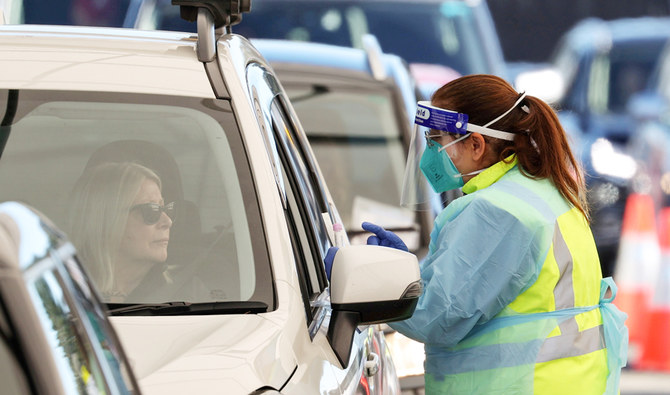
A medical worker prepares to administer a test at the Bondi Beach drive-through coronavirus disease (COVID-19) testing centre in the wake of new positive cases in Sydney, Australia. (REUTERS file photo)
Short Url
Updated 23 July 2021
Follow

Australian officials tighten Sydney lockdown as COVID-19 cases rise

  • New Zealand Prime Minister Jacinda Ardern on Friday suspended for at least eight weeks the so-called “travel bubble” with Australia that allows movement between the two countries without quarantine

SYDNEY: Australia’s New South Wales state on Friday reported its biggest daily rise in new COVID-19 cases this year, prompting state officials to tighten lockdown measures in Sydney in what they called a “national emergency.”
State Premier Gladys Berejiklian also flagged the likelihood that stay-home orders for the country’s biggest city would be extended beyond the current end date of July 30.
“There is no doubt that the numbers are not going in the direction we were hoping they would at this stage,” Berejiklian said as she announced 136 new cases in New South Wales.
Total infections in Australia’s worst outbreak since the peak of the pandemic last year have jumped to just over 1,900 since the first case was detected in a Sydney limousine driver transporting international flight crews in mid-June.
The outbreak of the fast-moving Delta strain was carried across borders to the neighboring states of Victoria and South Australia, leading to measures that have put more than half the country’s population in lockdown. That has shut down down large parts of the economy, even as other parts of the world, including Britain and the United States, open up..
New Zealand Prime Minister Jacinda Ardern on Friday suspended for at least eight weeks the so-called “travel bubble” with Australia that allows movement between the two countries without quarantine. The arrangement had already been paused for travelers to and from New South Wales, Victoria and South Australia.
Crucially, at least 53 of the new cases in Sydney were infectious in the community before being diagnosed. Authorities have said that figure needs to be near zero for a lockdown in the New South Wales capital to be lifted.
State chief health officer Kerry Chant said a national vaccination program needed to be refocused on the Sydney hotspots.
“I have advised the government today that this is a national emergency, and requires additional measures to reduce the case number,” Chant said.
A formalized “national emergency” would typically unlock federal government funding and other assistance.
In contrast to New South Wales, Victoria state officials reported a fall in new daily cases on Friday to 14, adding that 10 of those were in quarantine during their entire infectious period.

VACCINE ROLLOUT
With just over 32,500 COVID-19 cases and 916 deaths, Australia has fared much better than many other developed economies, but stop-and-start lockdowns and a sluggish vaccine rollout have frustrated residents.
About 15 percent of adult Australians have been fully vaccinated, a rate that is well behind many other developed nations.
Morrison on Thursday apologized for the slow vaccination rollout. His government is targeting full vaccination of the adult population by the end of the year. Just 15 percent have been vaccinated so far.
Federal Health Minister Greg Hunt on Friday said the country’s drug regulator has approved the use of Pfizer’s COVID-19 vaccine in children aged 12 to 15, although there were no immediate plans to add that group to the national rollout.
The Sydney lockdown is currently scheduled to run until July 30, while strict stay-home orders in Victoria and South Australia are in place until July 27.


Philippines struggles to evacuate nationals from Middle East as attacks escalate across region

Philippine President Ferdinand Marcos Jr. leads a Special Cabinet Meeting to discuss the situation in the Middle East.
Updated 6 sec ago
Follow

Philippines struggles to evacuate nationals from Middle East as attacks escalate across region

  • Over 1,400 Philippine nationals in Middle East have requested for repatriation
  • Filipinos are told to shelter in place, follow host government’s advice on situation

MANILA: The Philippines is in talks to evacuate its nationals from across the Middle East, President Ferdinand Marcos Jr. said on Tuesday, as an increasing number of Filipinos are seeking to leave amid growing destruction from US-Israeli strikes on Iran and Tehran’s counterstrikes against US bases in Gulf countries.

More than 2.4 million Filipinos live and work in the Middle East, where tensions have been high since Saturday, after coordinated US-Israel strikes killed Iran’s Supreme Leader Ali Khamenei and senior Iranian officials.

Tehran responded by targeting US military bases in Gulf countries, and violence has been widening across the region. 

Evacuating Philippine nationals across the region is not yet possible, Marcos said, as countries closed their airspace, leading to airport shutdowns and the cancellation of thousands of flights throughout the Middle East.

“For now, we are depending on the advice that will be given to us by the local authorities in the place where our nationals — where our people — are,” Marcos told reporters in Manila on Tuesday.

The Philippine government has received requests for repatriation from more than 1,400 Filipino nationals in various Middle Eastern countries, including 872 from the UAE and almost 300 from Israel. Similar requests have also been made by Filipinos in Iran, Bahrain and Jordan.

“Right now, the most dangerous area for our people right now would be Israel as attacks there are continuous,” Marcos said.

“The problem now is that no planes are flying and airports are being hit. That’s why the situation is very fluid, our assessment is that it may be too dangerous to mount flights.

“Even if we could charter an aircraft, we cannot do anything because number one, the airports are closed. They are all no-fly zones.”

As the Philippine government prepares for multiple scenarios, officials have secured buses and other vehicles for possible evacuation by land.

Filipinos in “danger areas” have been moved to a safer place, Marcos said, citing the targeting of Saudi Arabia’s Ras Tanura oil refinery by Iranian drones on Monday morning.

“But essentially our advice to them is shelter in place and follow the host government’s advice … For now it’s extremely difficult to enter or exit the region because the only aircraft flying are fighter jets and drones, and missiles.

“That’s why it is not a place that you would want to put in a civilian aircraft to take out our nationals,” he said.

“But again, as I said, the situation is changing by the minute, by the hour. We just have to be in very good and close contact with the local authorities.”