

Pakistan condemns reported restrictions by India on Eid prayers, animal sacrifice in Kashmir

Kashmiri Muslims offer prayers maintaining social distancing inside a mosque on Eid al-Adha in Srinagar, Indian controlled Kashmir, on July 21, 2021. (AP)
Short Url
Updated 22 July 2021
Follow

Pakistan condemns reported restrictions by India on Eid prayers, animal sacrifice in Kashmir

  • Urges international community, UN, rights organizations to take note of suppression of religious rights of Kashmiris
  • Reiterates support of Kashmiri people’s inalienable right to self-determination as enshrined in UN Security Council resolutions

ISLAMABAD: Pakistan has condemned reported restrictions imposed by Indian authorities on Eid Al-Adha prayers and the sacrifice of animals in Indian-administered Kashmir, state-run APP news agency reported on Wednesday. 
The Foreign Office’s statement came amid reports Eid prayers were disrupted by the presence of a large number of troops and restrictions had been imposed at major mosques in the region.
“Imposition of restrictions on prayers and religious festivities on one of the most important days of Islamic calendar represents complete disrespect and deep-rooted prejudice by the Indian government for the sentiments of the Muslims,” the Foreign Office said. “It is also a flagrant violation of their fundamental freedom of religion.”
“Pakistan urges the international community, the United Nations, and other human rights and humanitarian organizations to take notice of brutal suppression of the religious rights and freedoms of the Kashmiri people in violation of international laws and conventions,” Pakistan said. “India must realize that by such measures, it cannot break the will of the Kashmiris and suppress their aspirations for freedom…Pakistan reiterates its support of Kashmiri people for their inalienable right to self-determination as enshrined in the relevant UN Security Council resolutions.”
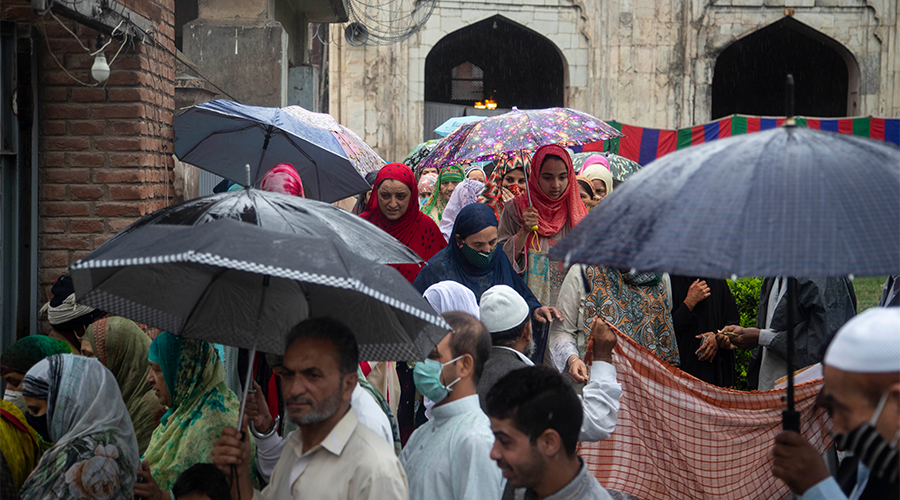


Kashmiri Muslims leave a mosque on Eid al-Adha in Srinagar, Indian controlled Kashmir, on July 21, 2021. (AP)

New Delhi has struggled for decades to dampen secessionist sentiments in what had been its only Muslim majority state, blaming neighboring Pakistan for supporting insurgencies in the Himalayan region, which Islamabad denies.
Reasserting New Delhi’s control in August 2019, Modi abolished Article 370 of the Constitution, ending the region’s autonomy and removing its statehood by splitting it into the federal territories of Jammu and Kashmir (J&K) and Buddhist-dominated Ladakh.


Pakistan PM leaves for Saudi Arabia on brief visit as Middle East crisis rages on

Updated 10 sec ago
Follow

Pakistan PM leaves for Saudi Arabia on brief visit as Middle East crisis rages on

  • The visit comes at a time of increased volatility in the region, following US-Israeli strikes on Iran and Tehran’s counterattacks
  • Sharif and Crown Prince Mohammed will discuss the ongoing tensions, regional security and bilateral relations, Sharif’s office says

ISLAMABAD: Pakistan’s Prime Minister Shehbaz Sharif on Thursday departed for Saudi Arabia on a brief, hours-long visit, his office said, amid an ongoing conflict in the Middle East.

The visit comes at a time of increased volatility in the region, following Unites States-Israeli strikes on Iran and Tehran’s counterattacks on US bases in several Gulf countries as well as commercial and oil infrastructure, raising the spectre of a wider war.

Sharif, expected to discuss regional security and diplomatic coordination with Saudi leaders, is visiting the Kingdom on the invitation of Crown Prince Mohammed bin Salman, according to the prime minister’s office.

“Sharif will meet His Highness Prince Mohammed bin Salman,” the former’s office said.

“The meeting between the two leaders will discuss the ongoing tensions in the region, the regional security situation and the bilateral relations between the two countries.”

The development came a day after Bloomberg, citing comments from Sharif’s spokesperson, reported that Pakistan is ready to support Saudi Arabia “no matter what” as tensions escalate across the Middle East following Iranian strikes on Gulf states.

Mosharraf Zaidi told Bloomberg TV Islamabad would come to Riyadh’s aid whenever required, emphasizing the longstanding security partnership between the two countries, which was further strengthened by a mutual defense pact signed in September last year.

There was “no question we might, we will” come to Saudi Arabia’s aid “no matter what and no matter when,” Zaidi said.

“Both countries, even before the defense agreement, have always operated on the principle of being there for the other,” he added.

Pakistan and Saudi Arabia have historically maintained close military and strategic ties, and the new agreement elevated their security cooperation at a time of heightened regional instability.

Zaidi said Pakistan was also working diplomatically to prevent the conflict from expanding further across the region.