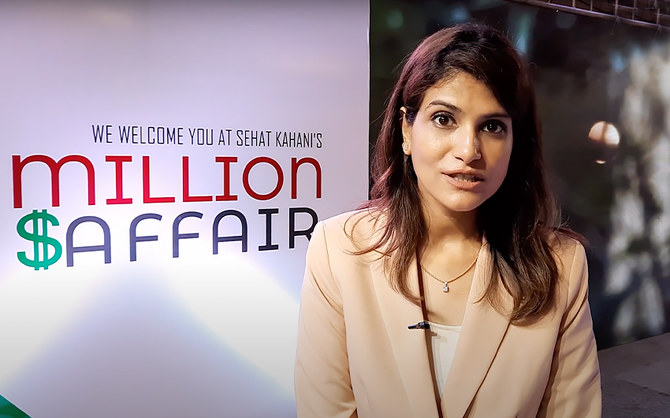
KARACHI: Pakistan’s Dr. Sara Saeed Khurram, the CEO of social enterprise Sehat Kahani, has been announced as one of the five winners of the ‘WE Empower UN SDG Challenge,’ a first-of-its-kind global competition for women social entrepreneurs who are advancing UN Sustainable Development Goals and inspiring communities in their respective countries.
The global business challenge is led in partnership by Vital Voices Global Partnership and the Julie Ann Wrigley Global Futures Laboratory at Arizona State University.
Sehat Kahani is a social enterprise — a business seeking to build a better world — that is innovating to plug health care gaps in Pakistan, a task given added urgency by the COVID-19 crisis.
“As Awardees, the five women leaders will participate in capacity-building training sessions, connect with renowned business experts from around the world and gain access to Vital Voices’ global network of more than 18,000 women leaders across 182 countries and territories,” Sehat Kahani said in a press release. “The WE Empower Awardees will also participate in a dynamic pitch competition, hosted by philanthropist, activist and Vital Voices Board Member Diane von Furstenberg, to present their business for the opportunity to receive a $20,000 grant.”
As COVID-19 strained Pakistan’s health system over the last year and a half, Khurram decided to tap into tens of thousands of women doctors sitting at home, their talents squandered in a country where millions have no access to medical care.
Many families encourage their daughters to study medicine not for a career, but to bolster their marriage prospects. The phenomenon even has a name — “doctor-brides”.
Appalled by the waste of expertise, Khurram set up a telemedicine platform enabling female medics to provide e-consultations from their homes to patients in rural communities.
Sehat Kahani has also liaised with the Pakistani federal government to provide free consultations to all patients during the first wave of COVID-19.
They also installed apps in hospital intensive care units treating COVID patients, allowing junior doctors to get immediate advice from critical care experts based elsewhere.
“In a pandemic, solutions like these can be crucial.” Khurram told media earlier this year. “This has already saved many lives.”
“Over the past year, we have seen women leaders emerge out of the most extraordinary circumstances. In the midst of a global pandemic, women have spearheaded front-line efforts to reverse the effects of climate change, combat gender-based violence, diversify legislative assemblies, and lead the way in the fight against the pervasive impacts of Covid-19,” Alyze Nelson, president and CEO of Vital Voices, said.
“It is my honor to congratulate this year’s five WE Empower Awardees. These incredible women have demonstrated tenacity, innovation and compassion that are cornerstones of the Vital Voices leadership model.”
Khurram, who has seen patient numbers increase ten-fold during the pandemic, believes her model can be replicated in other developing countries with doctor shortages.
Since launching in 2017, Sehat Kahani has established 35 rural telemedicine clinics across Pakistan where, for a small fee, a patient can see a nurse who will link them via the platform to a doctor.
The nurse is trained to carry out examinations guided by the doctor who may be sitting at home hundreds of miles away. Patients with a smartphone can also contact a doctor directly via an app.


![]()

Pakistani doctor innovating to plug COVID health gaps wins ‘UN SDG Challenge’
Short Url
https://arab.news/6avvs
Pakistani doctor innovating to plug COVID health gaps wins ‘UN SDG Challenge’
- We Empower Challenge recognizes women social entrepreneurs advancing Sustainable Development Goals
- Dr. Sara Saeed Khurram set up telemedicine platform enabling female medics to provide e-consultations to rural communities
Latest updates


© 2026 SAUDI RESEARCH & PUBLISHING COMPANY, All Rights Reserved And subject to Terms of Use Agreement.