

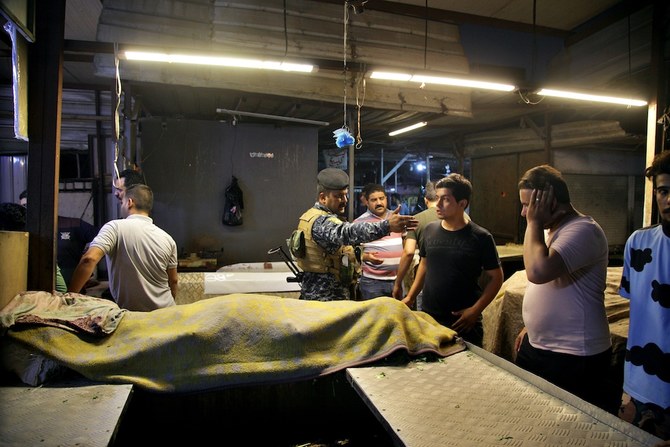

BAGHDAD: An explosion ripped through a busy market in the Iraqi capital Monday killing at least 35 people, according to medical sources, in an apparent suicide bombing ahead of Eid holiday celebrations.
In one of the worst attacks in Baghdad in recent years, body parts of victims lay scattered across the previously bustling market, that had been crowded with shoppers buying food ahead of the Islamic festival of Eid Al-Adha, according to an AFP photographer.
Some 60 people were also wounded in the blast, medics said.
Iraqi President Barham Salih called the bombing in the densely populated majority-Shiite suburb of Sadr City a “heinous crime,” and offered his condolences.
“They are targeting our civilians in Sadr City on the eve of Eid,” Salih said in a message on Twitter. “They do not allow people to rejoice, even for a moment.”
Eight women and seven children were among the dead, according to a medical sources, who said the toll lay between 28 and 30 killed.
There was no immediate claim of responsibility, but two security sources told AFP it was caused by a suicide bomber wearing an explosive belt.

Iraqis light candles for the victims of the blast in Sadr City, Baghdad. (AFP)
Video footage shared on social media after the blast showed bloodied victims and people screaming in terror. The blast was so strong it ripped the roofs off some market stalls.
“A terror attack using a locally-made IED (improvised explosive device) in Woheilat Market in Sadr City, in east Baghdad, left several victims dead and others injured,” Iraq’s interior ministry said in a statement.
Refrigerators full of water bottles were drenched with blood, and shoes were strewn on the ground alongside fruit, AFP journalists said.
“It’s a sad Eid night in Iraq,” the International Committee of the Red Cross said. “Our deepest sympathies and sincere condolences to those who lost their loved ones.”
Baghdad Operations Command, a joint military and interior ministry security body, said it had launched an investigation into the blast, and police and forensic teams late Monday were searching through the smoking wreckage for clues.
In January, the Daesh group claimed responsibility for a rare twin suicide bombing that killed 32 people — also at a crowded market in Baghdad.
That blast was the city’s deadliest attack in three years.
Such violence was commonplace in Baghdad during the sectarian bloodletting that followed the US-led invasion of 2003, and later on as Daesh swept across much of Iraq and also targeted the capital.
But after years of deadly violence, militant attacks have become relatively rare in the capital Baghdad.
The attack sparked a furious response from Iraqis on social media.
“Terrorism and the government’s failure keep on stealing our lives,” tweeted Alaa Sattar, a youth activist. “The authorities have nothing but condolences to dole out and empty investigative committees.”
Another Twitter user wrote “every Eid, there’s a tragedy in Baghdad. It’s impossible to celebrate like the rest of humanity.”
Iraq declared Daesh defeated at the end of 2017 after a fierce three-year campaign.
Yet the group’s sleeper cells have continued to operate in desert and mountain areas, typically targeting security forces or state infrastructure with low casualty attacks.
The US-led coalition that had been supporting Iraq’s campaign against Daesh has significantly drawn down its troop levels over the past year, citing the increased capabilities of Iraqi forces.
The United States, which provides the bulk of the force, has 2,500 troops left in Iraq — down from 5,200 a year ago.
They are mainly in charge of training, providing drone surveillance and carrying out air strikes while Iraqi security forces handle security in urban areas.
Sadr City, where Monday’s bomb blast took place, is named after revered Shiite cleric Mohammed Al-Sadr.
His son, Moqtada Sadr — a firebrand cleric with millions of followers and in command of paramilitary groups — is a crucial player in Iraqi politics who has often protested against the influence of both the United States and Iran.
The boycott by Sadr of upcoming elections slated for October is a blow to Prime Minister Mustafa Al-Kadhemi, who had called the early vote in response to demands by pro-democracy activists.


