ISLAMABAD: A day after India claimed “success” in ensuring that Islamabad remained on the grey list of the Financial Action Task Force (FATF), a global money-laundering watchdog, Pakistan’s foreign ministry said that the statement exposes New Delhi’s “true colors” and reflects its “politicization” of FATF processes.
“Following the recent confession by Indian Government, India’s credentials for assessing Pakistan in FATF as co-chair of the Joint Group or for that matter any other country are subject to questions, which we urge FATF to look into,” Zahid Hafeez Chaudhri, Foreign Ministry spokesperson, said in a statement on Monday.
Rejecting the claims, Chaudhri added that Pakistan has consistently highlighted the “politicization of FATF and undermining its processes by India” to the international community and was considering approaching FATF for “appropriate action in this matter.”
On Sunday, India’s External Affairs Minister A. Jaishankar said that Pakistan had been placed on FATF’s grey list “because of the efforts made by the Indian government.”
“Due to us, Pakistan is under the lens of FATF, and it was kept in the grey list. We’ve been successful in pressuring Pakistan, and the fact that Pakistan’s behavior has changed is because of pressure put by India through various measures,” Jaishankar was quoted as saying at a virtual training program for leaders of the ruling Bharatiya Janata Party (BJP) government.
“FATF keeps a check on funding for terrorism and deals with black money supporting terrorism,” he added.
Chaudhri said that while Pakistan has been “sincerely and constructively engaged with FATF” during the implementation of the action plan launched in 2018, “India has left no stone unturned in casting doubts on Pakistan’s progress through disgraceful means.”
He added that India’s recent statement is further “corroboration of its continued efforts to use an important technical forum for its narrow political designs against Pakistan.”
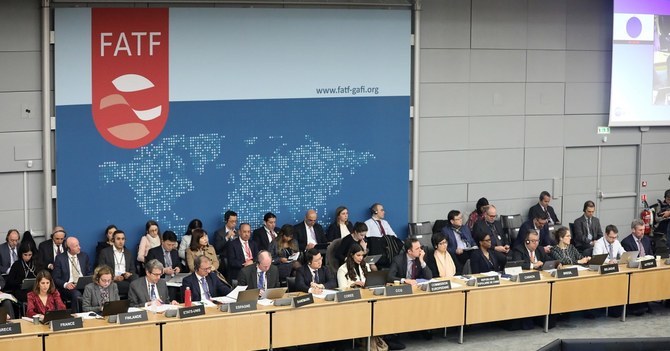
On June 25, Pakistan’s government questioned FATF’s decision to keep the country on its “increased monitoring list” until the implementation of two separate action plans for anti-money laundering (AML) and counter-terrorist financing (CFT).
Foreign Minister Shah Mahmood Qureshi pointed out that the global watchdog had acknowledged Islamabad’s efforts to strengthen its financial system, and “there is no justification to keep Pakistan on the grey list.”
“We will have to see if the FATF is a technical forum or … being used for political purposes,” Qureshi had said at the time.
However, he maintained that Pakistan would take all necessary measures to curb money laundering and terror financing.
In June 2018, Pakistan was placed on the FATF’s “grey list” of countries with weak and vulnerable financial systems that terrorist groups and criminal elements could exploit.
However, FATF President Dr. Marcus Pleyer has since admitted that Pakistan has made “significant progress” and largely addressed 26 out of 27 items on the action plan it first committed to four years ago.
Citing Islamabad’s progress in the FATF action plan, Chaudhri said: “India’s delusions of putting pressure on Pakistan have always remained unfulfilled and would never see the light of day.”
“(Despite) distractions, including politicization of FATF processes by certain jurisdictions, Pakistan reaffirms its commitment to bring its AML/CFT systems to international standards for its own good and also to fulfill its international obligations and commitments,” he added.


![]()

Pakistan says India’s statement on FATF reflects ‘politicization’ of global financial watchdog
Short Url
https://arab.news/nym7f
Pakistan says India’s statement on FATF reflects ‘politicization’ of global financial watchdog
- Rebukes New Delhi’s claims it had ensured Islamabad remained on FATF ‘grey list’
- Pakistan to approach FATF president for ‘appropriate action in this matter’, foreign ministry spokesperson says
Latest updates





© 2026 SAUDI RESEARCH & PUBLISHING COMPANY, All Rights Reserved And subject to Terms of Use Agreement.