Shaken South Africans clean up after deadly unrest

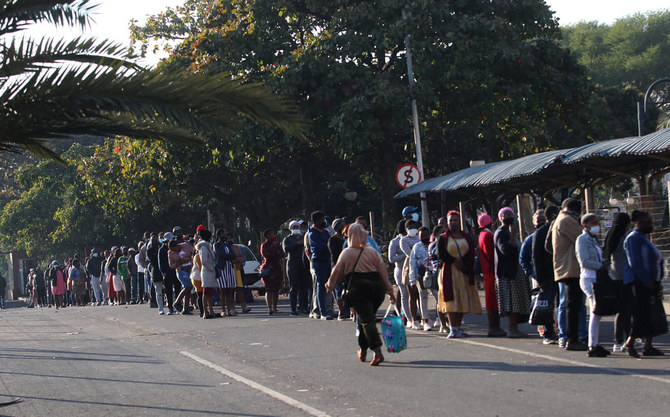
Shoppers queue to buy essentials at a mall in Durban on Saturday after a weeklong of unrest. South African President Cyril Ramaphosa has vowed to restore order to the country. (AP)
Short Url
Updated 17 July 2021
Follow

Shaken South Africans clean up after deadly unrest

  • Violence erupted after former president Jacob Zuma was sentenced to 15 months in jail for snubbing a corruption inquiry
  • Zuma’s successor President Cyril Ramaphosa said riots were a "coordinated and well-planned attack"

DURBAN: South Africans on Saturday cleaned up shopping centres and stores looted during a week of shocking violence that rocked the country and left more than 200 dead.
Aid organisations also handed out food in communities that had been cut off from main roads or where food shops were ransacked in the unrest.
The violence -- the worst in post-apartheid South Africa -- erupted after former president Jacob Zuma was sentenced to 15 months in jail for snubbing a corruption inquiry.
His successor President Cyril Ramaphosa, who came to office promising to curb graft, said the riots were a "coordinated and well-planned attack" on the country's young democracy.
"Using the pretext of a political grievance, those behind these acts have sought to provoke a popular insurrection," Ramaphosa said in a televised address on Friday night.
The rioting caused widespread destruction, leaving thousands of businesses trashed, including many retail shops that were specifically targeted.
As an uneasy calm set in Saturday, residents in the hard-hit KwaZulu-Natal province swept up debris at the Dube Village Mall in the township of Inanda, north of Durban, shovelling it into refuse bags.
Behind them walls topped with spikes and razor wire had been spray painted with the words "Free Zuma".
Zuma, whose home province is KwaZulu-Natal, commands support among loyalists in the ruling African National Congress (ANC), who portray him as a champion of the poor.
Walking across a charred shop, Sikhumukani Hongwane, a private security guard was on duty when the mall was attacked last Sunday, just after Ramaphosa had addressed the nation.
He saw a mob of people starting to burn a nearby garage and he fled. He is still haunted.
"We are scared, even now. All the memories...are coming back." he told AFP. "We can't sleep".
Many in the province are now going hungry after food stores were looted and burned, or cut off from suppliers as roads closed.
The government, humanitarian aid agencies, charities and churches have started moving food to people in need, including hospital patients and families.
"We are loading bread for staff for five hospitals," Imtiaz Sooliman, leader of Gift of the Givers, told AFP.
Sooliman said that his food convoys were being escorted by armed security. AFP journalists saw a supermarket delivery vehicles escorted by police.
"Yesterday we sent food for patients in private hospitals -- they had no food to feed patients. They have all the money but they can't buy anything, they called us saying patients haven't eaten," he said.
The organisation was also delivering food parcels door-to-door after a government minister told him Friday that dozens of Durban areas had no access to food, Sooliman added.
The few shops that were spared are opening for a few hours and in some places price of bread has almost doubled.
"It is mayhem because the few shops that are here cannot accommodate the whole community. The few stores we've got, (have) got snaking queues like people are going there to vote," said Siyanda Nxumalo, a community activist in Inanda.
Traffic was back to normal along a main highway linking the north to the port city of Durban after it had been closed for much of the week.
Ramaphosa said the instigators had "sought to exploit the social and economic conditions under which many South Africans live -- conditions that have worsened since the onset of the coronavirus pandemic".
He said that business owners told him it would take "a few months" to restore normal operations following the destruction, interrupting supply chains and raising the spectre of shortages.
Of the 212 people killed, 180 died in KwaZulu-Natal, according to government figures. Some of the fatalities were shot and others died in looting stampedes.
More than 2,500 people have been arrested for various offences linked to the violence, including theft.
The government said all but one of the suspected masterminds are at large.
Ramaphosa admitted that his government was "poorly prepared for an orchestrated campaign of public violence, destruction and sabotage of this nature".
He has called up army reserves and ordered the deployment of 25,000 troops -- 10 times the number that he initially deployed.
Opposition politicians have condemned the government's handling of the crisis, calling on Ramaphosa to ensure the suspected masterminds are arrested and charged.


Trump takes unconventional approach to communicating to the public about war in Iran

Updated 57 min 58 sec ago
Follow

Trump takes unconventional approach to communicating to the public about war in Iran

  • The communications strategy opened Trump to criticism that he hadn’t done enough to explain the rationale and objectives of the war

Typical of an unconventional presidency, the Trump administration waited more than 48 hours to make any live, public communication to the American people about why it had decided to go to war with Iran.
President Donald Trump discussed why he launched the attack prior to a White House ceremony honoring military heroes on Monday but took no questions from reporters. Earlier in the day, Defense Secretary Pete Hegseth and Joint Chiefs of Staff Chairman Dan Caine briefed journalists at the Pentagon.
The two days previous, Trump delivered two pretaped statements that were released on Truth Social, the social media site owned by the president’s media company, and granted telephone interviews to more than a dozen journalists — several of which produced fragmented responses that, to some, clouded as much as they cleared up.
The communications strategy opened Trump to criticism that he hadn’t done enough to explain the rationale and objectives of the war, even as the American military suffered its first casualties. By contrast, Israeli Prime Minister Benjamin Netanyahu, who has teamed with the US against Iran, delivered two statements the day the war began and addressed reporters Monday at the site of a missile attack that killed nine people. The Israeli military has held multiple press briefings each day.
“The American people need a commander in chief, and he has been absent in that role,” Rahm Emanuel, White House chief of staff under President Barack Obama, said on CNN Monday. Emanuel, a Democrat, is contemplating a run for the presidency in 2028.
An unconventional strategy leads to criticism
Peter Baker, chief White House correspondent for The New York Times, wrote on social media that “after Trump launched a new war on Iran, he did not rush back to the White House to make an Oval Office address to rally the nation as other presidents have done. He stayed at Mar-a-Lago to attend a glitzy political fundraiser.”
That post provoked a response from Steven Cheung, White House communications director. “Imagine being a reporter so consumed with Trump Derangement Syndrome that he wants President Trump to mimic the failed policies of the past. The truth is that President Trump spent the majority of his time monitoring the situation in a secure facility, in constant contact with world leaders, and made multiple addresses to the nation that garnered hundreds of millions of views. He also took dozens of calls with reporters.”
The calls included one with Baker’s colleague at The Times, Zolan Kanno-Youngs. Trump’s mobile phone number is known to many of the reporters who cover him, and the president often takes their calls for on-the-spot interviews. Besides The Times, he spoke in the aftermath of the attack to journalists for ABC, CBS, NBC, CNN, CNBC, Fox News Channel, The Atlantic, The Washington Post, Axios, Politico and an Israeli television station.
Most of the calls were brief and marginally illuminating; Politico’s Dasha Burns said Trump answered but said he was too busy to talk. The public couldn’t hear what Trump said in the interviews and was dependent upon what the journalists chose to report on the conversations.
“I spoke to President Trump today and he told me that the operation in Iran is going to go very fast,” Libby Alon, a reporter for Channel 14 News in Israel, wrote about her interview on X. “It’s doing very well, and (will) make the people of Israel very happy, and the people of the world very happy.”
The Times reported that in its six-minute chat, Trump “offered several seemingly contradictory visions of how power might be transferred to a new government — or even whether the existing Iranian power structure would run that government or be overthrown.”
In one of his two conversations with Trump, ABC News’ Jonathan Karl said when he asked about the death of Iranian Ayatollah Ali Khamenei, the president said: “I got him before he got me. They tried twice. Well I got him first.” CNN’s Jake Tapper went on the air minutes after his conversation Monday, saying Trump told him “the big one is coming soon,” an apparent reference to a future attack.
Asked for comment, White House spokeswoman Anna Kelly said: “President Trump is the most transparent and accessible president in American history. The American people have never had a more direct and authentic relationship with a president of the United States than they have with President Trump.”
Hegseth briefing concentrates on friendly reporters
Pentagon reporters learned late Sunday about Hegseth’s briefing. Reporters from The Associated Press, Reuters, ABC, CBS, NBC, CNN, Fox News Channel and Stars & Stripes were permitted into the briefing room, but Hegseth did not call on them. Instead, he took questions from NewsNation and Trump-friendly outlets like the Daily Caller, Daily Wire, One America News and the Christian Broadcasting Network. Most mainstream news outlets left their regular stations at the Pentagon last fall rather than agree to Hegseth’s rules restricting their work.
Hegseth denounced the “foolishness” of people wanting to know details of the operation in advance, such as whether Americans would commit to more than air power, and said the operation would continue as long as it took to achieve objections. He initially ignored NBC News’ Courtney Kube when she called out a question: “President Trump put a four-week time limit on it. Are you saying he’s wrong?”
Later, Hegseth denounced Kube for asking “the typical NBC sort of gotcha-type question. President Trump has all the latitude in the world to talk about how long it might take — four weeks, two weeks, six weeks, it could move up, it could move back. We’re going to execute at his command the objectives he set out to achieve.”
Unlike Pentagon briefings in past administrations, reporters were given assigned seats, with the Trump-friendly outlets seated in front. Jennifer Griffin, Hegseth’s former colleague at Fox News Channel who left the Pentagon with other reporters after not accepting his new rules, was seated in the last row.