


 JEDDAH: Pilgrims have arrived at the Grand Mosque in Makkah to perform tawaf in the first Hajj act of the year after reaching the city on Saturday through four entry points designed to limit the spread of coronavirus.
Saudi Arabia, which receives almost 2.5 million pilgrims each year, has limited the number of travelers permitted to perform Hajj for the second year in a row to 60,000, as health and safety is a top priority for officials amid the coronavirus pandemic.
The pilgrims permitted to perform Hajj comprise of different nationalities residing in the Kingdom and must be fully vaccinated against coronavirus.
According to this year’s Hajj organizing plan, pilgrims are gathering in four main entry locations: Al-Taneem, Al-Shara’i, the Kor checkpoint and the Al-Shumaisi security zone.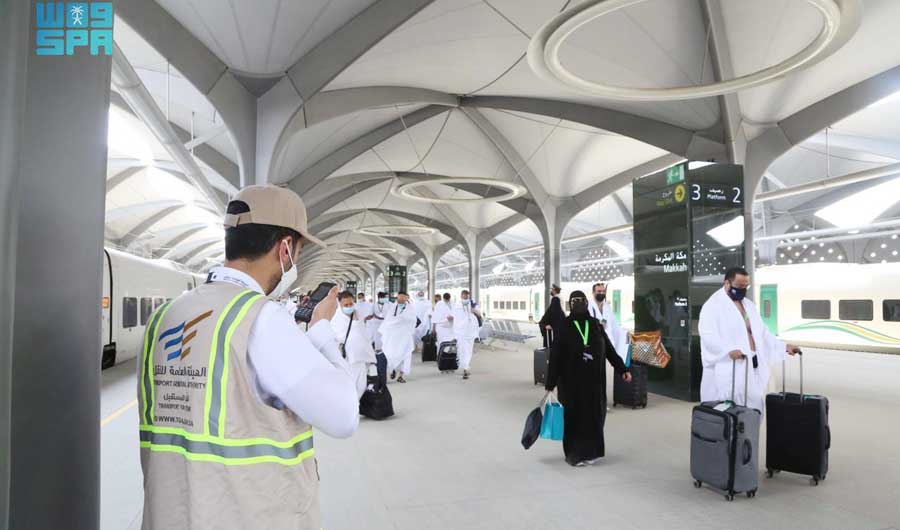
Pilgrims residing in Makkah were also directed to head to the nearest point to join up with arrivals.
Security and health checks were followed by bus transfers to take pilgrim groups to the Grand Mosque, where they performed tawaf upon arrival. Once completed, pilgrims left the Grand Mosque through the Bab Ali grouping station, where buses transported them to temporary residences near the holy sites.
HIGHLIGHT
According to this year’s Hajj organizing plan, pilgrims are gathering in four main entry locations: Al-Taneem, Al-Shara’i, the Kor checkpoint and the Al-Shumaisi security zone.
With a temperature of 41 degrees Celsius in Makkah, most pilgrims were seen carrying umbrellas to protect themselves from the scorching summer heat. Security personnel and civil workers were monitoring the movement of the pilgrims, ensuring that all health instructions were followed and to provide immediate help.
Hisham Saeed, spokesman of the Hajj and Umrah ministry, said that 6,000 pilgrims every three hours are expected to enter the Grand Mosque to perform tawaf. After each group leaves, a sterilization process will be carried out to ensure maximum safety.
For the security and safety of pilgrims, all entrances to Makkah are monitored by security officers and thermal-imaging cameras to prevent people without Hajj permits accessing the holy sites.
“The mountains surrounding Makkah and all its valleys, where people with no Hajj permits might believe they can access the holy sites, are completely monitored by the Mujahideen force and equipped with cameras to foil such attempts,” Commander of Hajj Security Forces Maj Gen. Zayed bin Abdulrahman Al-Tuwayan said in a press conference held in Makkah.
According to Maj. Gen. Mohammed Al-Bassami, assistant commander of Hajj Security Forces for the Grand Mosque and its surroundings, officials are working closely with health authorities to protect pilgrims and prevent the spread of the coronavirus during Hajj.
Al-Bassami told Arab News that the Hajj Security Forces have a “very high level of coordination” with the Saudi Ministry of Health.
Hajj, the world’s largest annual religious gathering with about 2.5 million people taking part in 2019, is one of the five pillars of Islam and must be undertaken by all capable Muslims at least once in their lives.


