

Middle East edtech presence expands in Pakistan as Jordan acquires e-learning platform

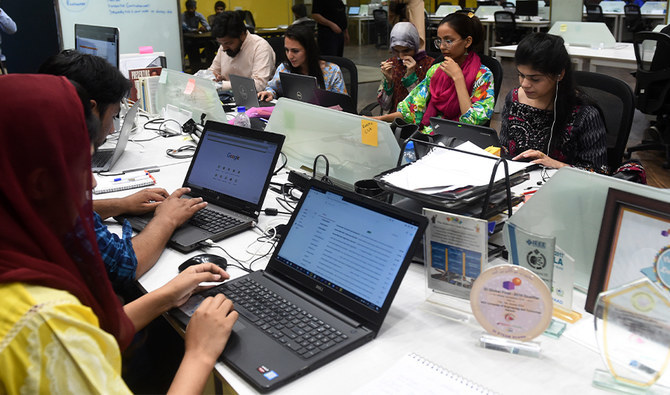
People work at their stations at a start-up incubator, in Lahore, Pakistan on on May 24, 2019. (AFP/File)
Short Url
Updated 18 July 2021
Follow

Middle East edtech presence expands in Pakistan as Jordan acquires e-learning platform

  • Abwaab becomes the second Middle Eastern company to enter Pakistan’s EdTech sector after Saudi Arabia’s Noon Academy
  • More collaborations with foreign firm are expected as Pakistan’s education sector is undergoing change due to the coronavirus pandemic

ISLAMABAD: Jordan has tapped into Pakistan’s growing educational technology sector with a recent acquisition of e-learning company Edmatrix, the Pakistani firm confirmed on Thursday, as more EdTech collaborations are expected to come to the local market. 

The Jordanian online education platform, Abwaab, began its operations in 2019 and has since expanded into Egypt, Iraq and Saudi Arabia. It becomes the second Middle Eastern company to penetrate the Pakistani EdTech sector, after Saudi Arabia’s Noon Academy entered the local market in September.

As the companies announced their partnership earlier this week, Edmatrix co-founder and chief executive officer Raja Ahmed told Arab News his company will now be a subsidiary of Abwaab but its management and goal to transform Pakistan’s education sector remain the same.

Edmatrix has been digitizing secondary school curriculum from grade 9 to 12 for local boards and also Cambridge curriculum of O and A levels.

“We started Edmatrix last year in Lahore after the pandemic began. Our ambition was to transform Pakistan’s education sector,” he said. “By partnering with Abwaab, we will not only be able to accelerate our pace but also create a greater impact by helping millions of students across the region.”

Abwaab co-founder and chief executive Sabri Hakim says he is also looking forward to making a positive impact: “We can’t wait to make use of the exceptional talent pool in Pakistan as well as the potential of impact Abwaab can create there.”

Pakistan’s EdTech sector is seen as having tremendous potential.

The Saudi company which was the first Middle Eastern investor into the market, Noon Academy, told Arab News 1.5 million students had registered with its online platform in less than a year.

“Students have been using our app across Pakistan,” Noor Academy human resources head Ali Nawaz said.

He added that several Pakistani start-ups were working in the EdTech sector, but their outreach was limited due to resource constraints and Abwaab’s arrival is a welcome development.

Nadeem Nasir, a spokesperson for Ignite, a national technology fund that supports the establishment of start-ups in Pakistan said such partnerships can also open opportunities for Pakistani start-ups in the Middle East and more EdTech collaborations are expected due to the changing environment of the educational sector.

“Such collaborations should increase, especially after the coronavirus pandemic,” he told Arab News.

“The requirements of local education sector are changing and there is more scope for online teaching platforms.”


Pakistan’s Balochistan establishes threat assessment center amid surge in militant attacks

Updated 14 sec ago
Follow

Pakistan’s Balochistan establishes threat assessment center amid surge in militant attacks

  • Provincial Intelligence Fusion and Threat Assessment Center brings police, CTD, intelligence agencies together on one platform, says official
  • Says center helps disrupt terror financing, narcotics trafficking, organized crime and enables action against unregulated communication networks

ISLAMABAD: The government in Pakistan’s southwestern Balochistan province has established a state-of-the-art threat assessment center to strengthen early warning and prevention against “terrorism” incidents, a senior official said on Monday amid a surge in militant attacks recently. 

Balochistan Additional Chief Secretary Hamza Shafqaat wrote on social media platform X that the Provincial Intelligence Fusion and Threat Assessment Center (PIFTAC Balochistan) brings police, the counter-terrorism department (CTD), intelligence agencies and civil administration together on one platform for real-time information sharing and joint analysis. 

“PIFTAC strengthens early warning and prevention against terrorism, helps disrupt terror financing, narcotics trafficking, and organized crime, and enables coordinated action against illegal spectrum and unregulated communication networks,” he wrote.

“Information that was once scattered is now shared and acted upon in time, allowing the state to move from reacting after incidents to preventing them before they occur.”

https://x.com/beyondfiles/status/2010444397163532547

The development takes place amid a steep rise in combat-related deaths in Pakistan during 2025. According to statistics released by the Pakistan Institute for Conflict and Security Studies (PICSS) last month, combat-related deaths in 2025 rose 73 percent to 3,387.

These deaths included 2,115 militants, 664 security forces personnel, 580 civilians and 28 members of pro-government peace committees, the local think tank said. 

Pakistan military spokesperson Lt. Gen. Ahmed Sharif Chaudhry last week highlighted Pakistan’s counter-terrorism efforts in 2025, saying that security forces had conducted 75,175 intelligence-based operations (IBOs) and killed 2,597 militants last year. He also said Pakistan reported 5,397 “terrorism incidents” last year. 

Pakistan frequently accuses Afghanistan of allowing militant groups, including the Tehreek-e-Taliban Pakistan (TTP) and the separatist Balochistan Liberation Army (BLA) to operate from its soil, charges Kabul has repeatedly denied.

Islamabad also accuses India of backing these militant groups against Pakistan. New Delhi rejects the allegations.