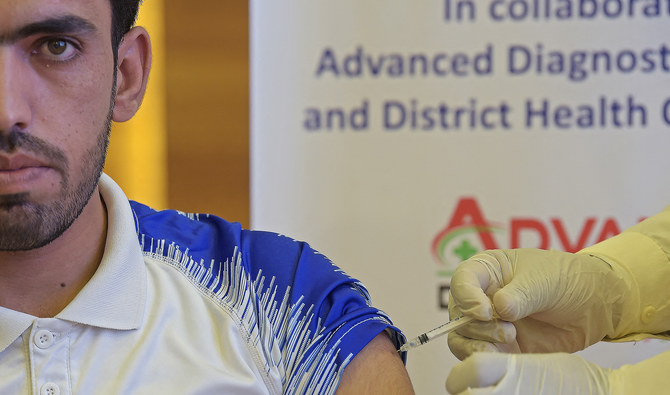
KARACHI: The delta variant of the novel coronavirus, which was first detected in India, has become the dominant strain in Karachi, said Professor M. Iqbal Choudhary, director of the International Centre for Chemical and Biological Sciences, while talking to Arab News on Thursday, shortly after the country’s health chief, Dr. Faisal Sultan, informed in a Twitter post that the positivity ratio in Pakistan’s southern port city had surged to 19 percent.
“Our latest report today has identified the delta variant in 69 percent of COVID-19 patients, whereas 26 percent are infected with an unknown strain which is probably delta-plus virus,” Choudhary said, adding that his organization was working to sequence the unidentified variant.
“One can assume that every COVID-19 patient in Karachi is infected with the delta variant,” he added. “The infection rate of the strain is 60 percent higher than the virus originally detected in Wuhan.”
Choudhary informed that the health of the patients suffering from the delta variant could rapidly deteriorate after the emergence of symptoms which were different from other strains.
He told Arab News that he had also briefed the provincial authorities about the situation, urging its officials to take a quick action.
Asked about the dominant form of the virus infecting people in the city, Rasheed Channa, a spokesperson for the Sindh chief minister, said: “We are going to review the situation on Monday and take decisions accordingly.”
However, the Sindh administration has already decided to close schools and impose a ban on indoor dining to avert another wave of the pandemic from setting in.
The provincial health department also proposed shutting down primary schools on Monday and suggested to keep businesses closed for two days a week in view of the rising positivity rate across the province.
Last month, the Pakistan government lifted nearly all coronavirus restrictions around the country as infection figures showed a constant decline. However, these numbers have shot up once again, prompting health officials to consider new curbs.
The country reported 2,545 new cases of coronavirus on Thursday, bringing the total number of infections to 981,392 since the beginning of the pandemic in the country.
Out of a total population of 220 million, 125 million people are eligible for vaccination in Pakistan, though the government has only managed to administer 21 million doses to date.
Pakistan’s planning minister Asad Umar also urged people on Thursday to follow the officially prescribed health guidelines and get themselves vaccinated, saying there was a “rapid” increase in the number of COVID-19 patients in hospitals and critical care units.
“Rapid build up starting to take place in covid patients hospital inflow, as well as patients in critical care,” Umar said on Twitter. “Do not risk your own & others lives.”
Umar also warned about the delta variant, reminding everyone it had caused devastation in other countries of the region.
The delta variant is more easily transmitted than earlier versions of the coronavirus and is suspected to cause more severe disease, especially among younger people.
Scientists are still tracking the data to determine how deadly it is. Based on hospitalizations in the UK, the delta variant seems to be more likely to lead to hospitalization and death, particularly among unvaccinated people, according to a recent study published in The Lancet.


Delta becomes dominant variant as positivity rate surges to 19% in Pakistan’s Karachi
https://arab.news/zpbvt
Delta becomes dominant variant as positivity rate surges to 19% in Pakistan’s Karachi

- A recent report say 69 percent COVID-19 patients in Karachi suffer from the delta strain while 26 percent have contracted an unknown variant
- Sindh government says it will review the situation on Monday, though it has already closed schools and banned indoor dining in the province

Pakistan stocks close at record high over current account surplus, falling bond yields
- KSE-100 index gains 1,646.79 points or 0.97% to close at new high of 171,960.64 points
- Pakistan’s central bank posted a current account surplus of $100 million in November
KARACHI: Pakistani stocks closed at an all-time high of 171,960.4 points on Thursday, with financial analysts attributing the surge to increasing investor confidence stemming from a current account surplus reported in November and a drop in government bond yields.
The benchmark KSE-100 index gained 1,646.79 points or 0.97% to close at an all-time high of 171,960.64 points on Thursday. The previous day, Pakistani stocks surged to 170,313.85 points at close of business.
Ahsan Mehanti, chief executive officer at Arif Habib Commodities, said the optimistic mood at the stock exchange was fueled by the $100 million current account surplus reported by the central bank in November.
“Speculations ahead of year-end close and fall in government bond yields up to 70 basis points after the SBP (State Bank of Pakistan) policy easing played the catalyst role in bullish activity at PSX,” Mehanti told Arab News.
The surplus was a welcome development for Islamabad as Pakistan’s central bank reported a $291 million deficit in October.
Topline Securities, a Pakistani brokerage firm, said in its daily market review that strong buying by local funds followed a drop in Pakistan Investment Bond (PIB) yields, which boosted investor confidence.
PIB yields are the returns on bonds or government-backed securities that pay fixed semi-annual interest, with rates influenced by market demand and SBP auctions.
“Strength in ENGRO (Engro Corporation), FFC (Fauji Fertilizer Company), UBL (United Bank Limited), LUCK (Lucky Cement) and BAHL (Bank AL Habib) underpinned positive momentum, collectively contributing 1,504 points to the index,” the brokerage firm wrote on X.
“This upside was partly offset by declines in PIOC (Pakistan International Oil Company), DHPL (D.H. Corporation Limited) and MLCF (Millat Tractor Limited), which together subtracted 176 points.”
The sustained rise in equities comes amid improving liquidity conditions and continued investor participation, with market participants focusing on corporate earnings, sector-specific developments and broader macroeconomic signals.
Earlier on Monday, Pakistan’s central bank cut its key policy interest rate by 50 basis points to 10.5%, a move that surprised analysts and followed four consecutive policy meetings where rates were held unchanged.
The cut came despite an International Monetary Fund staff report earlier this month cautioning against premature monetary easing.
Inflation eased to 6.1% in November, remaining within the SBP’s target band, though analysts have warned that price pressures could resurface later in the fiscal year as base effects fade and food and transport costs remain volatile.


