

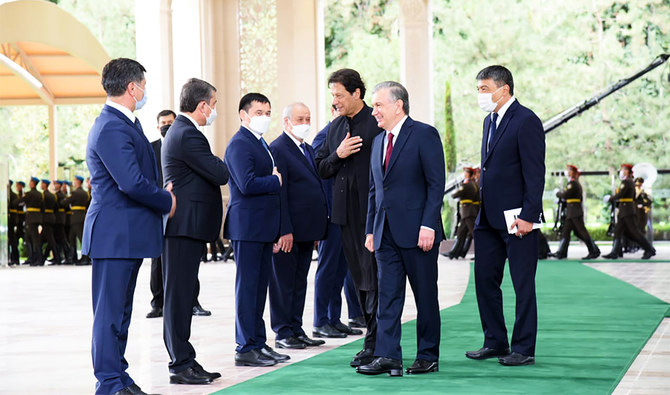

ISLAMABAD: Prime Minister Imran Khan on Thursday called for strengthening of economic ties and road connectivity to Uzbekistan during his two-day official visit to the country.
Addressing the first Pakistan-Uzbekistan Business Forum in Tashkent, he highlighted Islamabad’s historical, cultural and spiritual connections with the Central Asian state while emphasizing the importance of deeper economic engagement with other nations in the region.
The prime minister said the two countries must comprehensively upgrade their trade ties.
“Our business and trade relations are going to depend on how quickly we are able to connect with each other,” he noted.
Khan highlighted the importance of the trans-Afghan railway project that promises to connect Uzbekistan’s southern city of Termez with Mazar-e-Sharif and Kabul in Afghanistan and Peshawar in Pakistan.
“The trans-Afghan railway project is the most important project for Uzbekistan and Pakistan,” he maintained.
“For Pakistan, it connects us to Central Asia, to Uzbekistan, which is the biggest of the Central Asian republics, and beyond,” he added.
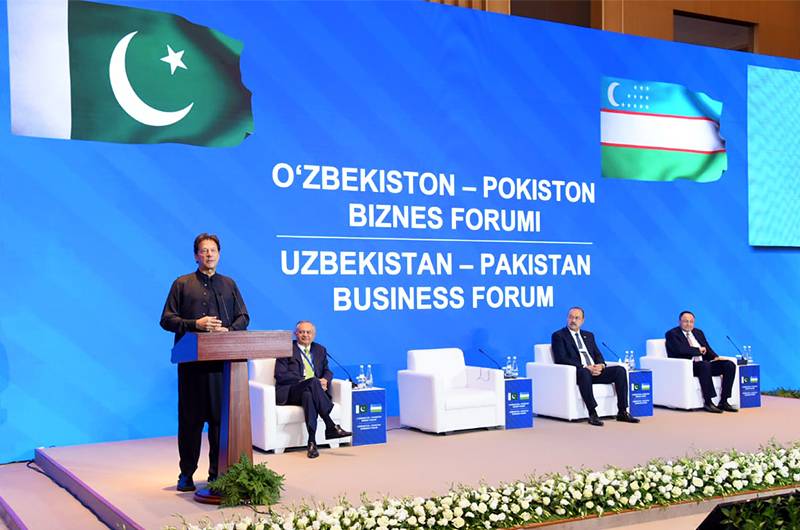
Pakistan's Prime Minister, Imran Khan (left) is addressing the first Uzbekistan-Pakistan Business Forum in Tashkent on July 15, 2021. (Photo courtesy: PID)
Uzbekistan is a landlocked country that heavily relies on Iran’s Bandar Abbas port for international business and commerce.
Islamabad wants to connect the landlocked states through its deep-sea Gwadar port in southwestern Balochistan to boost its geo-economic position in the region. Central Asia also offers Pakistan a $90 billion export market.
Pointing to the participation of over 100 top Pakistani businessmen in the forum, the prime minister maintained that regional connectivity presented a huge opportunity to Pakistani traders to forge stronger partnership with their Uzbek counterparts.
The forum is established to increase and diversify bilateral trade between the two sides by encouraging frequent exchanges of business delegations to identify new avenues of trade and investment.
Khan welcomed the fact that a large number of business contracts and deals between various companies on the two sides had also been concluded during the visit.
He emphasized the primary importance of promoting connectivity and highlighted Pakistan’s readiness to provide the Uzbek authorities access to its seaports.
Discussing Afghanistan, the prime minister said peace in Afghanistan was pivotal to his country’s regional connectivity agenda. Pakistan wanted to see a comprehensive political settlement in the neighboring country since that would benefit everyone from such connectivity projects in the region.
“For the business community, it will raise the living standard in both the countries,” he said.
Meanwhile, Pakistan’s information minister Fawad Hussain Chaudhry, who is also part of the prime minister’s Tashkent delegation, said Khan’s visit would begin a new phase of his country’s economic and security relationship with the Central Asian republics.
“The main purpose of this visit is to enhance the transportation facilities between Pakistan, Afghanistan and Uzbekistan,” he noted.
Chaudhry said Pakistan wanted to see export of goods from Karachi and Gwadar seaports to Tashkent that would help boost its trade with Central Asian economies.
“The second part of the visit is related to peace in Afghanistan,” he said. “An important conference will be held here tomorrow where regional connectivity will be discussed.”


