



QUETTA: Disguised as a boy, Khadija tul Kubra mounts her motorbike to drop her siblings to school every day, riding down the crowded roads and alleyways of Quetta, the capital of Pakistan’s southwestern Balochistan province.
For over five years, the 17-year-old has had to dress in men’s clothing to follow her dream: be mobile and independent herself and also help increase women’s mobility in a region where it is traditionally restricted.
After Arab News published her inspirational story on July 8, Quetta’s Senior Superintendent of Traffic Police, Gul Said Khan Afridi, invited Kubra to his office and gave her a learner’s permit on Tuesday, promising that she would get a full motorcycle license as early as next week.
“I have been receiving positive responses after Arab News did a story on me,” Kubra told Arab News on Tuesday. “The traffic police office in Quetta has issued my first license but I believe I have taken a step for other girls who really want to support their parents in practical life.”
“Girls facing problems while traveling in public transport for their school, college, and universities should start riding motorbikes,” Kubra added. “I have gained much confidence since I started riding my motorbike in the streets of Quetta.”
SSP Afridi said traffic police would continue extending support for girls who wanted to ride motorbikes in Quetta.
“Today we have issued a motorbike riding license to young Khadija after completing all formalities,” Afridi told Arab News. “Her story is inspiring for girls across the country.”
“We would welcome more girls who want to join hands with Khadija and are willing to ride motorbikes,” the police officer said. “Motorbikes are an easy conveyance for girls and they can easily learn bike riding from their fathers or brothers.”
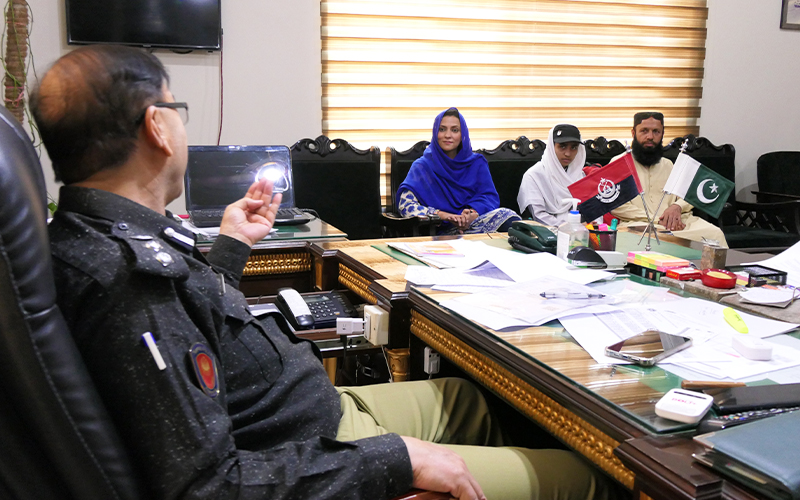
SSP Traffic Quetta, Gul Said Khan Afridi (left) meets Khadija Tul Kubra (second from right) at his office in Quetta, Balochistan, on July 13, 2021. (AN Photo)
Social norms and safety concerns limit women’s mobility across Pakistan, where general commuting and travel activity is estimated to be 80 percent dominated by men, according to a 2016 London School of Economics study on gender inequality in transportation.
Things are even worse in Balochistan, Pakistan’s most impoverished province, where in Quetta alone, traffic police registered 28,700 motorcyclists in 2021 — none of them women. Police data shows only three motorcycle licenses have been issued to female drivers in Quetta since the 1990s. According to the Pakistan Bureau of Statistic, female labor force participation in Balochistan is only 5.06 percent of the total population of women in the province, the lowest rate in Pakistan.
“Here, many girls have to skip their studies due to transportation problems,” Kubra told Arab News in an earlier interview on July 6. “I must disguise myself as a boy to avoid attention on roads, so I wear a male outfit with a cap, gloves, boy’s shoes, glasses.”
Kubra has been riding since 2015, when she passed her high school exams. The third eldest of 12 siblings, she is now responsible for driving her younger brothers and sisters to school, after which she goes to attend university, covering about 22 kilometers on her bike every day.
She learnt how to ride a bike from her father, Ghulam Qadir Bugti, a teacher at the Sariab Mill Boys High School in Quetta.
“Khadija had a passion for motorcycle riding when she was just 10,” Bugti said. “When I realized I couldn’t afford school transport for my children, I decided to teach Khadija bike riding. I always wanted my children, particularly my daughters, to get educated.”

17-year-old Khadija Tul Kubra (left) and her father Ghulam Qadir are pictured in SSP Traffic Gul Said Khan Afridi's office in Quetta, Balochista, on July 13, 2021. (AN Photo)
It was Bugti’s idea that Kubra disguise herself as a boy, he said: “I was afraid for my daughter Khadija, that she would have to bear negative comments and she might be hit by someone or chased by wandering boys.”
While girl riders remain invisible on the streets of Quetta, police say they will support them if they come forward.
“We will support them and plan for their training,” Afridi told Arab News. “We have many female traffic police officers performing duties at various points in Quetta and they have been assisting female drivers. If girl motorcyclists will be on roads, definitely traffic police would be available for their protection and assistance.”
But for that to happen, there must be a change in mindset, Kubra said, saying she had started by asking the parents of her university friends to allow their daughters to drive.
“It empowers us. Through this easy ride we could reach everywhere we want without facing hurdles or harassment on public transportation,” she said.
“I wish one day I will ride my bike in the streets of Quetta in my own girl dress,” she said. “I want to see more girls riding with me in the city in their own clothes.”


