Pakistan says new Afghan refugees to be kept in border camps away from cities

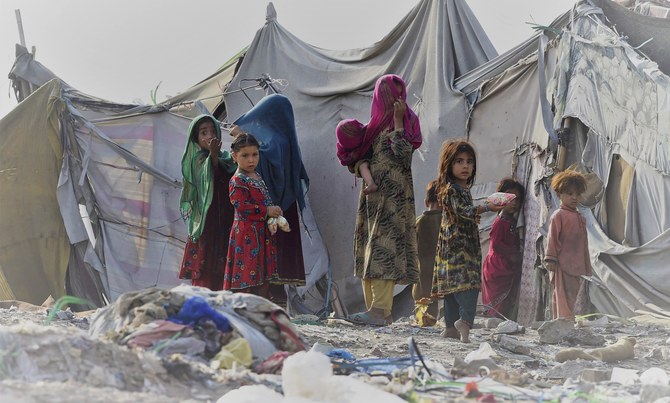
Children of Afghan refugees play outside tents in Afghan Basti area on the outskirts of Lahore on June 19, 2021. (AFP)
Short Url
Updated 13 July 2021
Follow

Pakistan says new Afghan refugees to be kept in border camps away from cities

  • US troop withdrawal is raising questions about Afghan refugee influx into Pakistan
  • About three million Afghans already live in Pakistan, with more in neighboring Iran

ISLAMABAD: Pakistani information minister Chaudhry Fawad Hussain has said if violence escalated in Afghanistan after the withdrawal of United States troops and led to a fresh influx of refugees into Pakistan, the government would confine them in border camps and not allow them to reach Pakistani cities.
The troop withdrawal has raised fears about the future of existing Afghan refugees — one of the largest and most protracted displacements in modern history — and concerns over a new influx of refugees into Pakistan if violence escalates.
About three million Afghans live in Pakistan, with more in neighboring Iran, many of them struggling to get full access to education, health and employment.
“In the past Pakistan had an open border with Afghanistan, which has now been fenced, and in case of new refugees, appropriate steps would be initiated to handle them in a systematic manner,” Hussain told reporters on Monday. “Pakistan is in contact with all Afghan parties and making full efforts for a peaceful [transition] and an all-encompassing government in Kabul.”
The information minister said Prime Minister Imran Khan had unequivocally declared that Pakistan would be a partner of the United States in peace efforts, but not war, in Afghanistan.


From Karachi to Lahore, free iftar spreads relief during Ramadan

Updated 20 February 2026
Follow

From Karachi to Lahore, free iftar spreads relief during Ramadan

  • Pakistan has increasingly experimented with targeted subsidies and digital systems to manage food affordability during Ramadan
  • Last week, PM Shehbaz Sharif launched $136 million relief package, pledging digital cash transfers to 12.1 million low-income families

ISLAMABAD: Mosques in Pakistan’s megacities Karachi and Lahore provide free iftar meal for the poor to break the fast during Ramadan, residents said.

Fasting during the holy month of Ramadan is one of the five pillars of Islam, where Muslims abstain from food and drink from sunrise to sunset.

This is followed by the sighting of the new moon and is marked by Eid-ul-Fitr, a religious holiday and celebration that is observed by Muslims across the world.

In Karachi, hundreds of people rush to sellers of traditional snacks to break the fast.

“You have to be patient, worship Allah, and keep Allah pleased by fulfilling your duties as described by Prophet Muhammad,” said Munir Qadri, a Karachi resident.

A volunteer arranges iftar meals on the first day of the Islamic holy month of Ramadan at the New Memon mosque in Karachi on February 19, 2026. (AFP)

“Yes, Allah has also allowed you to have a good iftar, but we must also think of the poor. All the people should eat equally, and may everyone receives the blessings of this Ramadan.”

Saad Sharif, another Karachi dweller, complained of higher food and commodity prices this Ramadan.

“The prices of everything are increasing,” he said.

“Petrol has become expensive, we can’t do anything about it. Flour has become expensive. Electricity, water, and gas, everything has become costly.”

Muslim devotees pray before breaking their fast on the first day of the Islamic holy month of Ramadan in Karachi on February 19, 2026. (AFP)

Pakistan has increasingly experimented with targeted subsidies and digital systems to manage food affordability during Ramadan, when consumption rises sharply and lower-income households face pressure after years of high inflation.

Last week, Prime Minister Shehbaz Sharif launched a Rs38 billion ($136 million) Ramadan relief package, pledging direct digital cash transfers of Rs13,000 ($47) each to 12.1 million low-income families across Pakistan.

Yet hundreds of Muslims flock to the Data Darbar, a historical shrine in the eastern city of Lahore, and sit on floor as volunteers distribute free food and drinks during iftar and sehri, post-sunset and pre-dawn meals.

Qari Muhammad Younus, an elderly man in Lahore, said that collective iftar holds great importance and there is huge divine reward for the ones who offer iftar to those with no means.

“There are countless [people] here, 24 hours, day and night, and there is more than enough food from iftar till sehri,” he said.

“There is so much food here that iftar at Data Darbar is second only to iftar at Prophet’s Mosque.”

Mushtaq Ahmad, a Lahore resident, said Allah Almighty asks Muslims to “spend out of what I have provided for you as sustenance.”

“And that includes these iftar meals. May Allah Almighty incline us toward such good deeds,” he added.