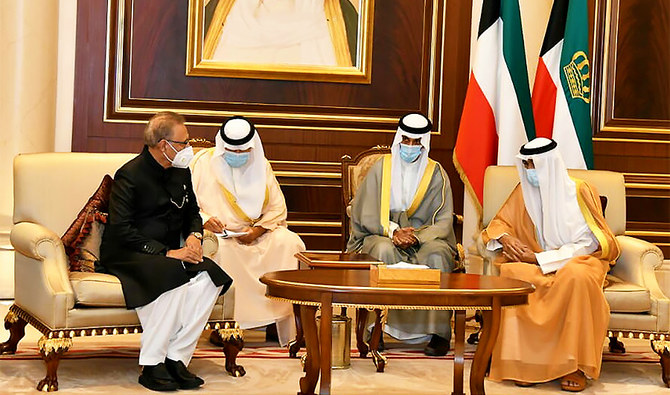
ISLAMABAD: Kuwaiti Emir Sheikh Nawaf Al-Ahmad Al-Jaber Al-Sabah has accepted President Arif Alvi’s invitation to visit Pakistan, Alvi’s office said in a statement on Monday, with the details of the trip yet to be finalized.
The Pakistani president said the emir of Kuwait had written a letter, expressing “satisfaction over the strong ties between Pakistan and Kuwait and reiterated his commitment to further expand relations in all fields for the mutual interest.”
Sheikh Nawaf’s letter follows Kuwait’s decision to lift a travel ban on Pakistanis in May this year.
Kuwait had suspended visas for nationals of Iran, Iraq, Syria, Pakistan and Afghanistan in 2011 over what it said was difficult security conditions in the five countries.
Pakistan began visa resumption talks with Kuwait in 2020, following which hundreds of nurses, doctors and medical technicians were able to travel to the Gulf state.
In May, after a meeting with Kuwait’s Prime Minister Sabah Al-Khalid Al-Sabah, Pakistan’s Interior Minister Sheikh Rashid Ahmed said business and family visas for Pakistani nationals would be resumed “immediately”.
Last month, during a meeting with his Kuwaiti counterpart, Sheikh Ahmad Nasser Al-Mohammad Al-Sabah, on the sidelines of the Antalya Diplomacy Forum in Turkey, Pakistan’s Foreign Minister Shah Mahmood Qureshi welcomed Kuwait’s relaxation of the travel restrictions.
Pakistan enjoys a long-standing fraternal relationship with Kuwait, an important Gulf Cooperation Council (GCC) country.

Kuwaiti emir accepts President Alvi’s invitation to visit Pakistan
https://arab.news/ppcr6
Kuwaiti emir accepts President Alvi’s invitation to visit Pakistan
- Sheikh Nawaf reiterates commitment to ‘expand relations’ between the two countries
- Kuwait lifted a decade-old travel ban on Pakistanis in May this year
Pakistan says over 500 Afghan Taliban militants killed in airstrikes as fighting continues
- Clashes began last week after Afghanistan targeted Pakistani military sites along the border
- Pakistan says it struck 62 targets in Afghanistan, destroyed 237 check posts in the conflict
ISLAMABAD: Pakistan has killed 527 Afghan Taliban fighters, wounded more than 755 and struck 62 locations inside Afghanistan in air attacks, Information Minister Attaullah Tarar said on Friday, as fighting between the two neighbors enters the second week.
Clashes between the two countries began last week when Afghan forces launched a surprise attack on Pakistani military installations along their shared border. Afghanistan said the assault was in retaliation for Pakistan’s earlier airstrikes in February on what Islamabad described as militant camps inside Afghanistan.
Last Friday, Pakistan’s Defense Minister Khawaja Muhammad Asif said the situation had become “open war” between Pakistan and Afghanistan as strikes and fighting escalated.
“Summary of Afghan Taliban losses: 527 killed, 755 + injured, 237 checkposts destroyed, 38 posts captured, 205 tanks, armored vehicles and artillery guns destroyed,” Tarar wrote on the social media platform X.
“62 locations across Afghanistan effectively targeted by air.”
The development comes after the Tehreek-e-Taliban Pakistan (TTP), also known as the Pakistani Taliban, announced a fresh offensive against Pakistan earlier today.
Pakistan accuses Kabul of sheltering militant groups such as the TTP on its soil and facilitating attacks against Pakistan. Afghanistan denies the allegations and has urged Islamabad to address its security challenges without blaming Kabul.
Afghanistan has called for dialogue to resolve the conflict. Pakistan, however, has rejected talks with Kabul, saying its operation “Ghazab Lil Haq” — meaning Wrath for Truth — will continue until its objectives are achieved.
Since the conflict began, diplomatic efforts have intensified, with several countries and international bodies, including the European Union and the United Nations, urging restraint and calling for talks.
Turkish President Recep Tayyip Erdogan has told Pakistani Prime Minister Shehbaz Sharif that Ankara would help restore a ceasefire, as other countries that had offered to mediate have themselves been affected by the conflict in the Gulf.


