

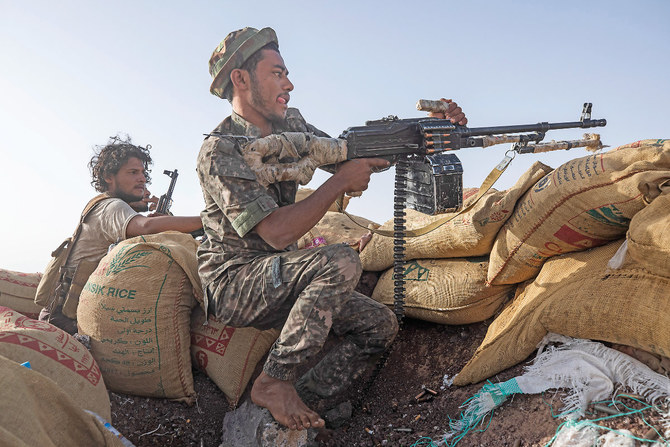
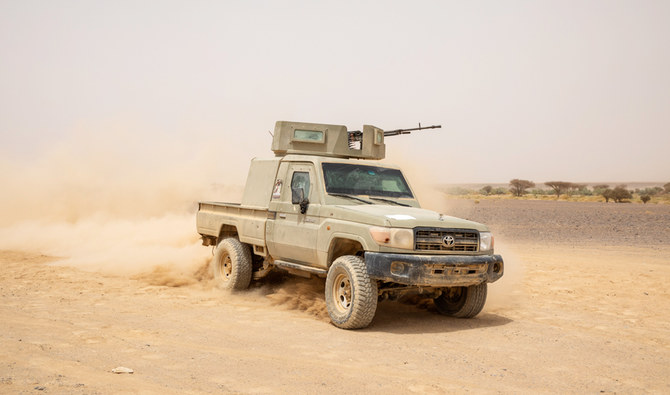

ALEXANDRIA: A top Houthi battlefield commander was killed on Saturday as new fighting raged between Yemeni government troops and Iran-backed forces in the provinces of Al-Bayda, Marib and Jouf.
Abu Yahya Al-Hanemi died in a fierce five-hour battle for Al-Zaher district, south of the central Al-Bayda province.
The Houthis mounted counterattacks on army troops and allied tribesmen in Al-Bayda, where loyalists scored major advances over the last seven days. Yemen’s Defense Ministry said on Saturday that the rebel forces suffered heavy casualties and lost military equipment in the battle for Al-Zaher.
FASTFACT
Thousands of combatants and civilians have been killed since February when the Houthis resumed an offensive on oil-rich Marib, the government’s last bastion in the north.
Backed by air support from the Arab coalition, government troops last week mounted an offensive to seize control of districts in Al-Bayda, and to relieve pressure on other government troops battling Houthi attacks in the central province of Marib.
Government troops seized control of a swath of territory in Al-Zaher district, and pushed deeper into Houthi-controlled areas in Al-Saoma and Al-Hazemia, southeast of the province, after killing, wounding and capturing dozens of rebel fighters.
By attacking the Houthis in Al-Bayda, Yemen’s government has sought to secure neighboring provinces such as Lahj, Abyan, Shabwa and Al-Dhale, push into other Houthi-controlled provinces such as Sanaa, Ibb and Dhamar, and weaken the Houthi offensive on Marib, army officials said.
Local officials say that fighting could escalate there in the coming days as the Houthis and government continue bringing in reinforcements.
In Marib province, the scene of the heaviest fighting, Yemen’s Defense Ministry said on Saturday that army troops and tribesmen mounted an attack on the Houthis in the Halhalan Valley and Mezam Mas, northeast of the province, as other government troops pushed back Houthi attacks in Al-Mashjah and Al-Kasara, west of Marib city.
In Jouf, army spokesman Rabia Al-Qurashi told Arab News that government troops repulsed a Houthi attack in Al-Jadafer region, west of Hazem, the provincial capital, and several Houthis were killed when a warplane from the Arab coalition targeted
their vehicle.


