

Families of Beirut port blast victims demand accountability

1 / 3
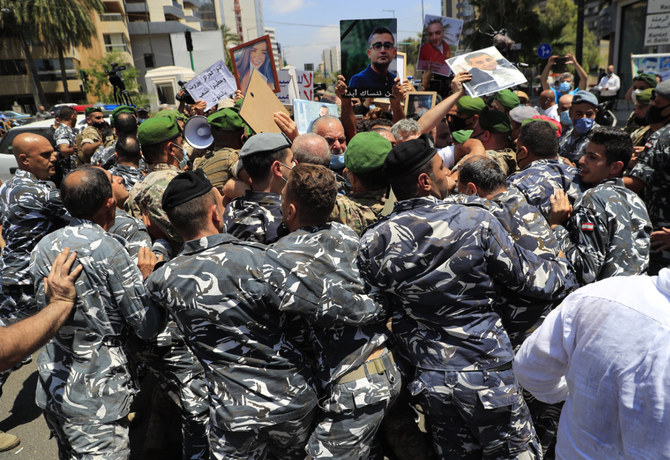
Lebanon parliament speaker Nabih Berri's security push back families of the victims of last year's Beirut seaport blast as they protest in Beirut on July 9, 2021. (AP)
2 / 3
A Lebanese man who lost her son during the last year's massive blast at Beirut's seaport shout slogans as he pushed back by a Lebanese army soldier during a rally on July 9, 2021. (AP)
3 / 3
Lebanese demonstrators display during a rally in Beirut on July 9, 2021 portraits of relatives who were killed during last year's massive blast at Beirut's seaport. (AFP)
Short Url
Updated 09 July 2021
Follow

Families of Beirut port blast victims demand accountability

  • Protesters pressure Lebanon’s parliament into lifting immunity for ex-ministers wanted for questioning in catastrophic Aug. 4, 2020 explosion
  • Pharmacies go on strike, two major power stations shut down and the Lebanese pound tumbles to a new low on the black market

BEIRUT: As the one-year anniversary of the Beirut port blast approaches, families of the victims are demanding answers. They protested in the capital on Friday to pressure parliament into lifting the immunity for ex-ministers wanted for questioning.

The Lebanese parliament failed to make progress in the port blast investigation and postponed a final decision for 15 days because it needed more proof. 

Nearly 3,000 tons of ammonium nitrate — a highly explosive material used in fertilizers — had been improperly stored in the port for years. The chemicals ignited in the catastrophic Aug. 4, 2020 blast that killed 211 people, injured more than 6,000, and damaged entire neighborhoods.

Some of the families of victims attempted to storm the headquarters of Speaker Nabih Berri in Beirut but met resistance and then clashed with the Lebanese army and parliamentary guards. 

“I have been crying over my son for a year and I am wishing every night I can see him in my dreams,” one protester shouted at the politicians. 

“You have broken our hearts. You lie to people and make false promises. You have robbed the country and you are trying to scare us.”

Earlier this month, the leading judge in the case, Tareq Bitar, said he had demanded that parliament lift the immunity of ex-finance minister Ali Hasan Khalil, former public works minister Ghazi Zaiter and ex-interior minister Nohad Machnouk. The defendants, who are current MPs, have been accused of negligence because they were allegedly aware of the ammonium nitrate that was stored at the port and did not take action. 

A request from Bitar to question Major General Abbas Ibrahim, head of the powerful General Security Agency, was rejected by Lebanon’s caretaker Interior Minister Mohammed Fehmi in a letter to the justice minister.

This action further angered families of the victims, who headed to the Interior Ministry headquarters to insist on “holding every person behind this crime accountable.”

The families and protesters said every official that refused to be questioned and took advantage of the immunity was guilty of manipulating the law.

“Avoiding the questions allows us to go to your house and bring you in to be questioned,” one protester said. “We are still waiting for you to appear before the justice.”

In other developments around the country, pharmacies went on strike over medicine shortages, two major power stations were grounded to a halt due to a lack of fuel and the Lebanese pound tumbled to a new low on the black market, reaching almost 20,000 for $1.

It was in the early morning hours Friday when the power plants shut down completely and electricity went out across the entire country and even inside the presidential palace.

Lebanon’s national electricity company, known as Electricite du Liban (EDL), said the power cuts were caused by a “delay in finalizing payment from foreign corresponding banks and the issuance of importers’ direct approval to unload the shipments.”

Water facilities in the north and south warned that they were reducing the distribution because of power cuts and low fuel levels.

The secretary-general of Lebanon’s Tourism and Trade Unions Federation, Jean Beiruti, said tourism facilities and hotels might be close soon due to the power outages.

“Tourism institutions are operated by private power generators and the diesel is purchased on the black market for double the price,” he said.

Pharmacies said they went on strike until the Health Ministry issues a price list for drugs and classifies them as subsidized and nonsubsidized, in agreement with Lebanon’s Central Bank (BDL).

President of the Pharmacists Syndicate Dr. Ghassan Al-Amin said he was surprised when he learned that BDL only has $400 million allocated for medicine, fuel, flour, and medical supplies, which means that “medicine will only be allocated a part of this amount.”

Al-Amin expected the caretaker government’s minister of health, Hamad Hassan, to announce a new plan for a subsidy policy and address the current medical crisis.


Arab Coalition announces ‘limited’ airstrike targeting two ships that smuggled weapons to Yemen

Updated 14 sec ago
Follow

Arab Coalition announces ‘limited’ airstrike targeting two ships that smuggled weapons to Yemen

RIYADH: The Coalition to Support Legitimacy in Yemen on Tuesday said it conducted a “limited” airstrike targeting two ships that smuggled weapons and other military hardware into Mukalla in southern Yemen.

In a statement carried by the Saudi Press Agency (SPA), the Coalition Forces spokesman, Major General Turki Al-Maliki, said that two ships coming from the port of Fujairah in the United Arab Emirates entered the port of Mukalla without obtaining official permits from the Joint Forces Command of the Coalition. 

“The crews of the two ships disabled the tracking systems of the two ships and unloaded a large quantity of weapons and combat vehicles to support the Southern Transitional Council forces in the eastern governorates of Yemen (Hadramawt, Al-Mahra) with the aim of fueling the conflict. This is a clear violation of imposing a truce and reaching a peaceful solution, as well as a violation of UN Security Council Resolution No. (2216) of 2015 AD,” said the spokesman.

Google map showing the location of Mukalla in southern Yemen

Al-Maliki said the Coalition Forces acted on a request by Rashad Al-Alimi, the president of the Yemeni Presidential Leadership Council, “to take all necessary military measures to protect civilians in the governorates of Hadramawt and Al-Mahra.”

Al-Alimi, the president of the Yemeni Presidential Leadership Council, warned last week that unilateral actions by the STC were pushing the country toward a dangerous tipping point.

“Given the danger and escalation posed by these weapons, which threaten security and stability, the Coalition Air Forces conducted a limited military operation this morning targeting weapons and combat vehicles unloaded from the two ships at the port of Al-Mukalla. This was done after documenting the unloading, and the military operation was carried out in accordance with international humanitarian law and its customary rules, ensuring no collateral damage occurred,”  spokesman Al-Maliki said on Tuesday.


READ MORE: Analysis: The risks of carving up Yemen


He affirmed the Coalition’s "continued commitment to de-escalation and enforcing calm in the governorates of Hadramawt and Al-Mahra, and to prevent any military support from any country to any Yemeni faction without coordination with the legitimate Yemeni government and the Coalition. This is aimed at ensuring the success of the Kingdom and the Coalition’s efforts to achieve security and stability and prevent the conflict from spreading.”

Disregarding previous agreements with the Coalition, the group calling itself Southern Transitional Council, or STC, launched a sweeping military campaign early in December, seizing the governorates of Hadramaut along the Saudi border and the eastern governorate of Al-Mahra in Yemen’s border with Oman.

The UAE-backed STC forces captured the city of Seiyun, including its international airport and the presidential palace. They also took control of the strategic PetroMasila oilfields, which account for a massive portion of Yemen’s remaining oil wealth.

This prompted Saudi Arabia to issue a firm demand for the STC to withdraw and hand over the seized areas to the National Shield Forces, a Saudi-backed unit.

The coalition warned that any military movements undermining de-escalation efforts would be dealt with immediately to protect civilians, according to the Saudi Press Agency.

On Dec. 26, the UAE issued a statement welcoming Saudi Arabia’s efforts to support security and stability in Yemen.

The statement carried by state news agency WAM praised Saudi Arabia’s constructive role in advancing the interests of the Yemeni people and supporting their legitimate aspirations for stability and prosperity.