

For girl student in Balochistan, empowerment comes on two wheels in boy's outfit

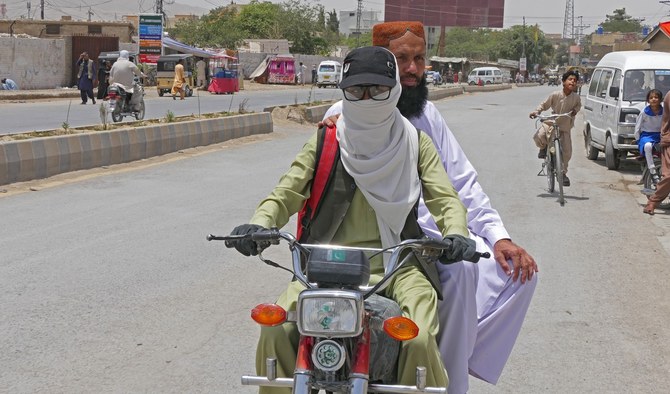
Khadija Tul Kubra drives her father to his workplace in Sariab Road, Quetta, Balochistan on July 6, 2021. (AN photo by Saadullah Akhter)
Short Url
Updated 09 July 2021
Follow

For girl student in Balochistan, empowerment comes on two wheels in boy's outfit

  • Khadija tul Kubra has been riding a motorcycle for last two years, she aims to improve women's mobility in the conservative tregion
  • In Quetta, traffic police registered 28,700 motorcyclists in 2021, none of them women, only 5% women in Balochistan are part of labour force

QUETTA: Disguised as a boy, Khadija Tul Kubra mounts her motorbike to drop her siblings to school every day, riding down the crowded roads and alleyways of Quetta, the capital of Pakistan’s southwestern Balochistan province.
The 17-year-old has a quest: increasing women's mobility in a region where it is traditionally restricted.
Social norms and safety concerns limit women's mobility across Pakistan, where general commuting and travel activity is estimated to be 80 percent dominated by men, according to a 2016 London School of Economics study on gender inequality in transportation.
Things are even worse in Balochistan, Pakistan’s most impoverished province, where in Quetta alone, traffic police registered 28,700 motorcyclists in 2021 - none of them women. Police data shows only three motorcycle licenses have been issued to female drivers in Quetta since the 1990s. According to the Pakistan Bureau of Statistic, female labor force participation in Balochistan is only 5.06 percent of the total population of women in the province, the lowest rate in Pakistan.
"Here, many girls have to skip their studies due to transportation problems," Kubra told Arab News in an interview this week. "I must disguise myself as a boy to avoid attention on roads, so I wear a male outfit with a cap, gloves, boy's shoes, glasses."
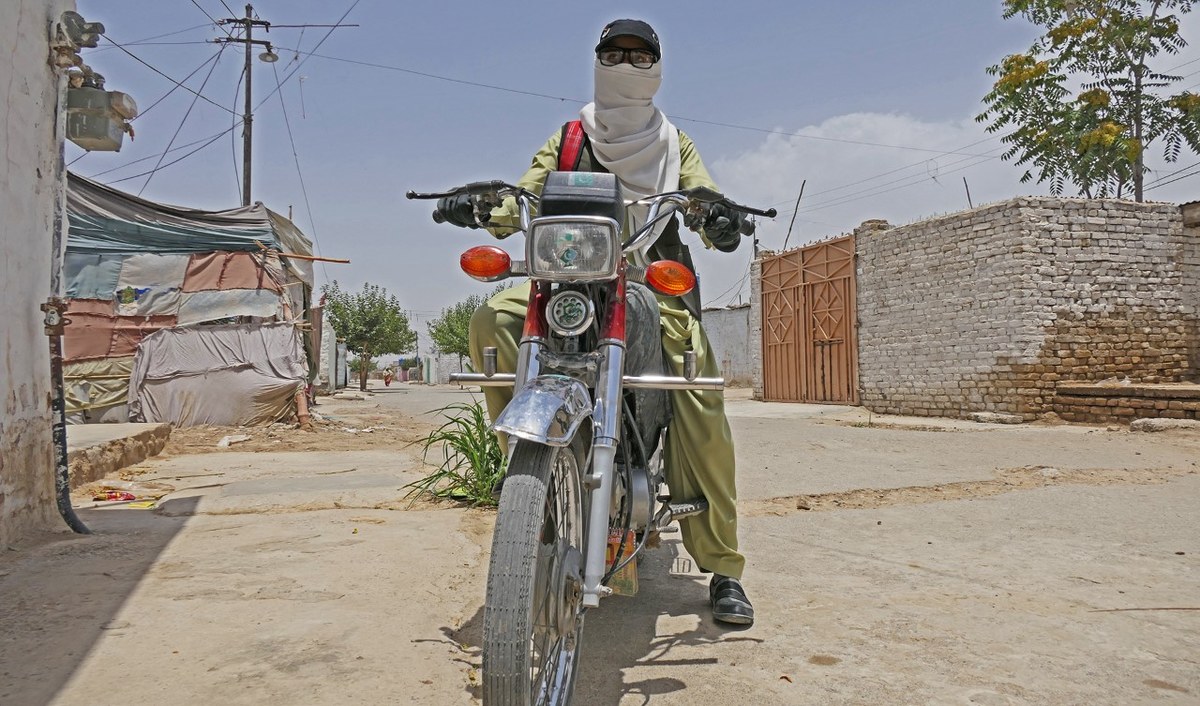


Disguised as a boy, 17-year-old Khadija Tul Kubra rides through the Quetta Joint Road area in Quetta, Balochistan on July 6, 2021. (AN photo by Saadullah Akhter)

Kubra has been riding since 2015, when she passed her high school exams. The third eldest of 12 siblings, she is now responsible for driving her younger brothers and sisters to school, after which she goes to attend university, covering about 22 kilometers on her bike every day.
She learnt how to ride a bike from her father, Ghulam Qadir Bugti, a teacher at the Sariab Mill Boys High School in Quetta.

"Khadija had a passion for motorcycle riding when she was just 10,” Bugti said. “When I realized I couldn't afford school transport for my children, I decided to teach Khadija bike riding. I always wanted my children, particularly my daughters, to get educated."It was Bugti's idea that Kubra disguise herself as a boy, he said: “I was afraid for my daughter Khadija, that she would have to bear negative comments and she might be hit by someone or chased by wandering boys."


High school teacher Ghulam Qadir Bugti helps his daughter Khadija Tul Kubra with her studies at their home in the Sariab area of Quetta, Balochistan on July 6, 2021. (AN photo by Saadullah Akhter)

While girl riders remain invisible on the streets of Quetta, police say they will support them if they come forward.
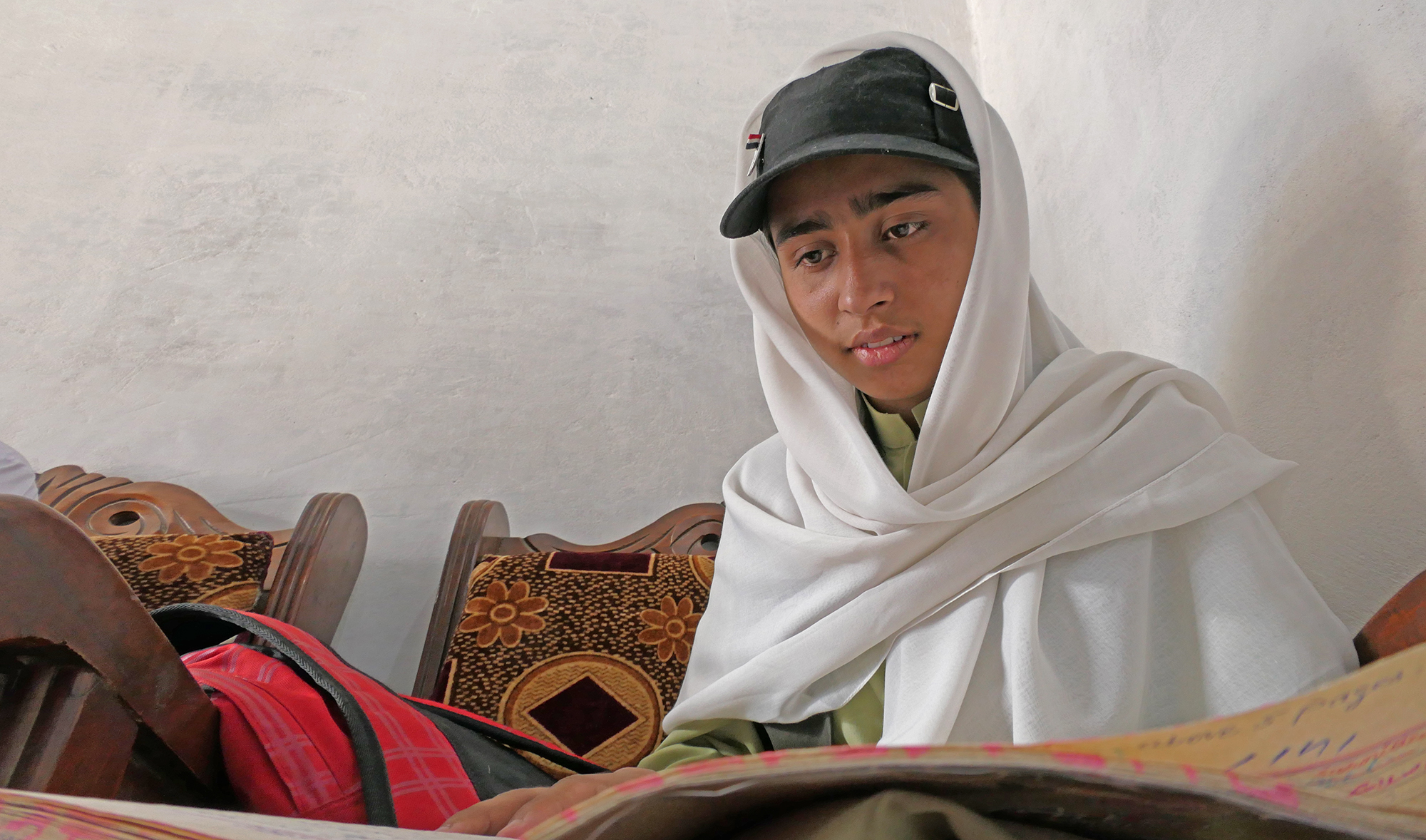


Khadija Tul Kubra is busy studying at her home in the Sariab area of Quetta, Balochistan on July 6, 2021. (AN photo by Saadullah Akhter)

"We will support them and plan for their training," Senior Superintendent Police Traffic Gul Said Khan Afridi told Arab News. "We have many female traffic police officers performing duties at various points in Quetta and they have been assisting female drivers. If girl motorcyclists will be on roads, definitely traffic police would be available for their protection and assistance."
But for that to happen, there must be a change in mindset, Kubra said, saying she had started by asking the parents of her university friends to allow their daughters to drive.
"It empowers us. Through this easy ride we could reach everywhere we want without facing hurdles or harassment on public transportation," she said.
"I wish one day I will ride my bike in the streets of Quetta in my own girl dress,” she said. “I want to see more girls riding with me in the city in their own clothes."


Karachi hosts scaled-down Lux Style Awards as industry reflects on recognition, evolving formats, inclusion

Updated 5 sec ago
Follow

Karachi hosts scaled-down Lux Style Awards as industry reflects on recognition, evolving formats, inclusion

  • 24th edition of prestigious awards held at historic Mohatta Palace after the ceremony in May was canceled
  • Awards introduce new Digital Content Creators category amid changing entertainment and media landscape

KARACHI: Pakistan’s entertainment industry gathered in Karachi on Thursday for a smaller, more intimate ceremony marking the cc, as artists reflected on the importance of recognition, evolving formats and broader inclusion across creative fields.

The awards, considered Pakistan’s longest running and most prestigious entertainment honors, were held at the Mohatta Palace, a departure from previous large-scale events at the Karachi Expo Center. 

Actress Sanam Saeed, who co-hosted the evening, described the ceremony as “small and intimate,” a tone echoed by several attendees.

The scaled-down format followed an unusual year for the awards. The 23rd Lux Style Awards, scheduled to take place in Lahore in May, were canceled amid the brief war between Pakistan and India, with winners announced digitally and trophies delivered to recipients’ homes.

Among the prominent stars attending this year’s ceremony were Fahad Mustafa, Hania Aamir, Mawra Hocane and Yumna Zaidi. Aamir, who won Actor of the Year – Female (Viewers’ Choice), for the hit television drama Kabhi Main Kabhi Tum, said award platforms play a vital role in sustaining creative industries.

“It’s extremely important to appreciate the art that comes out of your country,” she told Arab News at the red carpet. The drama, she noted, resonated beyond Pakistan, trending in Bangladesh and India during its broadcast.

The picture shows entrance of the 24th Lux Style Awards in Karachi, Pakistan, on December 11, 2025. (AN photo)

Addressing fans abroad, Aamir, arguably Pakistan’s most popular celebrity internationally, said:

“Thank you so much for loving beyond borders. We love you as much even more. So thank you so much for appreciating all the hard work that we do.”

She also called for broader recognition across productions. 

“I’d like Lux [Style Awards] and every other award show to have a lot more diverse categories to appreciate every single person who is a part of the team. [And] who actually makes the project come to life.”

The Lux Style Awards have long attracted debate over transparency and credibility, a recurring discussion whenever nominations and winners are announced. 

Still, many artists said the platform remains essential for motivation and visibility.

“Whenever we discuss the awards, no award will be fair because some people will have certain reservations with it,” producer Abdullah Seja of iDream Entertainment told Arab News. “These might be the most authentic awards in Pakistan [but] obviously there is room for improvement in everything.”

Reflecting shifts in Pakistan’s creative economy, the awards introduced a separate category this year for Digital Content Creators. The inaugural trophy went to real-life couple Rabya Kulsoom and Rehan Nazim, known online as ‘Ron and Cocco’.

“The credit goes to Lux [Style Awards] for introducing the category because content creation is not easy,” Nazim said. “Whoever is doing it, it’s a difficult job. And now it has become a full-time job. You can’t take it lightly and do it on the side. So, we need to recognize the people who are doing it.”

Actress Yumna Zaidi, who won her first film award for Nayab, described the ceremony’s return to Karachi as significant. 

“I am so glad that it’s happening in Karachi because it’s been a while,” she said, adding, “Lux [Style Awards] are the strongest because it includes nominations from all the channels and it’s the strongest [competition].”

Mawra Hocane, whose drama Jafaa was nominated for TV Play of the Year (Critics’ Choice), said meaningful storytelling mattered more than trophies. 

“Platforms [like these] are very very important but more than that what’s important is that a project strikes a chord with the audience,” she said.

“I do my projects so that we can work on the position of women in society. [And] somehow elevate them, somehow create some space for them. And I think ‘Jafaa’ has done that.”

Music remained a central draw of the evening. 

Co-host Sanam Saeed said she was particularly looking forward to live performances. 

“Music is the kind of genre that bonds people together and puts Pakistan on the map,” she said. 
“We become one when it comes to music, forgetting all the distance, limitations and borders. [And] Our music does that.”

Singer and songwriter Hasan Raheem, popular among younger audiences, also performed during the ceremony and reflected on the value of such platforms. 

“These [platforms] are important, honestly,” he said. “I feel like things like these should happen because the real present and the gift that I personally get is the love from people that is the epitome of all the awards. I can never get a better award than that.”