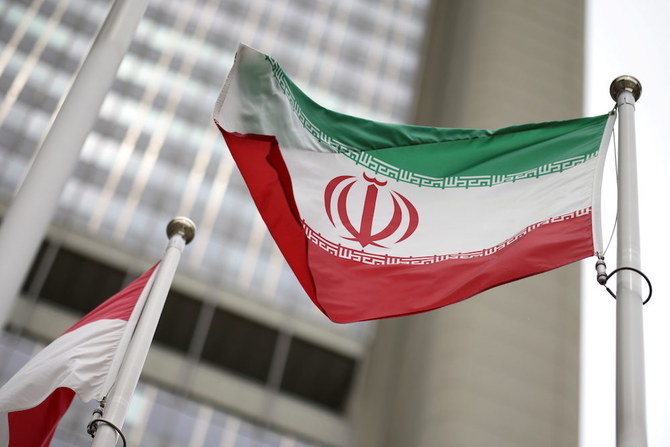
LONDON: Iran has given notice of concrete steps to produce uranium metal enriched to up to 20 percent purity for reactor fuel, the UN atomic watchdog said on Tuesday, describing a move that is likely to anger Western powers in talks to revive the Iran nuclear deal.
Iran has been in indirect talks with the United States since April to revive the 2015 deal, which former US President Donald Trump abandoned. The deal imposed curbs on Iran’s nuclear program in return for the lifting of sanctions, and after Trump withdrew, Iran began violating many of its restrictions.
Tehran has already produced a small amount of uranium metal this year that was not enriched. That is a breach of the deal, which bans all work on uranium metal since it can be used to make the core of a nuclear bomb.
Iran has outlined plans to produce enriched uranium metal, saying it is developing fuel for its Tehran Research Reactor, but Washington and its European allies dispute Tehran’s intentions and have called on it to stop.
“Today, Iran informed the Agency that UO2 (uranium oxide) enriched up to 20 percent U–235 would be shipped to the R&D laboratory at the Fuel Fabrication Plant in Esfahan, where it would be converted to UF4 (uranium tetrafluoride) and then to uranium metal enriched to 20 percent U–235, before using it to manufacture the fuel,” an International Atomic Energy Agency statement said.
Summarizing a report to its member states, the IAEA described the plan as a “multi-stage process,” suggesting it will take time before the enriched metal is produced.
The report is likely to increase tensions in the talks, which include the other parties to the 2015 deal. The talks adjourned on June 20 and a date for their resumption has not yet been set.
The US on Tuesday called Iran’s decision an “unfortunate step backwards” but said the window for diplomacy to allow both to resume compliance with the 2015 nuclear deal remained open.
“It is worrying that Iran chooses to escalate its non-performance of its (nuclear deal) commitments, especially with experiments that have value for nuclear weapons research. It’s another unfortunate step backwards for Iran, particularly when we for our part have demonstrated our sincere intention and willingness to return to the (deal),” US State Department spokesman Ned Price told reporters at a briefing.
“We continue to urge Iran to stop this brinksmanship, to return to Vienna prepared for real talks, and to be in a position to be prepared to finish the work that we have started in April,” he said.
Germany, France and Britain also voiced “grave concern” over the move by Iran that they say is a serious violation of its commitments under the 2015 nuclear deal with world powers, warning that it threatens the outcome of talks aimed at bringing the US back into the agreement.
Uranium metal can also be used for a nuclear bomb, and research on its production is specifically prohibited under the nuclear deal. The IAEA already said in February that its inspectors had confirmed that Iran has begun the production of uranium metal.
The three European powers’ foreign ministers issued a joint statement saying of Tehran’s latest step that “Iran has no credible civilian need for uranium metal (research and development) and production, which are a key step in the development of a nuclear weapon.”
They said it was “all the more concerning” given that no date has been set for the resumption of negotiations in Vienna, and that Iran has “significantly curtailed” IAEA access.
“We have repeatedly stressed that time is on no-one’s side,” the statement said. “With its latest steps, Iran is threatening a successful outcome to the Vienna talks despite the progress achieved in six rounds of negotiations to date.”
Bob Einhorn, a nonproliferation expert at the Brookings Institution think tank, said: “This is clearly an escalation — clearly another message by Iran that in the absence of any restoration of (the nuclear deal), they are going to continue ramping up their capability and their pressure.”
(With AP, AFP and Reuters)

Iran gives IAEA notice of escalating uranium metal work
Short Url
https://arab.news/w4mt5
Iran gives IAEA notice of escalating uranium metal work
- US warns Iran to stop nuclear ‘brinksmanship’
- European powers say ‘Iran has no credible civilian need for uranium metal and production, which are a key step in the development of a nuclear weapon’
Israel begins demolishing residential buildings in West Bank camp
- The 25 buildings were home to about 100 families in the Nur Shams refugee camp
- Israeli military claims demolitions are part of effort to root out armed groups in northern areas of the territory
NUR SHAMS, occupied West Bank: Israeli bulldozers began demolishing 25 buildings housing Palestinians in a refugee camp on Wednesday, in what the military said was an effort to root out armed groups in northern areas of the occupied West Bank.
The buildings, home to some 100 families, are in the Nur Shams camp, a frequent site of clashes between Palestinian militants and Israeli forces.
Israeli military bulldozers and cranes tore through the structures early Wednesday, sending thick plumes of dust into the air, an AFP journalist reported. Many residents watched from a distance.
The military said the demolitions were part of an operation against militants.
“Following ongoing counterterrorism activity by Israeli security forces in the area of Nur Shams in northern Samaria, the commander of the Central Command, Major General Avi Bluth, ordered the demolition of several structures due to a clear and necessary operational need,” the military told AFP in a statement.
“Areas in northern Samaria have become a significant center of terrorist activity, operating from within densely populated civilian areas.”
Earlier this year, the military launched an operation it said was aimed at dismantling Palestinian armed groups from camps in northern West Bank — including Nur Shams, Tulkarem and Jenin.
“Even a year after the beginning of IDF operations in the area, forces continue to locate ammunition, weapons, and explosive devices used by terrorist organizations, which endanger IDF soldiers and impair operational freedom of action,” the military said on Wednesday.
Earlier in December, AFP reported residents of the targeted buildings retrieving their belongings, with many saying they had nowhere to go.
The demolitions form part of a broader Israeli strategy aimed at easing access for military vehicles within the densely built refugee camps of the West Bank.
Israel has occupied the Palestinian territory since 1967.
Nur Shams, along with other refugee camps in the West Bank, was established after the creation of Israel in 1948, when hundreds of thousands of Palestinians were displaced from their homes in what is now Israel.
With time, the camps they established inside the West Bank became dense neighborhoods not under their adjacent cities’ authority. Residents pass on their refugee status from one generation to the next.
Many residents believe Israel is seeking to destroy the idea of the camps themselves, turning them into regular neighborhoods of the cities they flank, in order to eliminate the refugee issue.
The buildings, home to some 100 families, are in the Nur Shams camp, a frequent site of clashes between Palestinian militants and Israeli forces.
Israeli military bulldozers and cranes tore through the structures early Wednesday, sending thick plumes of dust into the air, an AFP journalist reported. Many residents watched from a distance.
The military said the demolitions were part of an operation against militants.
“Following ongoing counterterrorism activity by Israeli security forces in the area of Nur Shams in northern Samaria, the commander of the Central Command, Major General Avi Bluth, ordered the demolition of several structures due to a clear and necessary operational need,” the military told AFP in a statement.
“Areas in northern Samaria have become a significant center of terrorist activity, operating from within densely populated civilian areas.”
Earlier this year, the military launched an operation it said was aimed at dismantling Palestinian armed groups from camps in northern West Bank — including Nur Shams, Tulkarem and Jenin.
“Even a year after the beginning of IDF operations in the area, forces continue to locate ammunition, weapons, and explosive devices used by terrorist organizations, which endanger IDF soldiers and impair operational freedom of action,” the military said on Wednesday.
Earlier in December, AFP reported residents of the targeted buildings retrieving their belongings, with many saying they had nowhere to go.
The demolitions form part of a broader Israeli strategy aimed at easing access for military vehicles within the densely built refugee camps of the West Bank.
Israel has occupied the Palestinian territory since 1967.
Nur Shams, along with other refugee camps in the West Bank, was established after the creation of Israel in 1948, when hundreds of thousands of Palestinians were displaced from their homes in what is now Israel.
With time, the camps they established inside the West Bank became dense neighborhoods not under their adjacent cities’ authority. Residents pass on their refugee status from one generation to the next.
Many residents believe Israel is seeking to destroy the idea of the camps themselves, turning them into regular neighborhoods of the cities they flank, in order to eliminate the refugee issue.
© 2025 SAUDI RESEARCH & PUBLISHING COMPANY, All Rights Reserved And subject to Terms of Use Agreement.