Israel answers Jordan’s plea for urgent water supplies

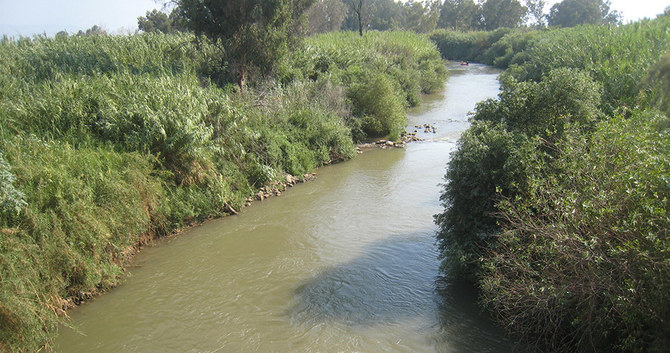
Israel is meant to supply water to Jordan under the the 1994 Wadi Araba Peace Treaty. (Raed Omari)
Short Url
Updated 06 July 2021
Follow

Israel answers Jordan’s plea for urgent water supplies

  • Move seen as gesture of goodwill from Israel’s new government
  • Jordan request comes amid warnings of critical water shortage

AMMAN: Israel has approved a Jordanian request to supply additional water to the kingdom in a move described as a goodwill gesture from Israel’s new government.

The move follows a rift in relations between the countries under the premiership of the former long-term leader Benjamin Netanyahu.

According to Israeli media, new Prime Minister Naftali Bennett has given his initial agreement to the sale of 50 million cubic meters of water to resource-poor Jordan, one of the most water-scarce countries in the world.

Netanyahu had delayed approving Jordan’s request for water supplies, the Israeli media has reported, amid tension over Jerusalem, Israeli plans to annex the Jordan Valley and the kingdom’s refusal to allow Netanyahu to overfly its airspace.

The request was submitted through the joint Jordanian-Israeli water committee, established after the 1994 peace deal between the countries, Israeli reports said.

The Jordanian government has not officially commented on the reports, saying there has been no announcement yet from the Israeli government.

However, a Jordanian official, speaking on condition of anonymity, told Arab News that by 2022 Israel will be selling Jordan an additional 50 million cubic meters of water to be pumped from the Lake Tiberias (Sea of Galilee) into the kingdom.

The official said the additional water supply is supposed to be a “routine procedure” stipulated in the 1994 Wadi Araba Peace Treaty under which Israel committed to provide Jordan with 55 million cubic meters of water a year.

“But the provision on water allocation has been misused by Netanyahu,” the official added.

“So, yes, this additional water supply will help alleviate much of our water concerns for this year.”

In April, Jordan confirmed it had received an additional quantity of 8 million cubic meters from Israel which, Israeli media said, was spurred by pressure from the administration of US President Joe Biden.

Meanwhile, Jordan’s ministry of water and irrigation has warned of severe drought this summer due to low rainfall through winter. Water storage in Jordan’s 10 major dams is 80 million cubic meters lower than last year, according to official estimates. 

Jordan is the second-largest refugee host per capita worldwide, according to UNHCR, with roughly 750,000 refugees, and is also classified as the second most water-scarce country in the world.


UN rights chief slams dangerous ‘tit-for-tat dynamic’ in Mideast war

Updated 4 sec ago
Follow

UN rights chief slams dangerous ‘tit-for-tat dynamic’ in Mideast war

  • Turk deplored the extensive attacks in residential areas, on health facilities, schools, cultural property and water and energy infrastructure
  • He stressed that “under the laws of war, civilians and civilian infrastructure must be protected at all costs“

GENEVA: The United Nations rights chief voiced alarm Tuesday at the Middle East conflict’s deepening impact on civilians, warning of the dangers of the seeming “tit-for-tat dynamic” between the warring sides.
The United States and Israel began striking Iran on February 28, prompting waves of Iranian strikes across the Gulf.
With hostilities intensifying, UN High Commissioner for Human Rights Volker Turk deplored the extensive attacks in residential areas, on health facilities, schools, cultural property and water and energy infrastructure.
“This apparent tit-for-tat dynamic, involving essential infrastructure with extremely significant civilian impacts, will only increase risks for civilian populations more broadly, with potentially dire consequences across the entire region,” he warned in a statement.
Turk stressed that “under the laws of war, civilians and civilian infrastructure must be protected at all costs.”
“All parties are bound by these rules, and must be held to account if they do not,” he said, warning: “the world is watching.”
The UN rights chief warned that “strikes against vital civilian infrastructure in the Middle East — as well as the widening geographic spread of strikes — are further increasing risks for populations across the region, and beyond.”
He pointed to strikes on a water desalination plant and fuel facilities in Iran over the weekend, igniting fires and reportedly disrupting water access for dozens of villages.
It also prompted warnings of “acid rain” that could cause chemical burns and serious lung damage.
“The foreseeable impacts on civilians and the environment of these strikes raise serious questions as to compliance of these attacks with the requirements of international humanitarian law of proportionality and precaution,” Turk said.
“This warrants careful legal scrutiny.”
He also highlighted the broader impact of the war.
The plunge in commercial shipping activity through the Strait of Hormuz was taking a severe toll on access to energy, food and fertilizer across the region and beyond — hitting the world’s most vulnerable people the hardest.
Turk raised concern about reports of detentions, charges and other forms of repression and intimidation against people in a number of countries, in connection with their expression of opinions around the Middle East conflict.
He demanded that all those arbitrarily detained be released immediately and unconditionally.
“States are reminded of their obligation under international human rights law to respect and protect people’s right to freedom of expression — particularly in times of crisis,” he said.