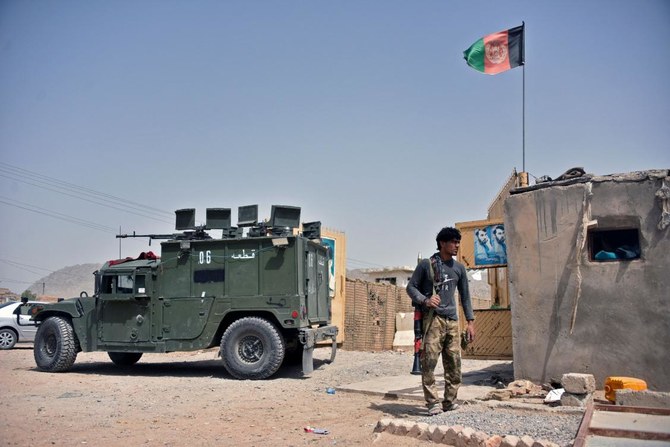
KABUL: Afghan authorities on Tuesday vowed to retake all the districts lost to the Taliban as hundreds of commandos deployed to counter the insurgents’ blistering offensive in the north.
This come after more than 1,000 government troops fled into neighboring Tajikistan.
Fighting has raged across several provinces, but the insurgents have primarily focused on a devastating campaign across the northern countryside, seizing dozens of districts in the past two months.
Last week, all US and NATO forces left Bagram Air Base near Kabul — the command center for anti-Taliban operations — effectively wrapping up their exit after 20 years of military involvement that began in the wake of the September 11 attacks.
“There is war, there is pressure. Sometimes things are working our way. Sometimes they don’t, but we will continue to defend the Afghan people,” National Security Adviser Hamdullah Mohib told reporters.
“We have plans to retake the districts,” he added.
Troops and pro-government militiamen were deployed in the northern provinces of Takhar and Badakshan where the Taliban have captured large swathes of territory at lighting speed, often with little resistance.
Afghan defense officials have said they intend to focus on securing major cities, roads and border towns in the face of the Taliban onslaught, launched as US and NATO troops pressed ahead with their final withdrawal in early May.
The militants’ rapid gains have spurred fears that Afghan forces are facing a spiralling crisis, particularly now vital US air support has been massively curtailed by the handover of Bagram Air Base.
Mohib acknowledged that the Afghan air force was stretched and largely unable to support bases that were in remote districts.
But he said the air force was now being reorganized and would offer the needed back-up support to troops on the ground.
“We had some glitches as a result of the (US) retrograde... (that put) additional pressure on the Afghan air force, he said.
On Monday, more than 1,000 Afghan troops fled into Tajikistan, forcing the neighboring country to bolster the frontier with its own soldiers.
Several hundred Afghan troops had already crossed into the country in recent weeks, in the face of an advancing Taliban.
Tajik President Emomali Rakhmon has ordered “the mobilization of 20,000 reserve troops to further strengthen the border between Tajikistan and Afghanistan,” a statement from the presidency said late on Monday.
“We had to abandon our base because there was no coordination or interest among our commanders to counter the attack,” said Mohammad Musa, a soldier who had fled to Tajikistan after his base in Kunduz province fell to the Taliban last week.
The fighting in the north has also forced Moscow to close its consulate in the city of Mazar-i-Sharif, the capital of Balkh province and one of Afghanistan’s largest urban centers near the border with Uzbekistan.
“The situation is changing rapidly. The Afghan forces, as they say, have abandoned too many districts. This logically creates nervousness,” Moscow’s envoy to Afghanistan Zamir Kabulov told the state-run TASS news agency on Monday.
Mohib said the soldiers who fled were returning and rejoining the security forces.
“They may have abandoned their posts because they ran out of ammunition or they ran out of supplies, but by no means has anyone defected to the Taliban,” he said.
The speed and ease of the Taliban’s effective takeover of swathes of areas in Takhar, Badakhshan and Kunduz represent a massive psychological blow to the Afghan government.
The area once served as the stronghold for the anti-Taliban Northern Alliance during the gruesome civil war in the 1990s and was never routed by the militants.
A psychological war has also been taking shape online.
The Taliban has marshalled its forces on social media, with insurgent-affiliated accounts providing live updates of the fall of districts and posting numerous videos of Afghan soldiers surrendering and handing over weapons caches and equipment to the group.
The Afghan government in turn has been releasing its own footage on social media — mostly grainy black and white videos of airstrikes obliterating alleged Taliban positions, while boasting of inflicting heavy casualties on the jihadist group.
Back on the ground, Afghan commander General Mirassadullah Kohistani, who is now in charge of Bagram Air Base following the US exit last week, put on a brave face when asked about the insurgents rapid advances.
“We are trying to do the best and as much as possible secure and serve all the people,” he said.

Afghan forces vow to retake districts lost to Taliban
Short Url
https://arab.news/gw3ht
Afghan forces vow to retake districts lost to Taliban
- Insurgents have primarily focused on a devastating campaign across the northern countryside
- Afghan defence officials said they intend to focus on securing major cities, roads and border towns in the face of Taliban onslaught
Pakistan combing for perpetrators after deadly separatist attacks
- Around a dozen sites where the attacks took place — including the provincial capital Quetta — remained sealed off
- The Baloch Liberation Army, the province’s most active militant separatist group, claimed responsibility for the attacks
QUETTA, Pakistan: Pakistan forces were hunting on Sunday for the separatists behind a string of coordinated attacks in restive Balochistan province, with the government vowing to retaliate after more than 120 people were killed.
Around a dozen sites where the attacks took place — including the provincial capital Quetta — remained sealed off, with troops combing the area a day after militants stormed banks, jails and military installations, killing at least 18 civilians and 15 security personnel, according to the military’s count.
At least 92 militants were also killed, the military added, while an official said that a deputy district commissioner had been abducted.
Mobile Internet service across the province has been jammed for more than 24 hours, while road traffic is disrupted and train services suspended.
After being rocked by explosions, typically bustling Quetta lay quiet on Sunday, with major roads and businesses deserted, and people staying indoors out of fear.
Shattered metal fragments and mangled vehicles litter some roads.
“Anyone who leaves home has no certainty of returning safe and sound. There is constant fear over whether they will come back unharmed,” Hamdullah, a 39-year-old shopkeeper who goes by one name, said in Quetta.
The Pakistan military said it was conducting “sanitization operations” in the areas that had been targeted in Saturday’s attacks.
“The instigators, perpetrators, facilitators and abettors of these heinous and cowardly act... will be brought to justice,” it said in a statement Saturday night.
The Baloch Liberation Army (BLA), the province’s most active militant separatist group, claimed responsibility for the attacks in a statement sent to AFP.
The group said it had targeted military installations as well as police and civil administration officials in gun attacks and suicide bombings.
Saturday’s attacks came a day after the military said it killed 41 insurgents in two separate operations in the province.
Pakistan has been battling a Baloch separatist insurgency for decades, with frequent armed attacks on security forces, foreign nationals and non-local Pakistanis in the mineral-rich province bordering Afghanistan and Iran.
Pakistan’s poorest province despite an abundance of untapped natural resources, Balochistan lags behind the rest of the country in almost every index, including education, employment and economic development.
Baloch separatists have intensified attacks on Pakistanis from other provinces working in the region in recent years, as well as foreign energy firms that they believe are exploiting its riches.
The separatists attacked a train with 450 passengers on board last year, sparking a two-day siege during which dozens of people were killed.
Around a dozen sites where the attacks took place — including the provincial capital Quetta — remained sealed off, with troops combing the area a day after militants stormed banks, jails and military installations, killing at least 18 civilians and 15 security personnel, according to the military’s count.
At least 92 militants were also killed, the military added, while an official said that a deputy district commissioner had been abducted.
Mobile Internet service across the province has been jammed for more than 24 hours, while road traffic is disrupted and train services suspended.
After being rocked by explosions, typically bustling Quetta lay quiet on Sunday, with major roads and businesses deserted, and people staying indoors out of fear.
Shattered metal fragments and mangled vehicles litter some roads.
“Anyone who leaves home has no certainty of returning safe and sound. There is constant fear over whether they will come back unharmed,” Hamdullah, a 39-year-old shopkeeper who goes by one name, said in Quetta.
The Pakistan military said it was conducting “sanitization operations” in the areas that had been targeted in Saturday’s attacks.
“The instigators, perpetrators, facilitators and abettors of these heinous and cowardly act... will be brought to justice,” it said in a statement Saturday night.
The Baloch Liberation Army (BLA), the province’s most active militant separatist group, claimed responsibility for the attacks in a statement sent to AFP.
The group said it had targeted military installations as well as police and civil administration officials in gun attacks and suicide bombings.
Saturday’s attacks came a day after the military said it killed 41 insurgents in two separate operations in the province.
Pakistan has been battling a Baloch separatist insurgency for decades, with frequent armed attacks on security forces, foreign nationals and non-local Pakistanis in the mineral-rich province bordering Afghanistan and Iran.
Pakistan’s poorest province despite an abundance of untapped natural resources, Balochistan lags behind the rest of the country in almost every index, including education, employment and economic development.
Baloch separatists have intensified attacks on Pakistanis from other provinces working in the region in recent years, as well as foreign energy firms that they believe are exploiting its riches.
The separatists attacked a train with 450 passengers on board last year, sparking a two-day siege during which dozens of people were killed.
© 2026 SAUDI RESEARCH & PUBLISHING COMPANY, All Rights Reserved And subject to Terms of Use Agreement.


