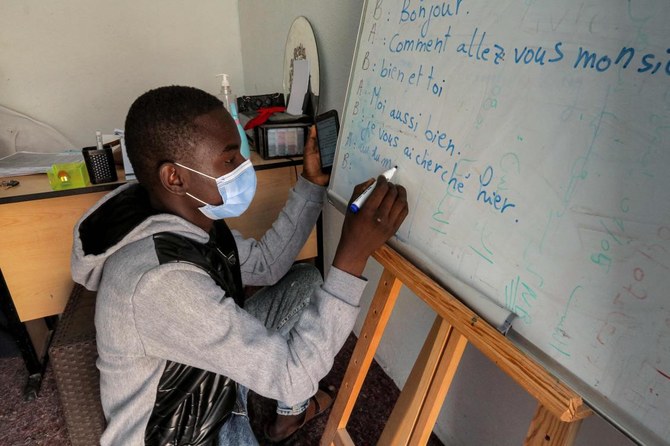
MEDENINE, Tunisia: In the front row of a small classroom, three women, all different nationalities, avidly learn French in southern Tunisia’s stifling summer heat — grateful for support from an umbrella of charities.
Based in the city of Medenine, it’s a rare locally driven opportunity for migrants to better themselves and integrate, in a wider North Africa region that is often far from welcoming.
And despite Tunisia’s own biting economic crisis and the rampant poverty in its under-developed south, local associations have banded together to offer the less fortunate support.
Awa, from Ivory Coast, speaks good French, but wants to learn to read and write in the language.
“I never went to school,” she said, her baby on her knee. “If you cannot read or write, it is as if you live in the dark — you cannot do anything.”
Banished by her family for refusing to marry, she traveled to war-torn Libya in the hope of crossing the Mediterranean to Europe, but was prevented from taking to the sea and detained.
“I was pregnant, and due to give birth,” Awa said, adding that she was told Tunisia “was welcoming because it is not in a state of war.”
That advice brought her to Medenine, where she attends a day center run by the Organization for the Support of Migrants, an initiative by eight Tunisian medical outfits that offers support to mainly female migrants.
“I was welcomed... I am very happy,” Awa added.
Fellow Ivorian Bintou has discovered an inner confidence thanks to sewing lessons offered at the day center.
“I have already sewn beautiful dresses — it’s a job that fascinates me,” she said.
“It inspires me,” she added, noting that she’d wanted to be a tailor even before she left her home country.
Like Awa, Bintou arrived in Tunisia in July last year.
Both are tempted to stay, largely because, as Bintou puts it, “it is peaceful,” even if she sometimes suffers street harassment and racism.
Over the last decade, the number of migrants of sub-Saharan origin arriving in Tunisia has swelled substantially.
They range from foreign workers displaced from Libya --- a country mired in chaos since the 2011 fall of dictator Muammar Qaddafi — to asylum seekers and new immigrants looking for work in Tunisia.
In the last six months alone, 1,000 people who embarked from Libya to Europe have been picked up in Mediterranean waters by Tunisian vessels and ended up in the country, according to the International Organization for Migration.
The danger of that crossing was brought into sharp focus again this weekend, when over 60 migrants disappeared or died as two boats sank in less than 72 hours off Tunisia.
With the country mired in an economic crisis that leaves it unable to meet the needs of its own citizens, migrants are low on the list of political priorities.
Two reception centers managed by UN agencies were established in Medenine in 2014 and 2015, but were quickly overwhelmed.
These limitations prompted the Organization for the Support of Migrants to form and kick into action.
“We felt that things were wrong — we saw migrants begging in the street,” explained Abdallah Said, a Tunisian of Chadian origin whose work as a civil servant in Medenine involves collaboration with the umbrella group.
The organization advises day center attendees on their options and provides them “with time to think about what they want to do” next, Said explained.
“That’s why they feel comfortable.”
The initiative also brings the migrants into contact with Tunisian women.
In the small classroom hosting the French class, Tunisian citizen Fatma hopes to learn French in order to join her brother in France.
The West African migrants help her develop her skills.
“I teach them Arabic and they teach us French,” she said.
The initiative has had some help from the authorities — Medenine municipality provided a building for it to use as its headquarters.
But the area is severely economically deprived, suffering an unemployment rate of nearly 20 percent, and cannot do more, according to municipal mayor Moncef Ben Yemma.
“I don’t even have the funds to build roads,” he lamented.
While there is an inclination to help migrants at the local level, there is resistance at the national level.
Tunisia tolerates irregular migrants, but it is very difficult for such foreign African nationals to legitimize their immigration status.
And Prime Minister Hichem Mechichi has rejected calls by the European Union and others to establish reception centers.
“Tunisia will not be a land of asylum,” he declared in May this year.


Migrants welcomed in Tunisia’s impoverished south
https://arab.news/z58tw
Migrants welcomed in Tunisia’s impoverished south

- Local associations have banded together to offer the less fortunate support
- In the last six months alone, 1,000 people who embarked from Libya to Europe have been picked up in Mediterranean waters by Tunisian vessels


Aoun hails disarmament progress: ‘Lebanon achieved in 1 year what it had not seen in 4 decades’
- President Joseph Aoun highlights achievements during first year in office despite many challenges
- Army announced this month it had successfully disarmed Hezbollah in the south of the country
BEIRUT: Lebanese President Joseph Aoun confirmed on Tuesday that the country’s armed forces “are now the sole operational authority south of the Litani River, despite doubts, accusations of treason, insults and slander.”
Speaking at the Presidential Palace in Baabda during a traditional New Year meeting with members of the diplomatic corps and the heads of international missions, he highlighted what he viewed as Lebanon’s achievements since he took office on Jan. 9, 2025.
The government’s approval in August and September last year of plans to bring all weapons in the country under state control, and ensure the authority of the state across all Lebanese territory using its own forces, was “no minor detail,” he said.
“Lebanon achieved in one year what it had not seen in four decades,” he added, as he recalled taking office in a “deeply wounded state” that has suffered decades of institutional paralysis and economic crises.
Despite campaigns of distortion, intimidation and misinformation, and Israel’s failure to abide by the November 2024 ceasefire agreement, the changed reality on the ground over the past 12 months speaks for itself, he said.
“The truth is what you see, not what you hear,” Aoun said, pointing out that “not a single bullet was fired from Lebanon during my first year in office, except for two specific incidents recorded last March, the perpetrators of which were swiftly arrested by official authorities.”
The army carried out “extensive operations” to clear large areas of the country of illegal weapons regardless of who controlled them, the president continued, in line with the terms of the Nov. 27 ceasefire agreement with Israel, which he described as “an accord Lebanon respects and that was unanimously endorsed by the country’s political forces.”
These efforts reflected a determination to spare the country a return to the “suicidal conflicts that have come at a heavy cost in the past,” he added.
Aoun stressed his commitment during the second year of his presidency to restoring control of all Lebanese territory to the exclusive authority of the state, securing the release of prisoners, and the reconstruction of war-ravaged areas.
He said that southern Lebanon, like all of the country’s international borders, would fall under the sole control of the Lebanese Armed Forces, putting a definitive end to any attempts “to draw us into the conflicts of others, even as those same parties pursue dialogue, negotiations and compromises in pursuit of their own national interests.”
The Lebanese Army Command announced early this month the completion of the first phase of its plans to disarm nonstate groups south of the Litani River. The government is now awaiting an army report next month detailing its next steps.
Gen. Rodolphe Haykal, the army’s commander, has said that the plan “does not have a specific time frame for completing this phase, which encompasses all Lebanese regions.”
A Lebanese official confirmed to Arab News that the army now has exclusive control of territory south of the Litani River, and no other armed forces or military factions have a presence there.
Aoun’s affirmation of his determination to “stay on course” came two days after Hezbollah leader Naim Qassem gave a sharply worded speech that delivered both implicit and explicit rebukes aimed at the president and Foreign Minister Youssef Raji.
His criticisms focused on their efforts to take control of weapons north of the Litani River, following a declaration by Aoun that “the time for arms is over,” a position that Hezbollah vehemently rejects in what appears to be an attempt to derail the gradual, phased disarmament strategy embraced by the Lebanese government and the international community.
Progress in the efforts of the military to take control of all weapons in the country hinges on securing vital logistical support for the country’s armed forces, a condition tied to the International Conference for Supporting the Lebanese Army and Internal Security Forces, which is due to take place on March 5 in Paris.
Aoun told the diplomats that the conference is the result of efforts led by the international Quintet Committee supporting Lebanon: the US, Saudi Arabia, France, Qatar and Egypt.
Archbishop Paolo Borgia, the papal ambassador to Lebanon, speaking in his role as dean of the diplomatic corps, said that the current crisis in the country serves “as a harsh test” that must remind political leaders of their duty to prevent history from repeating itself.
He called for respect for all electoral processes as a vital part of any nation’s democratic life, and for “genuine peace without weapons, one that can disarm enemies through the convincing power of goodness and the strength of meeting and dialogue.”
He added: “Those holding the highest public offices must give special attention to rebuilding political relationships peacefully, both nationally and globally, a process grounded in mutual trust, honest negotiations and faithful adherence to commitments made.”


