



LONDON: If Ons Jabeur had closed her eyes for a few moments after her victory over No.7 seed Iga Swiatek that earned her a maiden ticket to the Wimbledon quarter-finals, the Tunisian would have probably thought she was on the pitch at Esperance’s Olympique de Radès stadium and not on the No.2 Court at the All England Club where her fans were chanting Arabic football songs from back home to celebrate her historic achievement on Monday.
After taking out a Grand Slam champion for a third consecutive round, Jabeur became the first Arab player to reach the last-eight stage at Wimbledon since Egypt’s Ismail El Shafei in 1974, and the first Arab woman to ever achieve that feat.
As chants from the Tunisian fans echoed around the stands, Jabeur urged them to sing louder and was even tempted to join them.
“They were actually singing a football song. I felt the need to sing with them also. I felt so happy that I wanted to hear more. I was doing like this [waving her arms] to hear them,” she said with a smile.
“It gives me a lot of confidence. I appreciate it a lot. I hope they come even more for the next match.”
The next match will take place on Centre Court on Tuesday against Belarusian No.2 seed Aryna Sabalenka and is expected to be a titanic battle and a contrast of game styles.
Should she win, Jabeur would become the first Arab player in Open Era history (since 1968) to reach a Grand Slam semi-final.
The stakes could not be higher for the 26-year-old trailblazer but lucky for her, she got a surprise boost ahead of her quarter-final when she was stopped by Roger Federer in the Wimbledon hallways for a quick congratulatory greeting from the Swiss legend.
“I think now I’m good in my tennis career,” she told the press laughing, implying she was set for life now that her efforts were acknowledged by the 20-time major champion.
“He was very nice. He took the time to say congrats. That inspires me a lot and gives me the hunger to win more.”
Jabeur’s development from a 16-year-old junior winning the Roland Garros girls’ singles title back in 2011, to now standing as the match-wins leader on tour in 2021 and perched at No.8 in the year’s WTA Race to Shenzhen has been a long and winding process.
Growing up, she practiced with boys because there weren’t any girls at her level in Tunisia to train with.
She picked up a unique playing style that mixes finesse with power and aggression, and her creativity on the court was limitless.
But with so much talent on display from a young age, and with the ability to hit every shot in the book, Jabeur struggled during her transition from the juniors to the women’s tour, as she searched for the right formula to combine her strengths and utilize her versatility in an intelligent way.
“Early in my career, after the juniors, when I didn’t see the results that I wanted, when I was seeing the juniors that I played with breaking the top 50, top 40, it was very difficult for me,” reflected Jabeur on Monday as she sat at Wimbledon’s main interview room as the No.21 seed.
“I stayed patient. I finally found what I have to do and be able to stay with a clear head, which helped me a lot to be one of the good athletes right now.”
Finding the right team was key for her development and she mostly travels with her Tunisian coach Issam Jellali and her husband and fitness trainer Karim Kamoun.
Jellali is a tennis geek at heart and is loving every second of his time on tour.
He has immense knowledge of everyone’s game on the circuit and he emanates positivity, which has proven pivotal in Jabeur’s rise.
Kamoun helped his wife with her fitness and is constantly looking for new ways to motivate her.
When rain wreaked havoc with the schedule in Birmingham ahead of Wimbledon, Jabeur won three matches in one day (two singles and one doubles) en route to the title.
It’s fair to say the efforts of the popular couple are paying dividends.
Mentally, Jabeur has come on in leaps and bounds.
Aided by her psychologist Melanie Maillard, she has become one of the grittiest players on tour.
Her performances at Wimbledon are testament to that.
She’s been clutch at key moments, saving 26/33 break points she has faced through four matches (saved 12/15 against Swiatek).
After squandering 24 out of 29 break point opportunities against Muguruza in the third round, Jabeur was a perfect 7/7 on break points on the Swiatek serve on Monday.
One of the many things Jabeur has improved over the course of the past couple of years is her serve, which has become a key component of her arsenal on court.
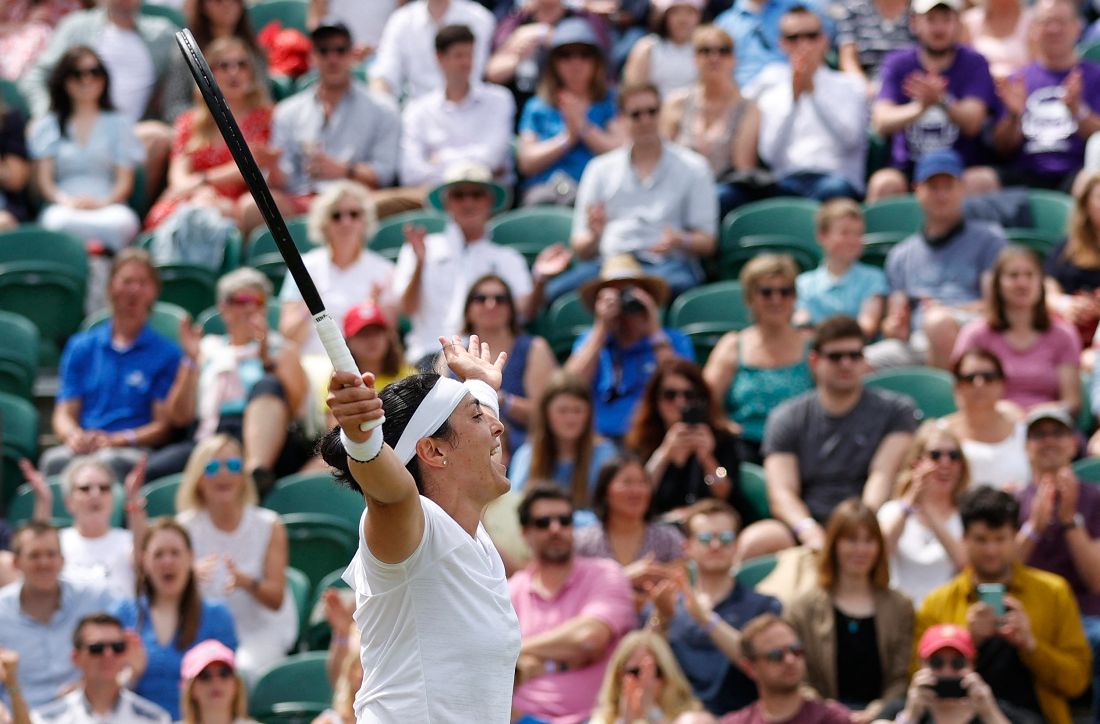
Tunisia’s Ons Jabeur beat Poland's Iga Swiatek in the women’s singles fourth round match on the 7th day of the 2021 Wimbledon Championships. (AFP)
She is in fourth place on the aces leaderboard on the women’s tour in 2021 and she has used her serve to great effect during her run at Wimbledon.
Jabeur has won 76 percent of her first-serve points so far this fortnight, which sees her tied with world No.1 Ashleigh Barty in fourth place for that stats category among the entire women’s field.
The Tunisian has held serve in 84 percent of her service games – the second highest success rate among the eight remaining quarter-finalists.
“I always believed that I could have a good serve. It wasn’t consistent at some time. You have some coaches that could doubt you and tell you that I’m short and I would never serve good. I guess I proved them wrong,” she says with a grin.
Renowned for her vicious drop shots that infuriate her opponents, Jabeur is equally deadly when she rips her forehand, and against Swiatek, she opted for fewer drop shots and instead mixed up the pace with slices from the back of the court while unleashing forehand missiles when possible.
Of the 118 winners she has struck, 48 have come courtesy of her forehand. Jabeur is very comfortable at the net and has won 44/62 (71%) of her net points through her first four matches at SW19.
“I try to have the whole package of having the drop shot, the slices, being aggressive at the same time,” she proudly stated on Monday.
The way Jabeur rebounded from dropping the opening set against Swiatek after blowing a 5-3 lead was remarkable.
The No.21 seed walked off court with a 5-7, 6-1, 6-1 victory and drew high praise from Swiatek after the contest.
“She’s just playing really intelligent tennis. When she’s in and when she gets the ball right, she can play anything. So it was pretty tough,” conceded Swiatek.
“She just has all the skills to play on grass, and that’s great. She can close the net and she’s pretty confident at it. I think she just has a flow, as well. She’s using all the skills that she has. It’s working out well for her.”
Jabeur’s next rival, Sabalenka, is a huge-hitter, who can overwhelm the very best of opposition with her raw power.
They are 1-1 head-to-head in previous meetings against one another.
The Tunisian will be playing her second major quarter-final while Sabalenka will be contesting her first.
“My goal is to break this quarter-final barrier and be able to go to the semi, and why not the final? I’m enjoying my time here in Wimbledon, enjoying the grass a lot,” said Jabeur. She certainly is having a ball. Hopefully the football chants make their way to Centre Court on Tuesday.


