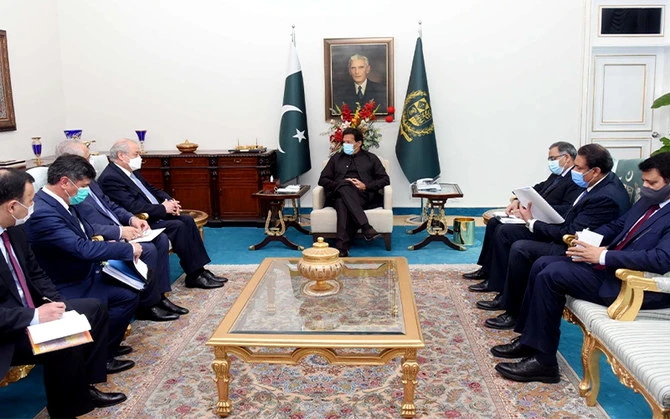
ISLAMABAD: To tap into an over $90 billion Central Asian export market, Pakistan is planning to sign transit and preferential trade agreements (PTA) during Prime Minister Imran Khan’s visit to Uzbekistan later this month to attend the ‘Silk Route Connect’ Conference, Khan’s commerce adviser has said.
The summit, which will take place in Tashkent on July 15-16, was conceived by Pakistan’s commerce ministry earlier this year and is being organized by the Trade Development Authority of Pakistan (TDAP). Khan is expected to leave for Uzbekistan on July 13 or 14.
“During the visit of the prime minister, Pakistan and Uzbekistan will sign a number of agreements, including Transit and PTA,” Abdul Razak Dawood, adviser to the PM on commerce, told Arab News in an exclusive interview in Islamabad, estimating that trade potential for the export of goods between Asian countries and Uzbekistan stood at over $90 billion.
Dawood said signing the PTA would help Pakistan diversify its export market outside of Europe and the United States.
“Pakistani exporters have been concentrating on Europe, UK, America, Japan and Korea but there is a much bigger world so one of our policies is to look at the Central Asia republics and that is why we have selected this ‘Silk Route Reconnect’ theme and we have selected Uzbekistan,” the commerce adviser said. “Uzbekistan is the only country that is connected with all Central Asian countries and they have very good infrastructure.”
Dawood added: “We are hopeful once we begin in Uzbekistan in July 2021 and our businesspeople settle in, we would be able to have more and more exports not only to Uzbekistan but to other Central Asian republics.”
The PM’s aide said Islamabad and Tashkent had agreed to set up warehouses in their respective countries for the facilitation of trade: “Dedicated space in Gwadar and Tashkent would be allocated for setting up warehouses.”
In May this year, the first TIR (Transports Internationaux Routiers/ International Road Transport) vehicle successfully crossed into Pakistan carrying goods from Uzbekistan via Afghanistan.
“After the successful trial of TIR we are planning to increase the flow of goods among the Asian countries”, Dawood said.
The PM’s adviser did not rule out the possibility of Pakistan accessing Moscow through land routes via Central Asian countries where the former Union of Soviet Socialist Republics (USSR) have set up road and railway infrastructure links with Russia.
Pakistani PM to sign agreements in Uzbekistan to tap $90 billion export market — aide
https://arab.news/m3zmp
Pakistani PM to sign agreements in Uzbekistan to tap $90 billion export market — aide
- Khan will be in Tashkent to attend ‘Silk Route Connect’ summit on July 15-16, PM’s commerce adviser says
- Dawood says Pakistan wants to diversify its export market beyond Europe and United States
Pakistan speaker raises concern over Afghan militancy in talks with Iranian delegation
- Ayaz Sadiq met Iran’s deputy speaker a day after a suicide bombing in Islamabad blamed on Afghan-based militants
- Iran offered to mediate between Pakistan and Afghanistan this month following border clashes, failed talks in Istanbul
ISLAMABAD: Pakistan’s National Assembly Speaker Sardar Ayaz Sadiq on Wednesday voiced concern over militant violence emanating from Afghanistan a day after a suicide bombing in Islamabad killed at least 12 people and was blamed by the Pakistani authorities on the proscribed Tehreek-e-Taliban Pakistan (TTP) militant network.
Sadiq’s comments came during a meeting with Iran’s Deputy Speaker Ali Nikzad, who is leading a parliamentary delegation to Islamabad. The Iranian official, whose country also shares a border with Afghanistan, discussed expanding parliamentary and economic cooperation with the National Assembly speaker while addressing regional security challenges.
Pakistan has in recent weeks accused Afghan authorities of harboring militants and facilitating their cross-border attacks on Pakistani security forces and civilians. The tensions triggered border clashes last month, followed by a collapse of peace talks in Istanbul earlier this month that aimed at easing bilateral tensions.
Iran, which maintains relations with both Kabul and Islamabad, subsequently offered to mediate between the two sides.
“Afghanistan’s soil is being used for terrorism in Pakistan,” Sadiq said during his conversation with the Iranian official, according to a statement from the National Assembly Secretariat. “Pakistan remains committed to the complete elimination of terrorism and to resolving conflicts through peaceful means.”
The speaker emphasized that cooperation between Pakistan and Iran was vital for regional peace, describing the two as “brotherly neighbors bound by shared history, religion and culture.”
He also thanked Tehran for its support to Pakistan during a military standoff with India in May and called for unity among Muslim countries in the face of regional crises.
Sadiq condemned Israeli strikes on Iran, noting that Pakistan’s parliament had unanimously passed a resolution denouncing the attacks, and congratulated Iran for its “firm response.”
Nikzad extended condolences over the suicide bombing in Islamabad and praised Pakistan’s “steadfast support” during his country’s war with Israel.
He also noted there were wide-ranging opportunities to expand cooperation between the two countries in multiple sectors.