Australian Grand Prix Formula 1 race canceled in November

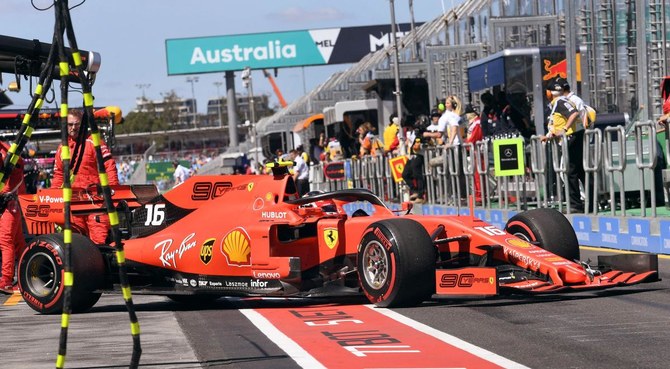
Ferrari’s Monegasque driver Charles Leclerc during the first Formula One practice session in Melbourne ahead of the Formula One Australian Grand Prix on March 15, 2019. (AFP)
Short Url
Updated 06 July 2021
Follow

Australian Grand Prix Formula 1 race canceled in November

  • The race was postponed from its original season-opening spot on the F1 calendar on March 21
  • The Australian Grand Prix Corporation has presented a COVID-safe plan to the Australian government

MELBOURNE: The Australian Grand Prix has been canceled after local organizers and Formula One couldn’t come up with a compromise over Australia’s strict travel and quarantine issues relating to the COVID-19 pandemic.
The race was postponed from its original season-opening spot on the F1 calendar on March 21 and had been rescheduled for Nov. 21.
The 2020 Australian GP at the Albert Park street circuit in Melbourne last March was called off at the last minute at the start of the coronavirus pandemic shutdown.
“It’s very disappointing that these much-loved events can’t proceed but this is the reality of the pandemic, but until we get much higher vaccination rates we cannot return to more normal settings,” Victorian Sports Minister Martin Pakula said in announcing the cancelation.
Victorian state Premier Daniel Andrews all but confirmed its cancelation earlier in the day, saying running such large events is “very challenging” given Australia’s low vaccination rate and international travel restrictions.
“When you’ve halved the number of people coming into the country, when you’ve got 10 percent of people vaccinated when you want and need 70 or 80 percent to have had the jab, we’re not at that point,” Andrews said. “The timing doesn’t quite line up, and that makes it very, very challenging.”
The Australian Grand Prix Corporation presented a COVID-safe plan to the Australian government, suggesting the event could be run safely with the drivers and crews operating within a biosecure bubble.
Formula One already has a race scheduled in Sao Paulo, Brazil for Nov. 7, which left little time for a potential hotel quarantine before the Australian race.


Teen burnout to Olympic gold: Alysa Liu ‘looking to inspire others’

Updated 2 sec ago
Follow

Teen burnout to Olympic gold: Alysa Liu ‘looking to inspire others’

  • Newly crowned Olympic women’s figure skating champion Alysa Liu says she wants her story to “inspire others” after the golden return of a former child prodigy who suffered burnout
MILAN:Newly crowned Olympic women’s figure skating champion Alysa Liu says she wants her story to “inspire others” after the golden return of a former child prodigy who suffered burnout.
Liu stepped away from figure skating aged just 16 years, tired of the endless training and wanting to live the life of a normal teenager.
But she returned to the rink even stronger two years later, and on Thursday night the 20-year-old produced an electrifying performance that put the US women back on top of the Olympic women’s podium for the first time since 2002.
“Honestly, it was more than just work, it was experience,” Liu said after her second gold of the Milan-Cortina Games having helped the US defend their team title.
“The last time I was skating, it was so rough. I genuinely can’t begin to start (talking) on it. It took a lot to get to this point, and studying psychology has really helped. I love psychology.”
The daughter of a Chinese political refugee, Liu started skating at the age of five with her life consumed by the sport as a child.
The Californian won her first senior US title aged 13, landing a rare triple axel jump and breaking Tara Lipinski’s record to become the youngest national champion.
For her first Olympic Games four years ago Liu’s preparation was disrupted by Covid. After testing positive she missed the US trials but was still selected for the Beijing Games where she finished sixth.
The following month, in the absence of Russian skaters she won the bronze medal at the 2022 world championships, giving the United States its first world medal in the women’s event since 2016.
But just a few weeks later Liu announced that she was ending her career, saying she felt she had achieved all her goals in the sport.
Away from competition, she got her driver’s license, enjoyed holidays, went to concerts and experienced something she had not before — a normal teenager’s life.
“Honestly, I didn’t have many people to look up to,” she explained.
“I only really had myself, and I think that’s all I needed. I got ‘alone’ time (during the pandemic). I got to think a lot.
“When Covid hit, that’s when I had my first ‘what to do with myself’ moment. It was like a ‘lightbulb’ moment.
“I was also going through puberty and my brain helped with that process (of understanding herself). A lot has happened in four years.”
Mental health awareness
She began to miss skating and competition and laced up her skates again for the 2024-2025 season.
In her very first year back, she won the world championship title shocking three-time reigning champion Kaori Sakamoto.
For her second Olympic Games, the 20-year-old skater approached things with a “completely different” mindset compared to Beijing.
“This time just feels so completely different. I know who I am as a person now,” she said.
Showing her own style with her streaked “Halo” hairstyle, she opened her competition by winning the team title.
Then, in the individual event, she placed third in the short program, just 2.12 points off the lead.
Two days later, she skated a magnificent free program to the disco sounds of Donna Summer and lit up the Milano Ice Skating Arena.
She gave the United States their first Olympic title in the women’s event since Sarah Hughes in 2002 and first medal since Sasha Cohen’s silver in 2006.
“I have no idea how I am going to deal with it (the fame). I’ll probably wear some wigs when I go outside,” she laughed.
“I think my story’s more important than anything to me and that’s what I hold dear and this journey has been incredible.
“I hope with all this attention I can raise awareness about mental health in sports, and mental health more generally.
“I think my story is very cool. Hopefully, I can inspire some people.
“All I want in my life is human connection and, damn, now I am connected with a hell of a ton of people.”