

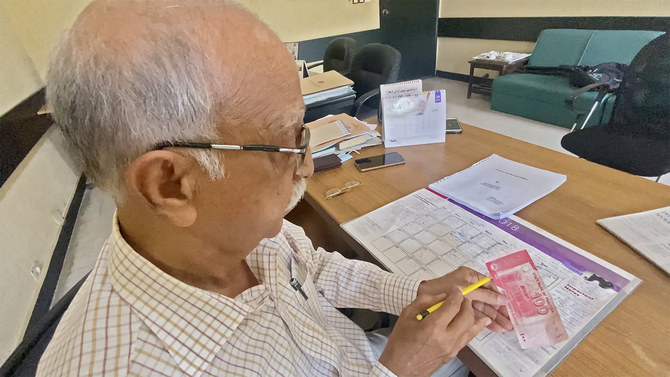

KARACHI: Eight years ago, Muhammad Mohsin noticed what he says are mistakes on the Pakistani 100-rupee note: the title of the country’s founder Muhammad Ali Jinnah was misspelt, he said, and Ziarat city in the southern Balochistan province was misidentified as being located in Quetta, the provincial capital.
Fixing the “blunder,” as Mohsin calls it, has since become the septuagenarian’s lifelong goal.
“There's a picture of the Ziarat residency [on the 100-rupee note] ... and it is written 'Quaid-e-Azam Residency, Ziarat-Quetta'," Mohsin told Arab News in a recent interview.
Ziarat city is located some 130 kilometers from Quetta and is home to the famous Quaid-e-Azam Residency where Jinnah spent the last two months before his death.
"Ziarat doesn’t fall within the geographical jurisdiction of Quetta," Mohsin said. "It is a separate district.”
Mohsin also says the grammatical particle in Urdu that links two words together should be spelled in the Latin script as “i” instead of “e.”
"Being a senior citizen, it is a very painful for me that we don't know the correct spelling of Quaid-e-Azam," he added.
Pakistan’s English-language daily Dawn, founded by Jinnah, spells the founding father’s name with an "i", Mohsin added, pointing to Dawn's masthead which reads: "Founded by Quaid-i-Azam Mohammad Ali Jinnah."
The Quaid-e-Azam Residency has appeared on the 100-rupee note since 2006 when new designs for the 100 and 50 rupee banknotes were launched by the central bank.
Almost ten years later, in September 2016, Mohsin wrote a letter to then central bank governor, Ashraf Mahmood Wathra, to draw his attention to the 'mistakes'. Wathra never responded.
Mohsin then wrote a second letter, this time to then finance minister Ishaq Dar, but did not receive a response.
As the years rolled by and new central bank governors took office and put their signatures on the 100-rupee note, Mohsin has continued with his petitions. No one has ever replied.
In a written statement to Arab News, Abid Qamar, the chief spokesperson for the Pakistani central bank, explained that Quaid-e-Azam was a compound word that in Urdu could be written with both the letters “e” and “i.”
He pointed to several instances where, like the 100 -rupee note, Jinnah's title was spelt with an “e”: “Quaid-e-Azam University Act 1973 … Quaid-e-Azam page on pakistan.gov.pk; Quaid-e-Azam college of commerce, University of Peshawar.”
On the point about Ziarat-Quetta, the spokesperson explained that the reverse side of SBP-issued banknotes carried pictures of national monuments and to place them in geographical context, “their locations are identified specifically as well as generally with reference to the nearest city/town already known to the public.”
“As most of such monuments are located in provincial or federal capitals, such as Faisal Mosque-Islamabad, Islamia College-Peshawar and Badshahi Mosque-Lahore, their specific and general location converge at the same place, which sometimes creates an impression, as if specific identification of the location is the policy in this area,” Qamar said.
“Where such monuments are located in places other than provincial or federal capital, specific and general reference for identification of location of the monument is the practice. For example, banknote of Rs. 20 carries the picture of the remains of Indus Valley Civilization, the geographic location of which has been specifically identifying Mohan Jo Daro, as well as generally by reference it to the nearest well-known town, Larkana.”
He added with regards to the 100-rupee note:
“The word Ziarat is identifying a specific location of the residency, whereas Quetta being the nearest well known place, is providing the geographic context to the audience. The SBP practice of describing national monuments on its banknotes should be examined holistically rather than individually by isolating a single denomination.”
Talk show host and journalist Zarrar Khuhro, who works at Dawn, said there were no official or standardized English spellings for many Urdu words used in English copy, even at the newspaper founded by Jinnah.
"We are taking an Urdu term and we are transcribing it into English, so it would be best if there was standardization,” he said. “'Quaid' can be spelt in a number of different ways as well.”
But he said the identification of Ziarat with Quetta on the 100-rupee note was incorrect.
“I'm amazed that no one has ever thought of this before," Khuhro said. "I have to salute this gentleman that he actually noticed this, and he took it as important enough to make an issue out of it."


