Pakistan accepts ‘China’s version’ on Xinjiang’s Uyghur Muslims — PM Khan

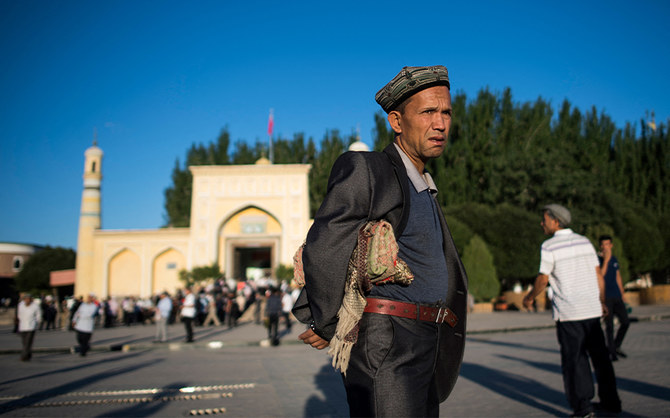
A Muslim man carrying a prayer rug as he arrives at a mosque for the morning prayer in the old town of Kashgar in China's Xinjiang on June 26, 2017. (AFP/File)
Short Url
Updated 02 July 2021
Follow

Pakistan accepts ‘China’s version’ on Xinjiang’s Uyghur Muslims — PM Khan

  • This is the first time a Pakistani prime minister has publicly endorsed Beijing’s narrative on the issue
  • International rights groups have demanded UN investigation into the alleged persecution of Muslims in China’s northwest region

ISLAMABAD: Prime Minister Imran Khan on Thursday endorsed the Chinese version regarding Xinjiang’s 1.5 million Uyghur Muslims who have been allegedly facing stern human rights violations on a massive scale.
In an interaction with Chinese journalists, Khan observed that Beijing’s version on the issue was completely opposite to “what we hear from the western media and western governments.”
“Because we have a very strong relationship with China and because we have a relationship based on trust, we actually accept the Chinese version,” the prime minister said.
He noted that there were “much worse human rights issues” in the world that were not raised by the international press while referring to the situation in Indian-administered Kashmir.
“And we hear about Xinjiang and Hong Kong which is a bit hypocritical,” he continued.
Human Rights Watch, an international non-governmental organization, claimed in one of its reports earlier this year that about a million Muslims in Xinjiang had been “arbitrarily detained in 300 to 400 facilities” that included “’political education’ camps, pretrial detention centers, and prisons.”
“Given the gravity of the abuses against Turkic Muslims, there is a pressing need for concerned governments to take strong, coordinated action to advance accountability,” the HRW said while recommending a UN inquiry into the alleged rights abuses against the Uyghur community.
Last month, the prime minister refused to acknowledge reports about Uyghur Muslims during an interview with Axios on HBO channel, saying: “Whatever issues we have with the Chinese, we speak to them behind closed doors.”
“China has been one of the greatest friends to us in our most difficult times,” he maintained. “When we were really struggling, our economy was struggling, China came to our rescue. So, we respect the way they are.”
This is the first time, however, Khan has publicly endorsed the Chinses version on Xinjiang.
Last October, Pakistan’s National Security Advisory Dr. Moeed Yusuf told an Indian journalist Karan Thapar that Islamabad was not worried about the situation in Xinjiang.
“We are 100 percent satisfied it is a non-issue,” he told the interviewer. “The West can say what it wants. I can say to you as a responsible official that we know everything about Uighurs and it is a non-issue.”
Pakistan and China are celebrating 70 years of their diplomatic relations this year.


Pakistan says IMF has not imposed new conditions under $7 billion bailout

Updated 4 sec ago
Follow

Pakistan says IMF has not imposed new conditions under $7 billion bailout

  • Finance ministry says measures cited as ‘new conditions’ are phased extensions of reforms already agreed
  • Media described steps like civil servants’ asset disclosures and sugar industry deregulation as new demands

ISLAMABAD: Pakistan said on Sunday some of the reform measures mentioned in the media and linked to the International Monetary Fund (IMF) bailout program are not “new conditions” imposed by the lender but extensions of commitments already agreed under the arrangement.

Local media and social platforms have described a series of IMF-linked structural benchmarks as fresh conditions under the $7 billion loan for Pakistan in recent weeks. News reports published and broadcast in India also mentioned 11 measures under the loan, describing them as new IMF demands imposed on the country.

“The Ministry of Finance has clarified the intent, context, and continuity of reform measures under Pakistan’s IMF Extended Fund Facility (EFF) program, particularly in response to recent commentary regarding so-called ‘new conditions,’” said an official statement circulated in Islamabad.

“The purpose is to reaffirm that the measures referenced are part of a phased, medium-term reform agenda agreed with the IMF, many of which are extensions or logical progressions of reforms already initiated by the Government of Pakistan,” it added.

The ministry said the EFF is designed to support medium-term structural reforms implemented in a sequenced manner, with each program review building on prior actions to meet policy objectives agreed at the outset.

It provided detailed clarification on 11 measures that had been characterized as new conditions, including public disclosure of asset declarations of civil servants, strengthening the operational effectiveness of the National Accountability Bureau, empowering provincial anti-corruption bodies through access to financial intelligence and facilitating foreign remittances.

Other measures cited included the development of the local currency bond market, deregulation of the sugar industry, a comprehensive reform roadmap for the Federal Board of Revenue, a medium-term tax reform strategy, phased privatization of power distribution companies, regulatory reforms to strengthen corporate compliance and contingency measures to address potential revenue shortfalls.

The ministry said several of these reforms had been embedded in the Memorandum of Economic and Financial Policies (MEFP), a document detailing mutually agreed commitments, dating back to May 2024 and March 2025, including pledges related to tax policy, governance, energy sector restructuring and revenue mobilization.

“During discussions and negotiations with the IMF, the Government of Pakistan presents its planned policy reform initiatives,” the statement added. “Where the IMF assesses that these initiatives contribute to the agreed program objectives, they are incorporated into the MEFP.”

“As a result,” it continued, “many of the structural benchmarks and actions included in the latest MEFP are derived from reforms already undertaken or initiated by the Government of Pakistan, rather than being externally imposed or newly introduced conditions.”

The statement noted the measures outlined in the latest MEFP represent “continuity, sequencing and deepening of Pakistan’s agreed reform agenda” under the IMF loan, rather than the “imposition of abrupt or unprecedented conditions.”