Former US Defense Secretary Donald Rumsfeld passes away aged 88

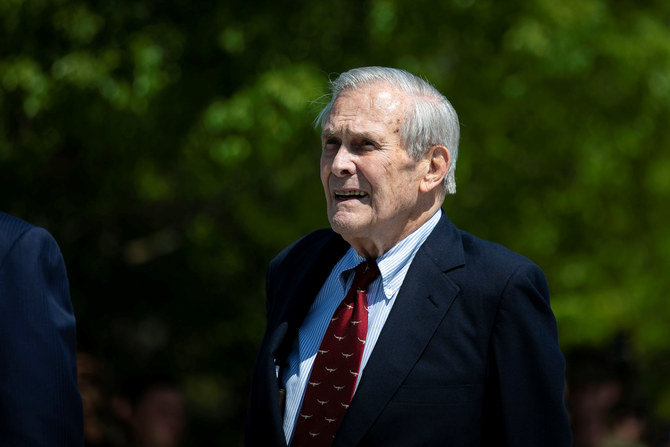
Donald Rumsfeld had a storied career in government under four presidents and nearly a quarter century in corporate America. (Reuters/File Photo)
Short Url
Updated 30 June 2021
Follow

Former US Defense Secretary Donald Rumsfeld passes away aged 88

  • Made a brief run for the 1988 Republican presidential nomination
  • Twice offered his resignation to President George W. Bush in 2004

WASHINGTON: Donald Rumsfeld, the two-time defense secretary and one-time presidential candidate whose reputation as a skilled bureaucrat and visionary of a modern US military was unraveled by the long and costly Iraq war, died Tuesday. He was 88.

In a statement Wednesday, Rumsfeld’s family said he “was surrounded by family in his beloved Taos, New Mexico.”

Regarded by former colleagues as equally smart and combative, patriotic and politically cunning, Rumsfeld had a storied career in government under four presidents and nearly a quarter century in corporate America.

After retiring in 2008 he headed the Rumsfeld Foundation to promote public service and to work with charities that provide services and support for military families and wounded veterans.

“Rummy,” as he was often called, was ambitious, witty, energetic, engaging and capable of great personal warmth. But he irritated many with his confrontational style. An accomplished wrestler in college, Rumsfeld relished verbal sparring and elevated it to an art form; a biting humor was a favorite weapon.

Still, he built a network of loyalists who admired his work ethic, intelligence and impatience with all who failed to share his sense of urgency.

Rumsfeld is the only person to serve twice as Pentagon chief. The first time, in 1975-77, he was the youngest ever. The next time, in 2001-06, he was the oldest.

He made a brief run for the 1988 Republican presidential nomination, a spectacular flop that he once described as humbling for a man used to success at the highest levels of the government, including stints as White House chief of staff, US ambassador and member of Congress.

For all Rumsfeld’s achievements, it was the setbacks in Iraq in the twilight of his career that will likely etch the most vivid features of his legacy.

Nine months into his second tour as defense secretary, on Sept. 11, 2001, suicide hijackers attacked the World Trade Center in New York and the Pentagon, thrusting the nation into wars for which the military was ill-prepared. Rumsfeld oversaw the US invasion of Afghanistan and toppling of the Taliban regime. Frequently presiding at televised briefings on the war, Rumsfeld became something of a TV star, applauded for his blunt talk and uncompromising style.

By 2002 the Bush administration’s attention shifted to Iraq, which played no role in the Sept. 11 attacks. The war effort in Afghanistan took a back seat to Iraq, opening the way for the Taliban to make a comeback and prevent the US from sealing the success of its initial invasion.

The US-led invasion of Iraq was launched in March 2003. Baghdad fell quickly, but US and allied forces soon became consumed with a violent insurgency. Critics faulted Rumsfeld for dismissing the pre-invasion assessment of the Army’s top general, Eric Shinseki, that several hundred thousand allied troops would be needed to stabilize Iraq.

Rumsfeld twice offered his resignation to President George W. Bush in 2004 amid disclosures that US troops had abused detainees at Iraq’s Abu Ghraib prison — an episode he later referred to as his darkest hour as defense secretary.

Not until November 2006, after Democrats gained control of Congress by riding a wave of antiwar sentiment, did Bush finally decide Rumsfeld had to go. He left office in December, replaced by Robert Gates.

Rumsfeld is survived by his wife, Joyce, three children and seven grandchildren.

Desert Storm: 30 years on
The end of the Gulf War on Feb. 28, 1991 saw the eviction of Iraq from Kuwait but paved the way for decades of conflict

Enter


keywords

Human rights situation in Colombia is backsliding, UN warns as nation heads into elections

Updated 2 sec ago
Follow

Human rights situation in Colombia is backsliding, UN warns as nation heads into elections

The annual report on Colombia’s human rights situation highlights a surge in attacks on rural communities by rebel groups and drug traffickers
Murders of human rights defenders increased by 9 percent last year

BOGOTA: Colombia is at risk of “reverting to the serious human rights situation” it faced before a peace deal with the nation’s largest rebel group improved security conditions, the United Nations warned Thursday, adding that an uptick of violence in rural areas could also “undermine” the nation’s upcoming elections.
The annual report on Colombia’s human rights situation highlights a surge in attacks on rural communities by rebel groups and drug traffickers as they fight over territory abandoned by the Revolutionary Armed Forces of Colombia following their 2016 peace deal with Colombia’s government.
According to the report, the number of people displaced by violence in Colombia increased by 85 percent in 2025 from the year before, with approximately 94,000 people forced to flee their homes.
Murders of human rights defenders increased by 9 percent last year alongside a 12 percent increase in the number of lockdowns imposed by armed groups on rural communities. During the lockdowns, villagers are banned from hunting or tending to their farms. Schools and businesses are also forced to shut down in small towns, disrupting the livelihoods of civilians.
“This report is an early warning,” said Scott Campbell, the Colombia representative for the United Nations High Commissioner for Human Rights. “There are a number of indicators that we are trying to draw attention to in order to prevent further degradation” of the human rights situation in Colombia.
While human rights violations in Colombia are not as numerous as they were at the height of the nation’s conflict with the FARC rebels — when an average of 300,000 people were displaced by violence each year — the report says that Colombia’s government has to take firmer actions to protect civilians from illegal groups.
One problem that persists is the forced recruitment of children by rebel groups that now use social media platforms to lure kids into their ranks.
Although the UN confirmed 150 cases of forced recruitment in 2025, the report notes this is likely an undercount, because many families are afraid to denounce these cases for fear of retaliation.
The administration of left-wing President Gustavo Petro, a former member of Colombia’s M-19 guerrilla group, has tried to reduce violence in Colombia by staging peace negotiations with the nation’s remaining rebel groups under a strategy known as “total peace.”
But often, the report notes, ceasefires between the Colombian government and rebel groups have failed to reduce attacks on civilians.
“We think it is very important that the government push for remedies to that,” Campbell said.
As Colombia prepares for upcoming elections, the report warns of a risky environment for political candidates. Last year alone, there were 18 murders of political leaders in Colombia and 126 attacks against them.
In June, conservative presidential hopeful Miguel Uribe was shot in the head during a rally in Bogota, marking the first attack against a Colombian presidential candidate in three decades. Uribe died from his injuries two months later.
“Violence and conflict, including the emergence of pre-electoral violence, have generated greater risks for the free and safe exercise of certain civil and political rights” the report said.
On March 8, Colombia will elect a new Senate and House of Representatives, with candidates competing to fill more than 300 congressional seats.
That will be followed up by a presidential election in May, in which at least half a dozen candidates are expected to run.
To improve the human rights situation in Colombia, the report said that the next administration must focus on the full implementation of the 2016 peace pact with FARC rebels.
While some parts of the deal have been implemented — including the FARC’s disarmament and the creation of a transitional justice system — others remain unfulfilled.
One of those is the creation of an agrarian jurisdiction to resolve conflicts over land. Schemes that could lure farmers away from growing coca, the base ingredient for cocaine, also require further implementation.
“It’s crucially important at this juncture ahead of elections to make sure that the current government and the future government take concrete actions to make sure that Colombia moves forward,” Campbell said.
He added that the 2016 peace deal provides a “road map” to a “Colombia of sustainable peace and respect for human rights.”