

Top Pakistani minister laments ‘judicial activism’ as court bans TikTok for third time

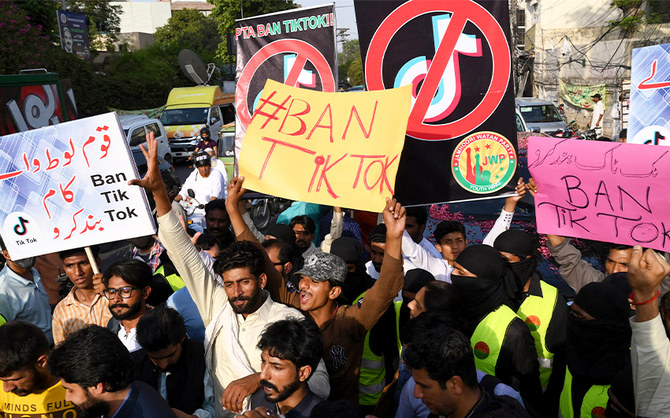
Activists carry placards during a protest to demand the ban of TikTok social media, in Lahore, Pakistan, on June 18, 2021. (AFP/File)
Short Url
Updated 02 August 2021
Follow

Top Pakistani minister laments ‘judicial activism’ as court bans TikTok for third time

  • If judicial reforms not carried out, Pakistan will never escape “economic crisis,” information minister says
  • Sindh High Court on Monday ordered telecoms regulator to suspend the application immediately

ISLAMABAD: Pakistan’s information minister Chaudhry Fawad Hussain on Wednesday said the country would never escape the “economic crisis” it was facing if judicial reforms were not carried out, slamming a decision this week by a provincial high court to ban social media app TikTok.
The Sindh High Court on Monday ordered the Pakistan Telecommunication Authority to suspend the application immediately for “spreading immorality.” The next hearing in the case is on July 8. 
“Since yesterday my head is spinning after reading the court verdict on the ban on Tiktok,” Hussain wrote on Twitter. 
“If judicial reforms are not carried out, the country will never be able to get out of the economic crisis … Already the country is suffering billions of dollars in losses at the hands of such judicial activism.”

Government functionaries usually restrain from commenting on court orders.
TikTok has been banned in Pakistan twice before over “immoral content.”
On March 11, the Peshawar High Court had ordered the app be blocked in the country based on a petition alleging it had obscene content. 
Last October, PTA blocked TikTok for similar reasons, but after 10 days it reversed its decision saying the company’s owners, China-based ByteDance, had agreed to moderate content in Pakistan.


Nearly 25% of Pakistan’s primary schools enrolling girls operate as single-teacher ones— report

Updated 13 sec ago
Follow

Nearly 25% of Pakistan’s primary schools enrolling girls operate as single-teacher ones— report

  • Pakistan needs over 115,000 more teachers in primary schools enrolling girls to meet global benchmark of one teacher per 30 students, says report
  • Sixty percent of Pakistani primary schools enrolling girls are overcrowded, while 32% lack clean drinking water or toilets, says Tabadlab report

ISLAMABAD: Nearly 25% of Pakistan’s primary schools that enrolls girls operate as single-teacher ones, a report by a leading think tank said this week, calling on the government to devolve teacher recruitment powers, upskill underutilized teachers and introduce reforms to hire and promote faculty members. 

Pakistan faces an acute education crisis which is reflected in the fact that it has the world’s second-highest number of out-of-school children, an estimated 22.8 million aged 5-16 who are not in educational institutions, according to UNICEF. 

While poverty remains the biggest factor keeping children out of classrooms, Pakistan’s education crisis is exacerbated by inadequate infrastructure and underqualified teachers, cultural barriers and the impacts of frequently occurring natural disasters. 

According to “The Missing Ustaani,” a report published by Islamabad-based think tank Tabadlab and supported by Malala Fund and the Pakistan Institute of Education (PIE), Pakistan needs over 115,000 more teachers in primary schools with girls’ enrolment to meet the basic international benchmark of ensuring one teacher per 30 children. Currently, the average Student-to-Teacher Ratio (STR) across Pakistan’s primary schools with girls’ enrolment is 39:1, it said. 

“Approximately 60% of these schools are overcrowded, necessitating the recruitment of over 115,000 additional teachers nationwide,” the report said on Monday. “Compounding this, nearly 25% of primary schools with girls’ enrolment operate as single-teacher schools, placing immense pressure on the quality of education.”

It said the situation is more dire in Pakistan’s poverty-stricken southwestern Balochistan province, where nearly 52% of the schools are single-teacher only ones while the percentage decreases slightly in the southern Sindh province to 51 percent. 

The report said while the STR improves to 25:1 at the middle school level, acute shortages of subject specialists emerge as the top-priority concern for quality education in these schools.

“Furthermore, around 32% of primary schools with girls’ enrolment and 18% of middle schools face ‘critical infrastructural shortages’— lacking clean drinking water or toilets in addition to high STRs— which significantly affects girls’ attendance and learning, particularly during adolescence,” the report said. 

The report cited a set of priority recommendations to address Pakistan’s systemic teacher deployment challenges and improve educational equity for girls. 

It urged the government to devolve recruitment authority to school or cluster levels to enable timely, context-specific hiring. It also called upon authorities to reform teacher transfer and promotion policies to introduce school-specific postings with minimum service terms. 

This, it said, would reduce arbitrary transfers and improving continuity in classrooms. The report advised authorities to upskill surplus or underutilized primary teachers to support instruction at the middle school level, helping address subject-specialist shortages.

“Together, these reforms offer a pathway toward a more equitable, efficient, and responsive teaching workforce— one capable of improving learning outcomes and ensuring that every girl in Pakistan has access to a qualified teacher,” the report said. 

To tackle Pakistan’s education crisis, Prime Minister Shehbaz Sharif declared an ‘education emeregency’ in September 2024, stressing the importance of education for all.