ROME: As the US works on its military withdrawal from Afghanistan, members of the global coalition fighting the Daesh group met Monday to plot future steps against the extremist group.
The meeting came just a day after the US launched airstrikes against Iran-backed militias near the Iraq-Syria border.
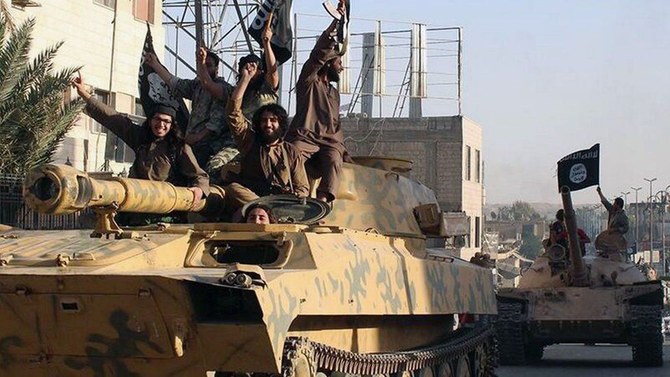
US Secretary of State Antony Blinken and Italian Foreign Minister Luigi Di Maio were co-chairing the gathering of senior officials from the seven-year-old, 83-member bloc. Participants were taking stock of their current efforts to ensure the complete defeat of IS, whose remnants still pose a threat in Iraq and Syria and have shown signs of surging in parts of Africa.
Amid significant other international priorities, including taming the coronavirus pandemic and stepping up the fight against climate change, the coalition is hoping to stabilize areas liberated from IS, repatriate and hold foreign fighters accountable for their actions and combat extremist messaging.
Blinken and Di Maio urged representatives of the 77 other countries and five organizations that make up the coalition not to drop their guard despite the destruction of the extremist group’s hold over broad swaths of territory in Iraq and Syria.
“Daesh can still be a threat and attract support,” Di Maio said. He appealed for special attention to be paid to Africa, notably in the Sahel region, where IS is gaining traction and called for the coalition to create a special mechanism to deal with that threat.
Blinken noted that despite their defeat, IS elements in Iraq and Syria “still aspire to conduct large-scale attacks.”
“Together, we must stay as committed to our stabilization goals as we did to our military campaign that resulted in victory on the battlefield,” he said.
Blinken announced a new US contribution of $436 million to assist displaced people in Syria and surrounding countries and called for a new effort to repatriate and rehabilitate or prosecute some 10,000 IS fighters who remain imprisoned by the Syrian Defense Forces.
“This situation is simply untenable,” Blinken said. “It just can’t persist indefinitely.”
He also announced sanctions against Ousmane Illiassou Djibo, a native of Niger, who is a key leader of the Daesh affiliate in the greater Sahara. Djibo was designated a global terrorist, meaning that any assets he may have in the US are frozen and Americans are barred from any transactions with him.
Monday’s meeting was the first the coalition has had at a senior level that has been held in-person since the COVID-19 pandemic began.
In addition to the meeting on IS, foreign ministers of countries concerned with the broader conflict in Syria were to meet in Rome on Monday ahead of a critical vote at the United Nations on whether to maintain a humanitarian aid corridor from Turkey. Russia has resisted reauthorizing the channel amid stalled peace talks between the Syrian government and rebel groups.
Last week, the UN special envoy for Syria, Geir Pederson, said there were worrying signs that Daesh may be getting stronger in the country and called for a boost in cooperation to counter it. Pederson has also joined calls for new international talks on ending Syria’s civil war.
Since the Syrian conflict erupted in March 2011, numerous high-level gatherings aimed at ending the fighting and guiding the country to a political transition have failed to have any lasting impact.
The UN, US, Russia and many other countries support a December 2015 Security Council resolution endorsing a road map to peace in Syria that calls for a new constitution followed by UN-supervised elections.


![]()

Nations chart future steps against Daesh extremists
Short Url
https://arab.news/6x59a
Nations chart future steps against Daesh extremists
- US Secretary of State Antony Blinken noted that despite their defeat, Daesh elements in Iraq and Syria “still aspire to conduct large-scale attacks"

Latest updates


Recommended


© 2026 SAUDI RESEARCH & PUBLISHING COMPANY, All Rights Reserved And subject to Terms of Use Agreement.