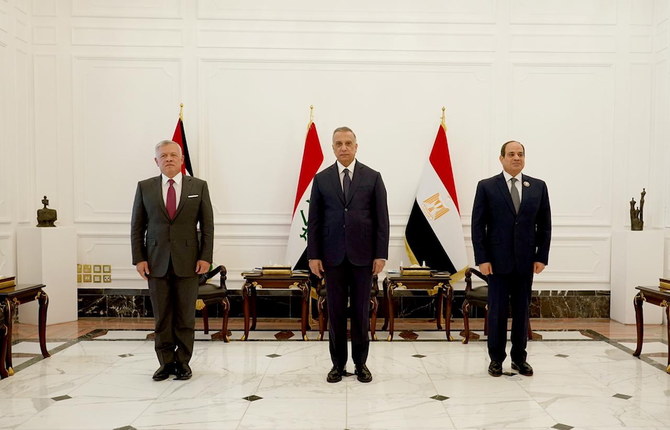
BAGHDAD/CAIRO: Egypt, Jordan and Iraq agreed to bolster security and economic cooperation at a tripartite summit Sunday that saw an Egyptian head of state visit Iraq for the first time in three decades.
The visits by Egypt’s President Abdel Fattah El-Sisi and Jordan’s King Abdullah II came as Iraq seeks to move closer to Arab allies of the United States in the Middle East.
In recent years, Iraq had signed cooperation deals in the energy, health and education sectors with both countries.
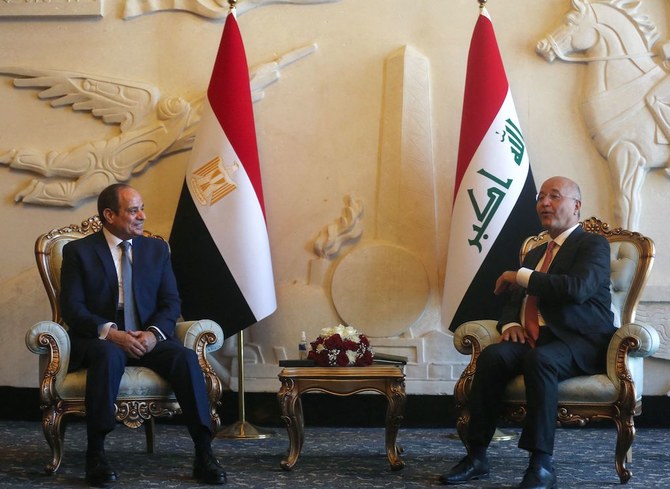
El-Sisi and Abdullah met Iraqi President Barham Saleh and Prime Minister Mustafa Al-Kadhimi, with Saleh saying the encounter was “an eloquent message amid enormous regional challenges.”
“Iraq’s recovery paves the way to an integrated system for our region built on the fight against extremism, respect for sovereignty and economic partnership,” Saleh said on Twitter.
The summit held between Kadhimi and his guests broached regional issues, as well as ways of bolstering cooperation between Iraq, Jordan and Egypt in the fields of security and intelligence, energy, trade, drug trafficking and cybercrime, according to a joint statement released at the end of the meeting.
“This visit is an important message to our people that we are mutually supportive and unified to serve our people and the people of the region,” Al-Kadhimi said, according to a statement from his office.
Iraqi Foreign Minister Fuad Hussein said in a press conference following the meeting that a wide range of topics had been discussed, including economic and political cooperation, large-scale industrial projects, and trade in medicine and agricultural pesticides.
The leaders discussed a “political solution” to Syria’s 10-year civil war based on UN resolutions “that would preserve its security and stability and provide adequate conditions for the return of refugees.”
The Syria conflict has killed hundreds of thousands and displaced millions, with refugee flooding the borders of neighboring countries including Jordan, which lacks in resources and faces economic hardships.
The leaders welcomed efforts underway to restore stability in Libya and Yemen, and called for the departure of foreign forces and mercenaries from Libya.
They called for renewed efforts to reach a “just and comprehensive peace” between Israel and the Palestinians, and for the creation of an independent Palestinian state.
They also hailed Egypt’s role in negotiating an end to deadly hostilities between Israel and the Gaza Strip’s Islamist rulers Hamas in May, and Cairo’s pledge to help rebuild the coastal enclave.
Ethiopia’s Grand Renaissance Dam project, which Egypt fears will imperil its water supply, was also discussed with Iraq and Jordan siding with Cairo, he added, and all three countries agreed that a political solution and the return of refugees was needed to end the Syrian crisis, said Jordan’s Foreign Minister Ayman Safadi.
“The message from the leaders is we stand together in the face of these challenges,” he said.
Kadhimi had set the tone at the start of the summit, saying the three countries would “try to shape a common vision... through cooperation and coordination” regarding Syria, Libya, Yemen and Palestine.
The Egyptian presidency said in a statement that “the leaders stressed the need to intensify consultation and coordination between the three countries on the most important regional issues.”
They also highlighted the importance of re-opening borders to encourage more trade in light of the economic crises brought on by the coronavirus pandemic.
“Iraq must be isolated from regional interventions,” Jordan’s Foreign Minister Ayman Safadi told reporters after the meeting, in an apparent reference to Iran’s powerful influence.
El-Sisi is the first Egyptian president to visit Baghdad since Iraqi dictator Saddam Hussein’s troops invaded Kuwait in 1990.
Relations between Baghdad and Cairo have improved in recent years, and officials from the two countries have conducted visits.
Kadhimi, El-Sisi and Abdullah held a summit in Amman last year and were due to hold another in Baghdad in April, but this was delayed after a deadly train crash in Egypt.
Egypt signed 15 deals and memoranda of understanding in sectors including oil, roads, housing, construction and trade in February after Iraq’s cabinet in December approved renewing its contract to supply the Egyptian General Petroleum Corporation (EGPC) with 12 million barrels of Basra light crude for 2021.
Iraq is also planning to build a pipeline that is meant to export 1 million barrels per day of Iraqi crude from the southern city of Basra to Jordan’s Red Sea port of Aqaba.
The Jordanian king visited in early 2019 for the first time in 10 years.
Iraqi analyst Ihsan Al-Shamari said that Sunday’s summit was “a message for the United States that Iraq will not only have relations with Iran at the expense of Arab countries.”
Analysts have long said that Iraq is a battleground for influence between arch-foes Washington and Tehran with whom it maintains good relations.
(With AFP, AP and Reuters)

Iraq, Egypt and Jordan hold tripartite summit in Baghdad
Short Url
https://arab.news/gtyad
Iraq, Egypt and Jordan hold tripartite summit in Baghdad
- Kadhimi said the three countries would 'try to shape a common vision... through cooperation and coordination' regarding Syria, Libya, Yemen and Palestine
- Ethiopia’s Grand Renaissance Dam project, which Egypt fears will imperil its water supply, was also discussed with Iraq and Jordan siding with Cairo
UN makes first visit to Sudan’s El-Fasher since its fall, finding dire conditions
- Paramilitary force overran the city in October committing widespread atrocities
- UN team visited Saudi Hospital where RSF massacred hundreds of people
CAIRO: A UN humanitarian team visited El-Fasher in Sudan’s Darfur region for the first time since a paramilitary force overran the city in October, carrying out a rampage that is believed to have killed hundreds of people and sent most of the population fleeing.
The hours-long visit gave the UN its first glimpse into the city, which remains under control of the Rapid Support Forces. The team found hundreds of people still living there, lacking adequate access to food, medical supplies and proper shelter, the UN said Wednesday.
“It was a tense mission because we’re going into what we don’t know … into a massive crime scene,” Denise Brown, the UN humanitarian coordinator for Sudan, said of Friday’s visit.
For the past two months, El-Fasher has been nearly entirely cut off from the outside world, leaving aid groups unsure over how many people remained there and their situation. The death toll from the RSF takeover, which came after a more than a year-long siege, remains unknown.
Survivors among the more than 100,000 people who fled El-Fasher reported RSF fighters gunning down civilians in homes and in the streets, leaving the city littered with bodies. Satellite photos have since appeared to show RSF disposing of bodies in mass graves or by burning them.
Brown said “a lot of cleaning up” appeared to have taken place in the city over the past two months. The UN team visited the Saudi Hospital, where RSF fighters reportedly killed 460 patients and their companions during the takeover.
“The building is there, it’s clearly been cleaned up,” Brown said of the hospital. “But that doesn’t mean by any stretch of the imagination that this story has been wiped clean because the people who fled, fled with that story.”
El-Fasher lacks shelters and supplies
El-Fasher, the capital of North Darfur state, had been the last stronghold of the Sudanese military in the Darfur region until the RSF seized it. The RSF and the military have been at war since 2023 in a conflict that has seen multiple atrocities and pushed Sudan into one of the world’s worst humanitarian crises.
The UN team visiting El-Fasher focused on identifying safe routes for humanitarian workers and conducted only an initial assessment on the situation on the ground, with more teams expected to enter, Brown said.
“Villages around El-Fasher appeared to be completely abandoned. We still believe that people are being detained and that there are people who are injured who need to be medically evacuated,” said Brown, citing the initial UN findings.
The exact number of people still living in the city is hard to determine, but Brown said they’re in the hundreds and they lack supplies, social services, some medications, education and enough food.
They are living in deserted buildings and in shelters they erected using plastic sheets, blankets and other items grabbed from their destroyed homes. Those places lack visible toilets and access to clean drinking water.
The first charity kitchen to operate since the city’s fall opened Tuesday in a school-turned- shelter, according to the Nyala branch of the local aid initiative Emergency Response Rooms (ERR). The charity kitchen will be operated by ERR Nyala, serving daily meals, food baskets, and shelter supplies. More community kitchens are expected to open across 16 displacement centers, sheltering at least 100 people.
The UN team found a small open market operating while they were in the city, selling limited local produce such as tomatoes and onions. Other food items were either unavailable or expensive, with the price of one kilogram (2.2 pounds) of rice reaching as high as $100, Brown said.
‘Paralyzed’ health care system
Mohamed Elsheikh, spokesperson for the Sudan Doctors Network, told The Associated Press Wednesday that medical facilities and hospitals in El-Fasher are not operating in full capacity.
“El-Fasher has no sign of life, the health care system there is completely paralyzed. Hospitals barely have access to any medical aid or supplies,” he added.
Brown described the situation in El-Fasher as part of a “pattern of atrocities” in this war that is likely to continue in different areas.
The United States has accused the RSF of committing genocide in Darfur during the war, and rights groups said the paramilitaries committed war crimes during the siege and takeover of El-Fasher, as well as in the capture of other cities in Darfur. The military has also been accused of rights violations.
The hours-long visit gave the UN its first glimpse into the city, which remains under control of the Rapid Support Forces. The team found hundreds of people still living there, lacking adequate access to food, medical supplies and proper shelter, the UN said Wednesday.
“It was a tense mission because we’re going into what we don’t know … into a massive crime scene,” Denise Brown, the UN humanitarian coordinator for Sudan, said of Friday’s visit.
For the past two months, El-Fasher has been nearly entirely cut off from the outside world, leaving aid groups unsure over how many people remained there and their situation. The death toll from the RSF takeover, which came after a more than a year-long siege, remains unknown.
Survivors among the more than 100,000 people who fled El-Fasher reported RSF fighters gunning down civilians in homes and in the streets, leaving the city littered with bodies. Satellite photos have since appeared to show RSF disposing of bodies in mass graves or by burning them.
Brown said “a lot of cleaning up” appeared to have taken place in the city over the past two months. The UN team visited the Saudi Hospital, where RSF fighters reportedly killed 460 patients and their companions during the takeover.
“The building is there, it’s clearly been cleaned up,” Brown said of the hospital. “But that doesn’t mean by any stretch of the imagination that this story has been wiped clean because the people who fled, fled with that story.”
El-Fasher lacks shelters and supplies
El-Fasher, the capital of North Darfur state, had been the last stronghold of the Sudanese military in the Darfur region until the RSF seized it. The RSF and the military have been at war since 2023 in a conflict that has seen multiple atrocities and pushed Sudan into one of the world’s worst humanitarian crises.
The UN team visiting El-Fasher focused on identifying safe routes for humanitarian workers and conducted only an initial assessment on the situation on the ground, with more teams expected to enter, Brown said.
“Villages around El-Fasher appeared to be completely abandoned. We still believe that people are being detained and that there are people who are injured who need to be medically evacuated,” said Brown, citing the initial UN findings.
The exact number of people still living in the city is hard to determine, but Brown said they’re in the hundreds and they lack supplies, social services, some medications, education and enough food.
They are living in deserted buildings and in shelters they erected using plastic sheets, blankets and other items grabbed from their destroyed homes. Those places lack visible toilets and access to clean drinking water.
The first charity kitchen to operate since the city’s fall opened Tuesday in a school-turned- shelter, according to the Nyala branch of the local aid initiative Emergency Response Rooms (ERR). The charity kitchen will be operated by ERR Nyala, serving daily meals, food baskets, and shelter supplies. More community kitchens are expected to open across 16 displacement centers, sheltering at least 100 people.
The UN team found a small open market operating while they were in the city, selling limited local produce such as tomatoes and onions. Other food items were either unavailable or expensive, with the price of one kilogram (2.2 pounds) of rice reaching as high as $100, Brown said.
‘Paralyzed’ health care system
Mohamed Elsheikh, spokesperson for the Sudan Doctors Network, told The Associated Press Wednesday that medical facilities and hospitals in El-Fasher are not operating in full capacity.
“El-Fasher has no sign of life, the health care system there is completely paralyzed. Hospitals barely have access to any medical aid or supplies,” he added.
Brown described the situation in El-Fasher as part of a “pattern of atrocities” in this war that is likely to continue in different areas.
The United States has accused the RSF of committing genocide in Darfur during the war, and rights groups said the paramilitaries committed war crimes during the siege and takeover of El-Fasher, as well as in the capture of other cities in Darfur. The military has also been accused of rights violations.
© 2025 SAUDI RESEARCH & PUBLISHING COMPANY, All Rights Reserved And subject to Terms of Use Agreement.