

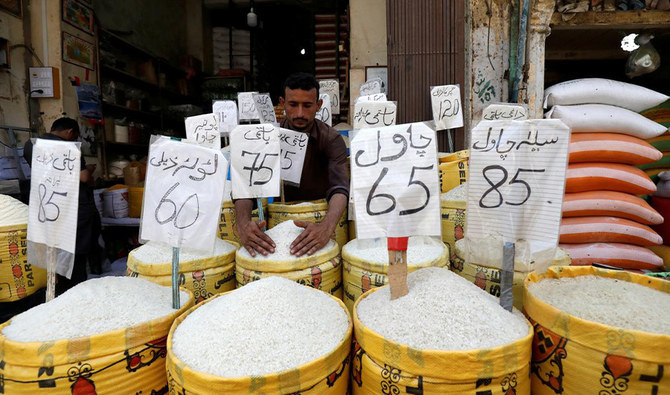

KARACHI: Pakistan’s rice exports have witnessed a massive decline of 48 percent, said local business community associated with the trade on Saturday, due to the Indian strategy of dumping the commodity in international market at cheaper rates.
“The main reason behind the decline in our overall rice exports this year is the low price of Indian rice,” Abdul Qayyum Paracha of the Rice Exporters Association of Pakistan (REAP) told Arab News. “Indian businesses have been engaging in the dumping practice.”
Pakistani exporters believe their rivals in India are getting subsidies from New Delhi which has enabled them to market rice at significantly low prices internationally.
“No one has pointed out that Indian prices are low or tried to determine the reason for that,” he continued. “This is not just affecting Pakistan but its impacts can also be seen elsewhere. Other rice exporting countries, such as Thailand and Vietnam, are also suffering.”
Dumping, a term used in the context of international trade, depicts the export practice of selling a product at much lower prices internationally than its market rate in the exporter’s home country.
According to the Pakistan Bureau of Statistics, local exporters experienced a 48 percent decline in basmati rice export in May while other varieties dropped by 50 percent in dollar terms.
The country’s overall basmati exports have gone down by 31 percent during the current fiscal year, resulting in a revenue of $1.8 billion instead of $2 billion last year.
“Indian exporters started selling rice at $350 per ton and increased the price to $380 per ton,” Muzammil Rauf Chappal, commodities importer and chairman of the Cereal Association of Pakistan, told Arab News. “They continued to sell at that rate throughout the year.”
“Pakistani exporters,” he continued, “started marketing rice from $420 per ton which went up to $460 per ton. After market fluctuations, the rate came back to $410 per ton.”
Chappal acknowledged the lower Indian rice prices were also helped by a higher production yield in the neighboring country.
“Indian prices are also at the lower side because their production is high and our production is low,” he said. “The competition in international market will only be possible when we reach a higher production rate at lower prices as well.”
The REAP president also blamed the rise in freight charges and lower post-COVID-19 consumption rate for the decline in Pakistan’s rice export.
“Freight charges have substantially increased recently, but they are also high in India,” Paracha said. “There is also the post-COVID impact since many buyers have already built up their stocks to counter any possible suspension of shipment after the recent wave of the pandemic in India.”
Pakistani exporters say freight charges have almost gone up by 600 percent in the recent times.
“We used to pay $100 per container for China, but now the rate has increased to $700 which has caused huge losses to traders,” Chappal informed. “Currency fluctuations have also played a role and contributed to their losses.”
Local business community associated with the trade says it has suggested ways to reverse the ongoing export trend for rice to relevant government functionaries.
“We are in touch with the ministry [of commerce] and have submitted our suggestions,” Paracha said while refraining to share details of the proposals.


