US House Speaker Pelosi signals new panel to investigate Jan. 6 Capitol riot

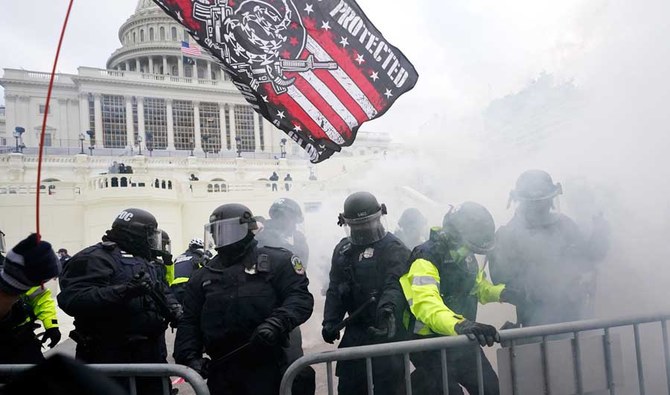
In this Jan. 6, 2021, file photo police hold off supporters of Donald Trump who tried to break through a police barrier at the Capitol in Washington. (AP)
Short Url
Updated 23 June 2021
Follow

US House Speaker Pelosi signals new panel to investigate Jan. 6 Capitol riot

  • A new select committee would put majority Democrats in charge of the investigation

WASHINGTON: House Speaker Nancy Pelosi is signaling that she is poised to create a new committee to investigate the Jan. 6 insurrection at the Capitol, pushing closer to a partisan investigation of the attack after Senate Republicans blocked the creation of an independent probe.
A person familiar with the matter said after a meeting with Democrats that Pelosi had told her colleagues that she would create a select panel. The person spoke on condition of anonymity to discuss the private remarks. But Pelosi later denied that, telling reporters, “No, I did not make that announcement.”
The new committee would come after the Senate voted earlier this month to block legislation to form a bipartisan, independent commission investigating the attack by former President Donald Trump’s supporters. Pelosi said afterward that the House would step up investigations of the riot, in which a violent mob overran police, broke into the building and hunted for lawmakers to try to stop the certification of Joe Biden’s election victory.
A new select committee would put majority Democrats in charge of the investigation. More than three dozen Republicans in the House and seven Senate Republicans said they wanted to avoid a partisan probe, and they supported the legislation to form a commission, which would have been modeled after a similar panel that investigated the 9/11 terrorist attacks.
Still, those numbers weren’t strong enough to overcome GOP opposition in the Senate, where support from 10 Republicans is needed to pass most bills if all Democrats vote yes. Senate Democratic leader Chuck Schumer has said he may hold a second vote after the legislation failed to advance last month, but there’s no indication that Democrats can win the necessary support from three additional Republicans.
Pelosi said earlier this month that the House “can’t wait any longer” and would proceed with a probe. She said then that she was considering a select committee or having an existing committee conduct the investigation.
Many Republicans have made clear that they want to move on from the Jan. 6 attack, brushing aside the many unanswered questions about the insurrection, including how the government and law enforcement missed intelligence leading up to the rioting and the role of Trump before and during the insurrection.
Some Republicans have gone so far as to downplay the violence, with one suggesting the rioters looked like tourists and another insisting that a woman, Ashli Babbitt, who was shot and killed that day while trying to break into the House chamber through a window was “executed.”
Last week, 21 Republicans voted against giving medals of honor to Capitol Police and Metropolitan Police to thank them for their service that day. Dozens of those officers suffered injuries, including chemical burns, brain injuries and broken bones.
Seven people died during and after the rioting, including Babbitt, three other Trump supporters who died of medical emergencies and two police officers who died by suicide in the days that followed. A third officer, Capitol Police Officer Brian Sicknick, collapsed and later died after engaging with the protesters, but a medical examiner determined he died of natural causes.


Starmer arrives in China to defend ‘pragmatic’ partnership

Updated 28 January 2026
Follow

Starmer arrives in China to defend ‘pragmatic’ partnership

  • British Prime Minister Keir Starmer arrived in Beijing on Wednesday to meet with Chinese leader Xi Jinping, hoping to restore long fraught relations

BEIJING: British Prime Minister Keir Starmer arrived in Beijing on Wednesday to meet with Chinese leader Xi Jinping, hoping to restore long fraught relations.
It is the first visit to China by a UK prime minister since 2018 and follows a string of Western leaders courting Beijing in recent weeks, pivoting from a mercurial United States.
Starmer, who is also expected to visit Shanghai on Friday, will later make a brief stop in Japan to meet with Prime Minister Sanae Takaichi.
For Xi, the trip is an opportunity to show Beijing can be a reliable partner at a time when President Donald Trump’s policies have rattled historic ties between Washington and its Western allies.
Starmer is battling record low popularity polls and hopes the visit can boost Britain’s beleaguered economy.
The trip has been lauded by Downing Street as a chance to boost trade and investment ties while raising thorny issues such as national security and human rights.
Starmer will meet with Xi for lunch on Thursday, followed by a meeting with Premier Li Qiang.
The British leader said on Wednesday this visit to China was “going to be a really important trip for us,” vowing to make “some real progress.”
There are “opportunities” to deepen bilateral relations, Starmer told reporters traveling with him on the plane to China.
“It doesn’t make sense to stick our head in the ground and bury in the sand when it comes to China, it’s in our interests to engage and not compromise on national security,” he added.
China, for its part, “is willing to take this visit as an opportunity to enhance political mutual trust,” foreign ministry spokesman Guo Jiakun reiterated Wednesday during a news briefing.
Starmer is the latest Western leader to be hosted by Beijing in recent months, following visits by Canadian Prime Minister Mark Carney and French President Emmanuel Macron.
Faced with Trump’s threats to impose tariffs on Canada for signing a trade agreement with China, and the US president’s attempts to create a new international institution with his “Board of Peace,” Beijing has been affirming its support for the United Nations to visiting leaders.
Reset ties 
UK-China relations plummeted in 2020 after Beijing imposed a sweeping national security law on Hong Kong, which severely curtailed freedoms in the former British colony.
They soured further since with both powers exchanging accusations of spying.
Starmer, however, was quick to deny fresh claims of Chinese spying after the Telegraph newspaper reported Monday that China had hacked the mobile phones of senior officials in Downing Street for several years.
“There’s no evidence of that. We’ve got robust schemes, security measures in place as you’d expect,” he told reporters on Wednesday.
Since taking the helm in 2024, Starmer has been at pains to reset ties with the world’s second-largest economy and Britain’s third-biggest trade partner.
In China, he will be accompanied by around 60 business leaders from the finance, pharmaceutical, automobile and other sectors, and cultural representatives as he tries to balance attracting vital investment and appearing firm on national security concerns.
The Labour leader also spoke to Xi on the sidelines of the G20 summit in Brazil in November 2024.
Jimmy Lai
The prime minister is also expected to raise the case of Hong Kong media mogul and democracy supporter Jimmy Lai, 78, a British national facing years in prison after being found guilty of collusion charges in December.
When asked by reporters about his plans to discuss Lai’s case, Starmer avoided specifics, but said engaging with Beijing was to ensure that “issues where we disagree can be discussed.”
“You know my practice, which is to raise issues that need to be raised,” added Starmer, who has been accused by the Conservative opposition of being too soft in his approach to Beijing.
Reporters Without Borders urged Starmer in a letter to secure Lai’s release during his visit.
The British government has also faced fierce domestic opposition after it approved this month contentious plans for a new Chinese mega-embassy in London, which critics say could be used to spy on and harass dissidents.
At the end of last year, Starmer acknowledged that China posed a “national security threat” to the UK, drawing flak from Chinese officials.
The countries also disagree on key issues including China’s close ties with Russian President Vladimir Putin amid the war in Ukraine, and accusations of human rights abuses in China.