

Shortage of natural gas to Karachi industry puts Pakistani exports at risk

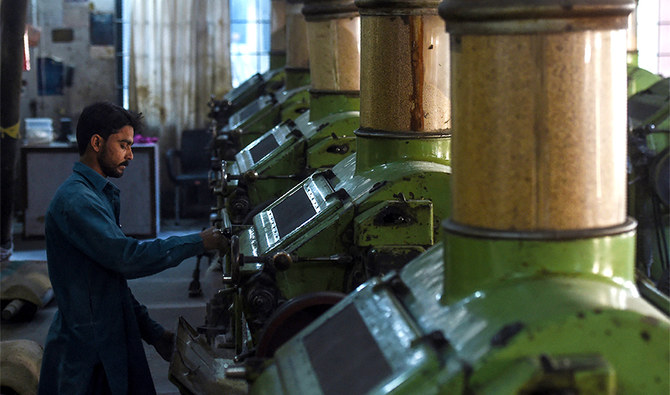
A worker monitors the wheat grind process turning it into flour at a mill in Karachi, Pakistan, on January 21, 2020. (AFP/File)
Short Url
Updated 23 June 2021
Follow

Shortage of natural gas to Karachi industry puts Pakistani exports at risk

  • Industrialists warn persistent gas shortages can reduce Pakistan’s exports from $22.5 billion to $17 billion
  • The Sui Southern Gas Company says the situation is going to normalize from July 4 after it resumes gas supply from a field undergoing annual maintenance

KARACHI: Pakistani industrialists in the southern port city of Karachi complained of disruptions in their production activities on Tuesday, pointing out that low pressure of gas and frequent fluctuations had made it impossible for them to deliver export orders on time.
The prevailing shortage of natural gas in Karachi, the country’s industrial and commercial capital, has been caused by the annual maintenance of a gas field that is currently carried out by the Sui Southern Gas Company (SSGC).
“Under our load management plan, we are supplying gas to domestic consumers on a priority basis,” the SSGC spokesperson Shahbaz Islam told Arab News.
He said the SSGC was facing a gas shortage of about 200 million cubic feet per day (mmcfd).
Under the utility company’s load management plan, supply has been suspended to fuel stations selling compressed natural gas (CNG) across the southern Sindh province until June 29.
“Some 613 CNG stations across Sindh, which only consume about 32 mmcfd of gas, have been shut down,” Samir Najmul Hasan, coordinator of the All Pakistan CNG Association for Sindh, said.
“This is happening due to the policies of the federal government since it should have made arrangements before initiating the maintenance activity at the gas field,” he said. “The frequent suspension of gas has already reduced our sales to 30 percent.”
According to SSGC officials, the company has not stopped supplying gas to industrial units, though factory owners say they have to deal with low gas pressure and frequent outages during the day.
“It takes us hours to heat up boilers due to low gas pressure these days,” Abdul Hadi, president of the SITE Association of Industry, told Arab News. “Then there are frequent fluctuations that delay our production activities by about three to four hours a day.”
He maintained that the current situation was making it difficult for manufacturers to process export orders properly.
“If we fail to execute these orders on time, foreign buyers will move away from us and go to other manufacturers,” he added. “If the government cannot provide us such basic facilities, we should probably relocate our industries somewhere else for survival.”
Some industrialists warned if such a situation was allowed to persist, it would have a negative impact on the country’s exports which were going to fall from $22.5 billion to about $17 billion.
“Karachi’s share in Pakistan’s overall export is about 58 percent,” Muhammad Zubair Motiwala, chairman of the Businessmen Group at the Karachi Chamber of Commerce and Industry, told Arab News. “It is up to the government to think how it is putting the country’s huge industrial exports from Karachi at stake.”
The SSGC spokesperson, however, hoped the situation would normalize after July 4 when the supply of gas would be restored from the field.

In a separate development, Sui Southern Gas Company Limited on Tuesday cut 100 percent supply of gas to non-export industries and 50 percent to captive power plants to ensure supply of gas to domestic consumers, according to notifications issued by the utility following the suspension of output from Kunnar Pasakhi gas field.
Pakistan gas production has declined by 4.3 percent or 3.3 billion cubic feet per day during June 9 to 15 as compared to 3.5 bmcfd from June 2 to 8, 2021, according to Arif Habib Research.


Islamic military coalition, Pakistan to deepen cooperation to combat ‘terrorism’ — Pakistani military

Updated 02 February 2026
Follow

Islamic military coalition, Pakistan to deepen cooperation to combat ‘terrorism’ — Pakistani military

  • Islamic Military Counter Terrorism Coalition is a 43-member alliance that includes Pakistan, Saudi Arabia, Egypt, Jordan, UAE and other nations
  • The Pakistani military statement comes after a meeting between IMCTC secretary-general and the chief of Pakistani defense forces in Rawalpindi

ISLAMABAD: Pakistan and the Islamic Military Counter Terrorism Coalition (IMCTC) have reaffirmed their commitment to deepening cooperation, including intelligence sharing and capacity building, to jointly combat “terrorism” and “extremism,” the Pakistani military said on Monday.

The IMCTC is a 43-member military alliance that was formed on Saudi Arabia’s initiative in Dec. 2015 to consolidate Muslim countries’ efforts in countering “terrorism.”

A 17-member IMCTC delegation is visiting Pakistan from Feb. 2-6 to conduct a training at National University of Sciences and Technology on “Re-integration and Rehabilitation of Extremist Elements,” according to the Pakistani military.

On Monday, IMCTC Secretary-General Maj. Gen. Mohammed bin Saeed Al-Moghedi held a meeting with Chief of Pakistani Defense Forces Field Marshal Asim Munir to discuss cooperation among IMCTC member states.

“During the meeting, matters of mutual interest were discussed, with particular emphasis on regional security dynamics and enhanced cooperation in counter-terrorism efforts,” the Inter-Services Public Relations (ISPR), the Pakistani military’s media wing, said in a statement.

“Both sides reaffirmed their shared commitment to combating terrorism and extremism through collaborative strategies, intelligence sharing, and capacity building among member states.”

The IMCTC features Pakistan, Saudi Arabia, Türkiye, Afghanistan, Egypt, Jordan, Qatar, Palestine, UAE, Bangladesh and other nations. In 2017, Pakistan’s former army chief Gen. (retd) Raheel Sharif was appointed as the IMCTC commander-in-chief.

During discussions with Major General Al-Moghedi, Field Marshal Munir appreciated the role of IMCTC in fostering stability and promoting coordinated counterterrorism initiatives across the Islamic world, according to the ISPR.

The IMCTC secretary-general acknowledged Pakistan’s significant contributions and sacrifices in the fight against militancy and lauded the professionalism of Pakistan’s armed forces.

“The meeting underscored the resolve of both sides to further strengthen institutional collaboration for peace, stability, and security in the region,” the ISPR added.

Pakistan enjoys cordial ties with most Muslim countries around the world, particularly Gulf Cooperation Council countries. In Sept. 2025, Pakistan signed a landmark defense pact with Saudi Arabia according to which an act of aggression against one country will be treated as an act of aggression against both.