

Pakistan’s national air carrier launches scenic air safari for tourism promotion

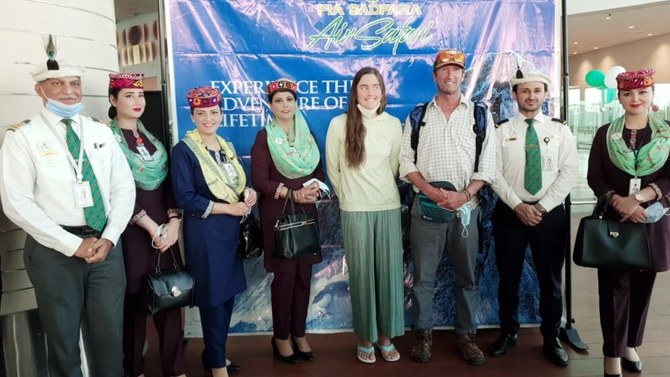
The Pakistan International Airlines crew is seen with passengers on the launch of Sadpara Air Safari on June 19, 2021. (Photo Courtesy: Social Media)
Short Url
Updated 19 June 2021
Follow

Pakistan’s national air carrier launches scenic air safari for tourism promotion

  • Named after the country’s iconic high-altitude mountaineer, Sadpara Air Safari will take tourist from Islamabad to Skardu and fly over K2 and Nanga Parbat
  • Tour operators believe the initiative will help the residents of Gilgit-Baltistan who mostly rely on tourism for livelihood

KHAPLU, Gilgit-Baltistan: The Pakistan International Airlines launched Sadpara Air Safari on Saturday to benefit the tourism industry in the country’s northern areas by offering passengers a spectacular view of some of the world’s tallest snowy mountains, glaciers and lakes.
Named after Pakistan’s iconic high-altitude mountaineer Muhammad Ali Sadpara, who tragically lost his life earlier this year while attempting a winter ascent of K2, the air safari will take tourists from Islamabad to Skardu and charge them a one-way fare of Rs24,000.
“Our flight will depart from the Islamabad International Airport and fly over K2, Nanga Parbat, Gasherbrum peaks, Deosai Plain and the famous Saif-ul-Malook Lake where every passenger will wonder at the beauty of the air safari from their personal window seat,” said the airline’s official statement.
While most flights to Gilgit-Baltistan offer a clear view of the world’s ninth tallest Nanga Parbat mountain, not many people get a glimpse of K2, also known as “Savage Mountain,” which hides in a remote corner of the region.
Hundreds of domestic and international tourists have already started visiting Pakistan’s Gilgit-Baltistan region in the north after the government eased the COVID-19 restrictions and opened the tourism sector on May 24.
“People living abroad usually fear security deficit while planning a trip to Pakistan,” PIA spokesperson Abdullah Hafiz Sheikh recently told Arab News over the phone. “Many of them are not aware of the beautiful and scenic locations of the country. Once they experience the air safari and fly over these places, they will surely come back to explore them again.”
Sheikh informed that the airline would only sell window seats.
“The return flight will depart from Skardu after two hours of arrival,” he continued. “It will be entirely up to our passengers if they want to take the same flight back to Islamabad or prolong their trip to the region to experience more magical moments.”
Asghar Ali Porik, who leads the Pakistan Association of Tour Operators, applauded the initiative, saying it would positively impact Pakistan’s image.
“Allowing travelers to decide when to get back after experiencing the air safari will also help the residents of Gilgit-Baltistan since they mostly rely on tourism to make a living,” he said.
“Like the air safari, the authorities should also start a helicopter service for backpackers in Skardu because that is what most foreigners demand in the area. If the helicopter service is launched, it will also make things easier for international climbers who will be able to reach Concordia, K2’s basecamp, in a short span,” he added.


Security forces kill four militants in Pakistan’s volatile southwest, military says

Updated 13 January 2026
Follow

Security forces kill four militants in Pakistan’s volatile southwest, military says

  • Balochistan, Pakistan’s largest province by land area bordering Iran and Afghanistan, has long been the site of a low-level insurgency
  • The Balochistan government has recently established a threat assessment center to strengthen early warning, prevent ‘terrorism’ incidents

ISLAMABAD: Pakistani security forces gunned down four militants in an intelligence-based operation in the southwestern Balochistan province, the military said on Tuesday.

The operation was conducted in Balochistan’s Kalat district on reports about the presence of militants, according to the Inter-Services Public Relations (ISPR), the Pakistani military’s media wing.

The “Indian-sponsored militants” were killed in an exchange of fire during the operation, while weapons and ammunition were also recovered from the deceased, who remained actively involved in numerous militant activities.

“Sanitization operations are being conducted to eliminate any other Indian-sponsored terrorist found in the area,” the ISPR said in a statement.

There was no immediate response from New Delhi to the statement.

Balochistan, Pakistan’s largest province by land area bordering Iran and Afghanistan, has long been the site of a low-level insurgency involving Baloch separatist groups, including the Balochistan Liberation Army (BLA) and the Balochistan Liberation Front (BLF).

Pakistan accuses India of supporting these separatist militant groups and describes them as “Fitna Al-Hindustan.” New Delhi denies the allegation.

The government in Balochistan has also established a state-of-the-art threat assessment center to strengthen early warning and prevention against “terrorism” incidents, a senior official said this week.

“Information that was once scattered is now shared and acted upon in time, allowing the state to move from reacting after incidents to preventing them before they occur,” Balochistan Additional Chief Secretary Hamza Shafqaat wrote on X.

The development follows a steep rise in militancy-related deaths in Pakistan in 2025. According to statistics released by the Pakistan Institute for Conflict and Security Studies (PICSS) last month, combat-related deaths in 2025 rose 73 percent to 3,387.

These included 2,115 militants, 664 security forces personnel, 580 civilians and 28 members of pro-government peace committees, the think tank said.