

Iranians nonchalant as regime opens poll

1 / 2
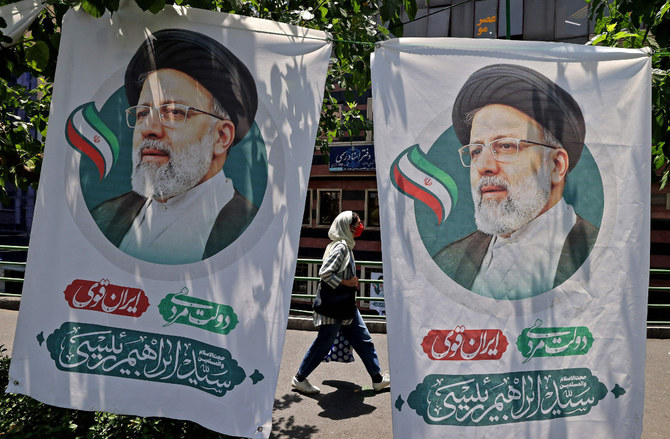
An Iranian woman walks past banners of ultraconservative cleric and presidential candidate Ebrahim Raisi in Tehran on June 17, 2021. (AFP/ATTA KENARE)
2 / 2
Short Url
Updated 18 June 2021
Follow

Iranians nonchalant as regime opens poll

  • Khamenei’s ally Raisi likely to succeed succeed the pragmatist incumbent Hassan Rouhani

JEDDAH: Iranians vote on Friday in a race that is seen by the regime’s critics as not democratic, fair, or free by any means.

The election, tightly managed by the nation’s top authorities, is likely to hand the presidency to a judge sanctioned by Washington for alleged involvement in executions of political prisoners.

Hard-liner Ebrahim Raisi, an ally and protege of Iran’s Supreme Leader Ayatollah Ali Khamenei, is the favorite to succeed the pragmatist incumbent Hassan Rouhani.

“The regime will attempt to project that it enjoys legitimacy during this election. Government employees will be instructed to go to the ballots in order to show the popularity of the regime, while the authorities may manipulate the statistics in order to show a high voter turnout,” Dr. Majid Rafizadeh, a Harvard-educated Iranian-American political scientist, writes in Opinion.

Khamenei on Wednesday urged Iranians to turn out and vote, but a record number of people are expected to boycott the polls due to anger over worsening economic hardship and frustration with hard-line rule.

Another potential deterrent for voters is a hard-line vetting body’s disqualification of hundreds of would-be candidates, including many advocating more freedoms.

For an overwhelmingly young population chafing at political restrictions, the lack of choice at the ballot box means a vote serves little purpose, analysts of Iranian politics say.

Soraya, a student at Tehran University, told Arab News: “The government is telling people to vote. But I see voting as an insult. We are not going to vote in order to show the world that we Iranians are frustrated with this clerical establishment.

“We are not with a government that shoots down a passenger plane (Ukraine International Airlines Flight 752, which was downed by the IRGC in January 2020), lies repeatedly, and kills and tortures its own citizens.

“We are not with a government that steals the nation’s natural resources and spends it on its militias. The old game of moderate or hard-liner is over. They are all the same.”

Within Iran’s mix of clerical rulers and elected officials, Khamenei has the final say on all state matters, including nuclear and foreign policies. But the elected president will be in charge of tackling an economy hammered by US sanctions.

Over 50 percent of Iran’s 85 million population has been pushed under the poverty line since 2018 when then US President Donald Trump ditched a 2015 nuclear deal and reimposed nuclear-related sanctions that have squeezed Tehran’s oil income.

Aware of its vulnerability to anger over the economy, the leadership fears a revival of street protests that have erupted since 2017, in which protesters called for “regime change.”

Kurds in Turkiye protest over Syria Aleppo offensive

Updated 09 January 2026
Follow

Kurds in Turkiye protest over Syria Aleppo offensive

  • Several hundred people gathered in Diyarbakir while hundreds more joined a protest in Istanbul
  • In the capital, Ankara, DEM lawmakers protested in front of the Turkish parliament

DIYARBAKIR, Turkiye: Protesters rallied for a second day in Turkiye’s main cities on Thursday to demand an end to a deadly Syrian army offensive against Kurdish fighters in Aleppo, an AFP correspondent said.
Several hundred people gathered in Diyarbakir, southeastern Turkiye’s main Kurdish-majority city, while hundreds more joined a protest in Istanbul that was roughly broken up by riot police who arrested around 25 people, the pro-Kurdish DEM party said.
In the capital, Ankara, DEM lawmakers protested in front of the Turkish parliament, denouncing the targeting of Kurds in Aleppo as a crime against humanity.
The protesters demanded an end to the operation by Syrian government forces against the Kurdish-led SDF force in Aleppo, where at least 21 people have been killed in three days of violent clashes.
It was the worst violence in the northwestern city since Syria’s Islamist authorities took power a year ago. The fighting erupted as both sides struggled to implement a March agreement to integrate autonomous Kurdish institutions into the new Syrian state.
In Istanbul, hundreds of protesters waving flags braved heavy rain near Galata Tower to denounce the Aleppo operation under the watchful eye of hundreds of riot police, an AFP correspondent said.
But some of the slogans drew a sharp warning from the police, who moved to roughly break up the gathering and arrested some 25 people, DEM’s Istanbul branch said.
“We condemn in the strongest terms the police attack on the Rojava solidarity action in Sishane. This brutal intervention, oppression, and violence against our young comrades is unacceptable!” the party wrote on X, demanding the immediate release of those arrested.
At the Diyarbakir protest during the afternoon, protesters carried a huge portrait of the jailed PKK militant leader Abdullah Ocalan, an AFP video journalist reported.
“We urge states to act as they did for the Palestinian people, for our Kurdish brothers who are suffering oppression and hardship,” Zeki Alacabey, 64, told AFP in Diyarbakir.
Although Turkiye has embarked on a peace process with the PKK, it remains hostile to the SDF, which controls swathes of northeastern Syria, seeing it as an extension of the banned militant group and a major threat along its southern border.
It has repeatedly demanded that the SDF merge into the main Syrian military. A defense ministry official said on Thursday that Ankara was ready to “support” Syria’s operation against the Kurdish fighters if needed.
Demonstrators had already taken to the streets in several major Turkish cities with Kurdish majorities on Wednesday, including Diyarbakir and Van, according to images broadcast by the DEM.