Kuwait to allow vaccinated foreigners entry from August

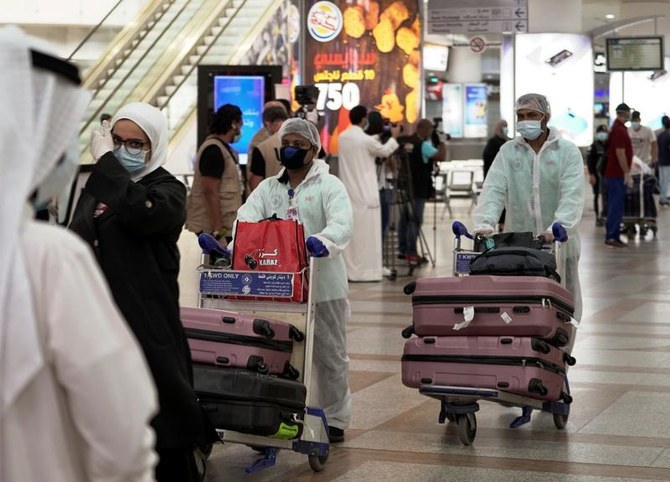
Citizens wearing masks arriving in April at the airport of Kuwait that announced Thursday foreigners, who’ve been fully vaccinated, could enter from August 1. (Reuters)
Short Url
Updated 17 June 2021
Follow

Kuwait to allow vaccinated foreigners entry from August

  • The Gulf country in February banned entry of non-citizens to limit the spread of the virus
  • Foreign travellers will need to have been fully inoculated with one of Pfizer/BioNTech, AstraZeneca, Moderna and Johnson & Johnson

KUWAIT: Kuwait announced Thursday it would allow foreigners who have been fully vaccinated against the novel coronavirus to enter the country from August 1, after a months-long suspension.
The Gulf country in February banned the entry of non-citizens in a bid to limit the spread of the virus, but has started to ease some of its Covid-19 restrictions in recent weeks.
Government spokesman Tareq Al-Mizrem said foreign travelers will need to have been fully inoculated with one of the four vaccines that the Gulf country has approved — Pfizer/BioNTech, AstraZeneca, Moderna and Johnson & Johnson.
Passengers must also hold a negative PCR test conducted a maximum of 72 hours before travel, and undergo another test during a seven-day quarantine in the country, Mizrem told a press conference.
Meanwhile, only Kuwaiti citizens who have been fully vaccinated will be allowed to travel abroad from August 1, he said, although some exceptions would be made, such as for pregnant women.
Previously, Kuwaitis were required to have had at least one jab in order to travel.
Mizrem also announced that Kuwait would allow access to large shopping malls, gyms and restaurants from June 27 only for those who have been fully inoculated.
“The government has decided to allow those who have received a (full) Covid-19 vaccine... to enter restaurants and cafes, gyms, salons, shopping malls more than 6,000 square meters,” said Mizrem.
Kuwait has officially recorded more than 332,000 coronavirus cases, over 1,800 of them fatal.


First responders enter devastated Aleppo neighborhood after days of deadly fighting

Updated 10 sec ago
Follow

First responders enter devastated Aleppo neighborhood after days of deadly fighting

  • The US-backed SDF, which have played a key role in combating the Daesh group in large swaths of eastern Syria, are the largest force yet to be absorbed into Syria’s national army

ALEPPO, Syria: First responders on Sunday entered a contested neighborhood in Syria’ s northern city of Aleppo after days of deadly clashes between government forces and Kurdish-led forces. Syrian state media said the military was deployed in large numbers.
The clashes broke out Tuesday in the predominantly Kurdish neighborhoods of Sheikh Maqsoud, Achrafieh and Bani Zaid after the government and the Syrian Democratic Forces, the main Kurdish-led force in the country, failed to make progress on how to merge the SDF into the national army. Security forces captured Achrafieh and Bani Zaid.
The fighting between the two sides was the most intense since the fall of then-President Bashar Assad to insurgents in December 2024. At least 23 people were killed in five days of clashes and more than 140,000 were displaced amid shelling and drone strikes.
The US-backed SDF, which have played a key role in combating the Daesh group in large swaths of eastern Syria, are the largest force yet to be absorbed into Syria’s national army. Some of the factions that make up the army, however, were previously Turkish-backed insurgent groups that have a long history of clashing with Kurdish forces.
The Kurdish fighters have now evacuated from the Sheikh Maqsoud neighborhood to northeastern Syria, which is under the control of the SDF. However, they said in a statement they will continue to fight now that the wounded and civilians have been evacuated, in what they called a “partial ceasefire.”
The neighborhood appeared calm Sunday. The United Nations said it was trying to dispatch more convoys to the neighborhoods with food, fuel, blankets and other urgent supplies.
Government security forces brought journalists to tour the devastated area, showing them the damaged Khalid Al-Fajer Hospital and a military position belonging to the SDF’s security forces that government forces had targeted.
The SDF statement accused the government of targeting the hospital “dozens of times” before patients were evacuated. Damascus accused the Kurdish-led group of using the hospital and other civilian facilities as military positions.
On one street, Syrian Red Crescent first responders spoke to a resident surrounded by charred cars and badly damaged residential buildings.
Some residents told The Associated Press that SDF forces did not allow their cars through checkpoints to leave.
“We lived a night of horror. I still cannot believe that I am right here standing on my own two feet,” said Ahmad Shaikho. “So far the situation has been calm. There hasn’t been any gunfire.”
Syrian Civil Defense first responders have been disarming improvised mines that they say were left by the Kurdish forces as booby traps.
Residents who fled are not being allowed back into the neighborhood until all the mines are cleared. Some were reminded of the displacement during Syria’s long civil war.
“I want to go back to my home, I beg you,” said Hoda Alnasiri.