In Pakistan’s Sindh, rabies treatment faces unlikely adversary: traditional healers

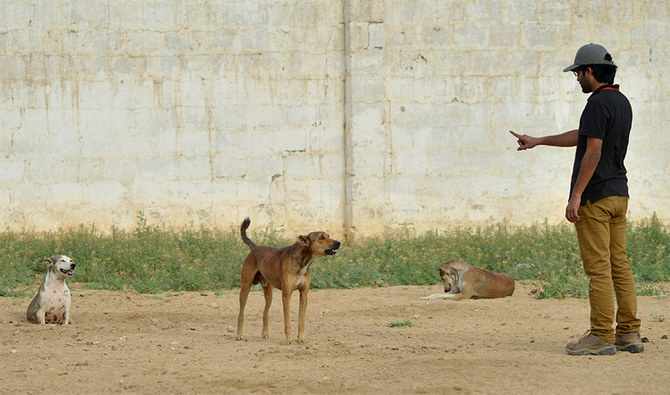
A boy gestures beside stray dogs at the Edhi Animal Home on the outskirts of Karachi, Pakistan, on August 17, 2016. (AFP/File)
Short Url
Updated 17 June 2021
Follow

In Pakistan’s Sindh, rabies treatment faces unlikely adversary: traditional healers

  • Hundreds die of rabies in Pakistan every year because families seek traditional healers instead of professional medical help
  • World Health Organization estimates about 500 to 5,000 people die of the virus in Pakistan each year

KARACHI: When Junaid Ahmed Khan was brought to Jinnah Postgraduate Medical Center (JPMC) in Karachi last week, he was suffering from high fever and delirium. 
Doctors diagnosed the 45-year-old with rabies and began treatment — but it was too late.
On Monday this week, Khan passed away.
Months had passed since he had been bitten by a stray dog — precious time his family wasted in seeking treatment from local faith healers and trying home remedies. 
Indeed, Khan is one of hundreds of people who die of rabies in Pakistan every year because families prefer to see traditional healers instead of visiting hospitals and getting anti-rabies vaccines in time, doctors in Karachi told Arab News this week.
Rabies is endemic in Pakistan, with human infections mostly due to dog bites. The World Health Organization estimates about 500 to 5,000 people die of the virus in Pakistan each year.
And while the Global Alliance for Rabies Control says more than 80,500 cases of dog bites are reported by basic health units across Pakistan annually, those managed by spiritual healers are not recorded. Doctors believe the real number of cases may be significantly higher.
“Seven patients brought to the hospital since the beginning of the year, including Khan, were not administered anti-rabies vaccines on time,” Jinnah Postgraduate Medical Center (JPMC) executive director, Dr. Seemi Jamali, told Arab News. 
“He was brought to us nearly three months after he was attacked by a stray dog,” she said. “When he first developed symptoms of rabies, his family took him to a faith healer instead of bringing him here.”
“People do not get timely treatment due to lack of awareness,” the doctor said, lamenting that patients often first tried home remedies like rubbing various substances like pepper and antimony into their wounds. 
Two hospitals in Karachi, the Indus Hospital and JPMC, have together already handled 8,500 dog bite cases since the beginning of the year.
“The figures provided by hospital authorities are just the tip of the iceberg,” Aftab Gohar, manager of the Rabies Prevention Center at the Indus Hospital in Karachi, said. 
He said at least four patients died at his hospital this year because it was too late to start treatment by the time they were brought in.
It was ignorance that mostly led to such incidents, Gohar said, as rabies treatment, although it costs about Rs12,500 ($80), was administered free of charge at many Karachi hospitals.
“In rural areas of the province, dog bite cases are not taken seriously, and people are mostly rushed to faith healers or shrines,” Gohar said, adding that cases were also mismanaged at local health centers. “Even if someone goes to a local hospital for dog bite treatment, some doctors and nurses are unaware of how to deal with the problem under the World Health Organization’s guidelines.”


Pakistan PM orders accelerated privatization of power sector to tackle losses

Updated 15 December 2025
Follow

Pakistan PM orders accelerated privatization of power sector to tackle losses

  • Tenders to be issued for privatization of three major electricity distribution firms, PMO says
  • Sharif says Pakistan to develop battery energy storage through public-private partnerships

ISLAMABAD: Pakistan’s prime minister on Monday directed the government to speed up privatization of state-owned power companies and improve electricity infrastructure nationwide, as authorities try to address deep-rooted losses and inefficiencies in the energy sector that have weighed on the economy and public finances.

Pakistan’s electricity system has long struggled with financial distress caused by a combination of factors including theft of power, inefficient collection of bills, high costs of generating electricity and a large burden of unpaid obligations known as “circular debt.” In the first quarter of the current financial year, government-owned distribution companies recorded losses of about Rs171 billion ($611 million) due to poor bill recovery and operational inefficiencies, official documents show. Circular debt in the broader power sector stood at around Rs1.66 trillion ($5.9 billion) in mid-2025, a sharp decline from past peaks but still a major fiscal drain. 

Efforts to contain these losses have been a focus of Pakistan’s economic reform program with the International Monetary Fund, which has urged structural changes in the energy sector as part of financing conditions. Previous government initiatives have included signing a $4.5 billion financing facility with local banks to ease power sector debt and reducing retail electricity tariffs to support economic recovery. 

“Electricity sector privatization and market-based competition is the sustainable solution to the country’s energy problems,” Prime Minister Shehbaz Sharif said at a meeting reviewing the roadmap for power sector reforms, according to a statement from the prime minister’s office.

The meeting reviewed progress on privatization and infrastructure projects. Officials said tenders for modernizing one of Pakistan’s oldest operational hubs, Rohri Railway Station, will be issued soon and that the Ghazi Barotha to Faisalabad transmission line, designed to improve long-distance transmission of electricity, is in the initial approval stages. While not all power-sector decisions were detailed publicly, the government emphasized expanding private sector participation and completing priority projects to strengthen the electricity grid.

In another key development, the prime minister endorsed plans to begin work on a battery energy storage system with participation from private investors to help manage fluctuations in supply and demand, particularly as renewable energy sources such as solar and wind take a growing role in generation. Officials said the concept clearance for the storage system has been approved and feasibility studies are underway.

Government briefing documents also outlined steps toward shifting some electricity plants from imported coal to locally mined Thar coal, where a railway line expansion is underway to support transport of fuel, potentially lowering costs and import dependence in the long term.

State authorities also pledged to address safety by converting unmanned railway crossings to staffed ones and to strengthen food safety inspections at stations, underscoring broader infrastructure and service improvements connected to energy and transport priorities.