

House bars Pakistani lawmakers from entering parliament over fistfights, obscenities

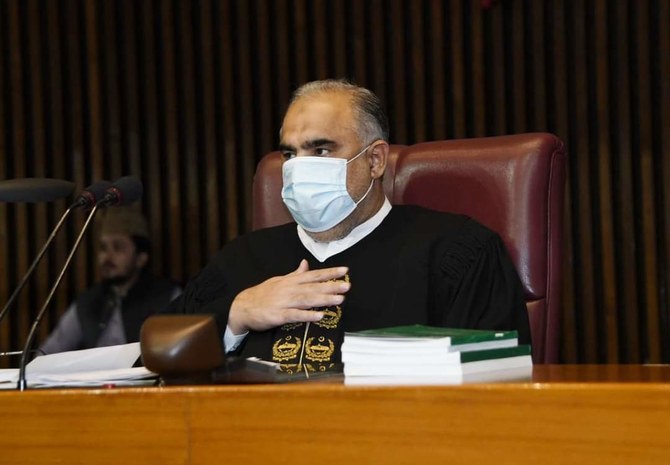
Pakistan’s National Assembly speaker, Asad Qaiser, chairs budget session in Islamabad, Pakistan, on June 11, 2021. (Photo courtesy: National Assembly of Pakistan/File)
Short Url
Updated 16 June 2021
Follow

House bars Pakistani lawmakers from entering parliament over fistfights, obscenities

  • Opposition and ruling party lawmakers shouted obscenities and hit each other with documents during Tuesday’s budget debate session
  • For third consecutive day on Wednesday, opposition leader Shehbaz Sharif was prevented by lawmakers from delivering his budget speech

ISLAMABAD: Pakistan’s National Assembly speaker, Asad Qaiser, on Wednesday barred seven lawmakers from entering the House building, after scuffles and “unparliamentary” behavior during a session a day earlier.
The House turned into a battleground on Tuesday as opposition and treasury members shouted obscenities and hit each other with budget documents and fists, with government lawmakers refusing to stop sloganeering meant to disrupt the budget speech of Leader of the Opposition, Shehbaz Sharif.
The battle went on after the speaker suspended the proceedings, and only stopped when the assembly hall lights were switched off.
In a notification shared on Twitter, the House speaker barred from entering the building three lawmakers from the opposition Pakistan Muslim League-Nawaz (PML-N), one of the Pakistan Peoples Party (PPP), and three from the ruling Pakistan Tehreek-e-Insaf (PTI) party, including the prime minister’s special assistant on capital development authority affairs, Ali Nawaz Awan.
“Members who were disruptive during the National Assembly session and the Leader of the Opposition’s speech yesterday were barred from entering the House due to their unparliamentary and inappropriate behavior,” Qaiser said.

The lawmakers, he said in the notification, have been banned from entering the House building “till further orders.”
Despite the speaker’s punitive measure, the budget speech of Sharif was again disrupted by other lawmakers for a third consecutive day on Wednesday 
Surrounded by sergeants, the opposition leader tried to deliver his address amid sloganeering by other parliament members, despite Qaiser’s appeals for calm. The speaker adjourned the session after an object was thrown at his platform.
“I will not conduct this House until both the government and the opposition settle their matters,” he was quoted as saying by the local media.
Sharif’s speech has been rescheduled for Thursday.


Pakistan finance chief urges stronger reform implementation amid stabilizing economy

Updated 6 sec ago
Follow

Pakistan finance chief urges stronger reform implementation amid stabilizing economy

  • Muhammad Aurangzeb calls for inter-ministerial coordination, data-driven policymaking
  • He stresses the need to translate policy into execution in an address to civil servants

KARACHI: Federal Minister for Finance and Revenue Muhammad Aurangzeb on Friday urged senior civil servants to strengthen implementation of economic reforms and improve coordination across government, as the country seeks to consolidate gains made after a prolonged financial crisis.

Speaking to officers of the 124th National Management Course at the National School of Public Policy (NSPP) in Lahore, Aurangzeb emphasized the role of senior administrators in translating policy into execution, according to a statement issued by the Finance Division.

“Sustainable economic progress depends not only on sound policy formulation but also on effective implementation across tiers of government,” the statement quoted him as saying.

It added that Aurangzeb highlighted the importance of strategic thinking, data-driven decision-making and inter-ministerial coordination in addressing challenges including fiscal sustainability, energy sector reform and climate resilience.

Pakistan has stabilized its economy in recent years with support from the International Monetary Fund and financial backing from regional partners and has pledged to broaden the tax base, improve public financial management and strengthen transparency to sustain recovery.

The Finance Division said the session formed part of a “Strategic Policy Dialogue” initiative aimed at fostering engagement between national leadership and senior civil servants on governance and economic priorities.