VIENNA: Diplomats from outside the European Union cautioned Sunday that negotiations with Iran to salvage a landmark nuclear deal still need more time.
Leaders of the Group of Seven wealthy nations also reaffirmed a commitment to stop the Islamic republic from building nuclear weapons.
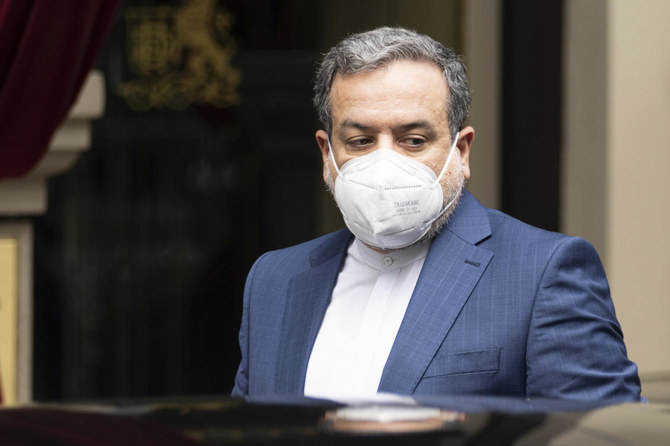
Iranian envoys held another round of negotiations with international delegations in Vienna a day after EU coordinators suggested that differences over the 2015 accord limiting Iran’s nuclear activities had narrowed further. But Iranian Deputy Foreign Minister Abbas Araghchi told Iranian state media he thought a deal was unlikely to emerge in the coming week. A diplomat from Russia also said more time was needed to work out details.
The Vienna meetings are aimed at rebuilding a nuclear containment agreement between Iran and major world powers that the Trump administration withdrew the United States from in 2018.
US President Joe Biden and other G-7 leaders expressed support for the Vienna process after a three-day summit in southwest England that ended Sunday. The G-7 nations are Canada, France, Germany, Italy, Japan, the United Kingdom and the United States.
“We are committed to ensuring that Iran will never develop a nuclear weapon,” the leaders said in a joint statement.
“A restored and fully-implemented (nuclear deal) could also pave the way to further address regional and security concerns,” the statement said.
A resolution would see Iran return to commitments made in 2015, aimed at making the development of a nuclear weapon impossible, in exchange for lighter US sanctions.
US Secretary of State Antony Blinken said Sunday on CBS’ “Face the Nation” that Iran had been “galloping forward” with its nuclear ambitions and violating the terms of the accord since the United States pulled out of the deal.
“I think puts some urgency in seeing if we can put the nuclear problem back in the box,” Blinken said.
Sunday’s bilateral meetings followed joint negotiations held Saturday involving senior diplomats from China, Germany, France, Russia, and Britain. The United States was not directly involved.
An Iranian pro-opposition group held a small protest outside the famed Vienna Opera House, near the downtown hotel where the talks are taking place. Organizers said local police in Austria’s capital instructed them not to protest outside the hotel. The event ended peacefully.

Caution on Iran nuclear deal as G7 leaders vow to stop bomb
Short Url
https://arab.news/c5zv6
Caution on Iran nuclear deal as G7 leaders vow to stop bomb
- EU coordinators suggested that differences over the 2015 accord limiting Iran's nuclear activities had narrowed further
- Iranian Deputy Foreign Minister said a deal was unlikely to emerge in the coming week
Turkish and Greek leaders set for talks on migration, maritime borders
- Fifteen migrants died in a shipwreck off the Greek island of Chios last week after their boat collided with a Greek coast guard vessel and sank in the Aegean Sea off the Turkish coast
ANKARA: Turkish President Tayyip Erdogan will host Greek Prime Minister Kyriakos Mitsotakis on Wednesday for talks likely to focus on migration and longstanding maritime disputes, as the NATO allies and historic rivals try to build on warming ties.
Fifteen migrants died in a shipwreck off the Greek island of Chios last week after their boat collided with a Greek coast guard vessel and sank in the Aegean Sea off the Turkish coast.
Mitsotakis will be accompanied by ministers responsible for foreign affairs, finance, development and migration, Greek officials said.
Developments in the Middle East, Iran and Ukraine, migration, trade and organized crime are also likely to be on the agenda.
Greek Foreign Ministry spokeswoman Lana Zochiou said on Tuesday the aim was “to assess the progress of bilateral cooperation” and “to keep communication channels open to defuse any potential crises.”
Turkiye is a transit country for migrants seeking to reach the European Union via Greece. Ankara says the EU has not fully delivered on commitments under a 2016 migration deal and Athens wants Turkiye to do more to curb irregular crossings.
Despite a thaw in rhetoric since a 2023 declaration on friendly relations, the neighbors are at odds over maritime boundaries in the Aegean, an area widely believed to hold energy resources and with implications for airspace and military activity.
Ankara said last month it had issued a maritime notice urging Greece to coordinate research activities in areas of the Aegean that Turkiye considers part of its continental shelf.
Greece’s foreign minister had said Athens planned to extend its territorial waters further, including potentially in the Aegean.
In 1995, Turkiye’s parliament declared a casus belli — a cause for war — should Greece unilaterally extend its territorial waters beyond six nautical miles in the Aegean, a stance Athens says violates international maritime law. Greece says it wants only to discuss demarcation of maritime zones.
Fifteen migrants died in a shipwreck off the Greek island of Chios last week after their boat collided with a Greek coast guard vessel and sank in the Aegean Sea off the Turkish coast.
Mitsotakis will be accompanied by ministers responsible for foreign affairs, finance, development and migration, Greek officials said.
Developments in the Middle East, Iran and Ukraine, migration, trade and organized crime are also likely to be on the agenda.
Greek Foreign Ministry spokeswoman Lana Zochiou said on Tuesday the aim was “to assess the progress of bilateral cooperation” and “to keep communication channels open to defuse any potential crises.”
Turkiye is a transit country for migrants seeking to reach the European Union via Greece. Ankara says the EU has not fully delivered on commitments under a 2016 migration deal and Athens wants Turkiye to do more to curb irregular crossings.
Despite a thaw in rhetoric since a 2023 declaration on friendly relations, the neighbors are at odds over maritime boundaries in the Aegean, an area widely believed to hold energy resources and with implications for airspace and military activity.
Ankara said last month it had issued a maritime notice urging Greece to coordinate research activities in areas of the Aegean that Turkiye considers part of its continental shelf.
Greece’s foreign minister had said Athens planned to extend its territorial waters further, including potentially in the Aegean.
In 1995, Turkiye’s parliament declared a casus belli — a cause for war — should Greece unilaterally extend its territorial waters beyond six nautical miles in the Aegean, a stance Athens says violates international maritime law. Greece says it wants only to discuss demarcation of maritime zones.
© 2026 SAUDI RESEARCH & PUBLISHING COMPANY, All Rights Reserved And subject to Terms of Use Agreement.


