

Manchester Arena owner, security firm face multimillion-pound lawsuits after bombing inquiry

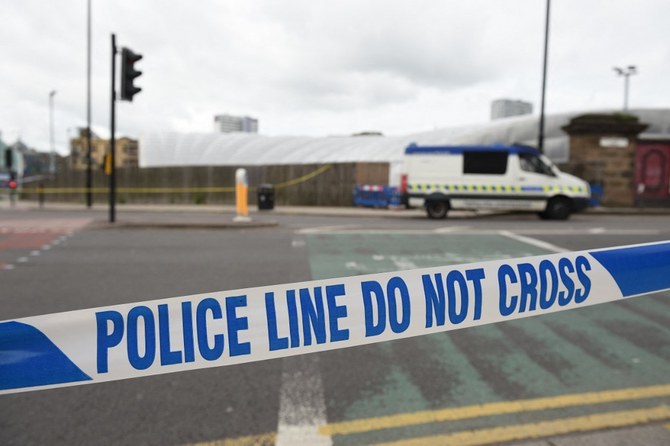
Above, a police cordon surrounds Manchester Arena in Manchester, northwest England following the deadly terror attacks on May 23, 2017. (AFP file photo)
Short Url
Updated 14 June 2021
Follow

Manchester Arena owner, security firm face multimillion-pound lawsuits after bombing inquiry

  • SMG Europe, Showsec both criticized in terror attack report, set to be published Thursday
  • Greater Manchester Police, British Transport Police also set for severe criticism in report

LONDON: The owners of Manchester Arena are set to be hit with a series of multimillion-pound lawsuits by victims of the bombing of an Ariana Grande concert at the venue in 2017, with an inquiry report on the attack set to be released this week.

Twenty-two people, mainly young women and girls, were killed when Salman Abedi detonated a bomb in the arena’s foyer, injuring hundreds of others.

His brother Hashem was later jailed for a minimum of 55 years for his role in organizing the attack.

SMG Europe, the owner of the arena, is set to be heavily criticized in the report, due to be published on Thursday, along with the British Transport Police, Greater Manchester Police and Showsec, the company that provided security for the concert.

Showsec is also likely to face lawsuits from survivors and families of the victims for substantial damages.

Sources told the Daily Telegraph that the companies and police forces had all received letters detailing criticisms of them from Sir John Saunders, the inquiry’s chairman, ahead of publication to allow them to respond.

Letters have also been sent to two men — Kyle Lawler and Mohammed Agha — both of whom worked for Showsec at the arena on the night and were alerted to Abedi’s presence by members of the public. 

Another source said: “The actions will be levelled against SMG primarily because ultimately they were the ones legally responsible for protecting the audience.”

The lawsuits against SMG and Showsec could run to tens of millions of pounds, with many survivors of the attack experiencing physical injury as well as long-term mental health issues.

Showsec, the inquiry heard, employed a large and predominantly casual labor force who were poorly trained and on minimum wage.

The company said blame for not stopping the attack predominantly lay with the police and SMG, with whom there had been a “breakdown in communication” over checking the area of the venue, a mezzanine level and CCTV blindspot in which Abedi hid for almost an hour. Both SMG Europe and Showsec declined to comment.

Thursday’s report, focusing on security arrangements at the venue, is the first of three set to be released following the inquiry.

The second will examine the emergency response to the attack, and the third will assess whether it was preventable.

The UK Home Office, meanwhile, is considering proposals for a new law — named after one of the victims, Martyn Hett — to require large hospitality and public venues to put in place protection and protocols to prevent terrorist attacks in future.


Police suspect suicide bomber behind Nigeria’s deadly mosque blast

Updated 6 sec ago
Follow

Police suspect suicide bomber behind Nigeria’s deadly mosque blast

  • Nigeria police said Thursday that they suspected a suicide bomber was behind the blast that killed several worshippers in a mosque on Christmas eve in the country’s northeastern Borno state
MAIDUGURI: Nigeria police said Thursday that they suspected a suicide bomber was behind the blast that killed several worshippers in a mosque on Christmas eve in the country’s northeastern Borno state.
A police spokesman put the death toll at five, with 35 wounded. A witness on Wednesday told AFP that eight people were killed.
The bomb went off inside the crowded Al-Adum Juma’at Mosque at Gamboru market in the capital city of Maiduguri, as Muslim faithful gathered for evening prayers around 6:00 p.m. (1700 GMT), according to witnesses and the police.
“An unknown individual, whom we suspect to be a member of a terrorist group, entered inside the mosque, and while prayer was ongoing, we recorded an explosion,” police spokesman Nahum Daso told journalists.
Daso said in a statement late on Wednesday that the “incident may have been a suicide bombing, based on the recovery of fragments of a suspected suicide vest and witness statements.”
Police officials have been deployed to markets, worship centers and other public places in the wake of the blast.
Nigeria has been battling a jihadist insurgency since 2009 by jihadist groups Boko Haram and an offshoot, Islamic State West Africa Province (ISWAP), in a conflict that has killed at least 40,000 and displaced around two million from their homes in the northeast, according to the UN.
Although the conflict has been largely limited to the northeastern region, jihadist attacks have been recorded in other parts of the west African nation.
Maiduguri itself — once the scene of nightly gunbattles and bombings — has been calm in recent years, with the last major attack recorded in 2021.