China, US diplomats clash over human rights, COVID-19 pandemic origin

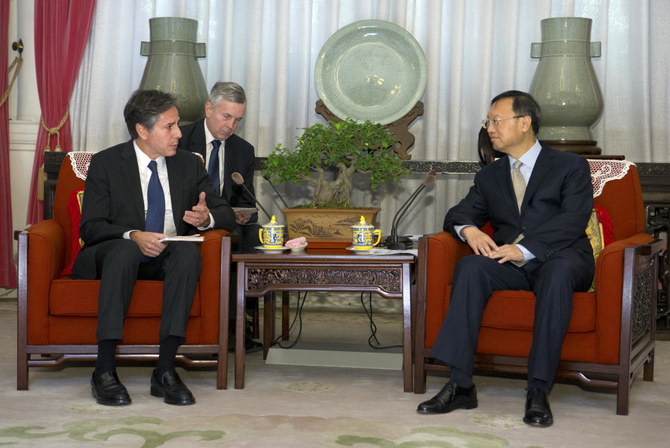
Then-US Deputy Secretary of State Antony Blinken, left, speaks with Chinese State Councilor Yang Jiechi in Beijing, China in this Oct. 8, 2015 photo. (AP)
Short Url
Updated 12 June 2021
Follow

China, US diplomats clash over human rights, COVID-19 pandemic origin

  • Calls for a more thorough investigation into the origin of the SARS-CoV-2 virus that causes COVID-19 are particularly sensitive for China

BEIJING: Top US and Chinese diplomats appear to have had another sharply worded exchange, with Beijing saying it told the US to cease interfering in its internal affairs and accusing Washington of politicizing the search for the origin of the COVID-19 pandemic.
Senior Chinese foreign policy adviser Yang Jiechi and Secretary of State Antony Blinken held a phone call Friday that revealed wide divisions in a number of contentious areas, including the curtailing of freedoms in Hong Kong and the mass detention of Muslims in the northwestern Xinjiang region.
Calls for a more thorough investigation into the origin of the SARS-CoV-2 virus that causes COVID-19 are particularly sensitive for China because of suggestions that it might have Blinked escaped from a laboratory in the central city of Wuhan, where cases were first discovered.
Yang said China was “gravely concerned” over what he called “absurd” stories that the virus escaped from the Wuhan lab.
China “firmly opposes any despicable acts that use the epidemic as an excuse to slander China and to shift blames,” Yang was quoted as saying by the official Xinhua News Agency.
“Some people in the United States have fabricated and peddled absurd stories claiming Wuhan lab leak, which China is gravely concerned about,” Yang said. “China urges the United States to respect facts and science, refrain from politicizing COVID-19 origin tracing and concentrate on international anti-pandemic cooperation.”
The State Department said Blinken “stressed the importance of cooperation and transparency regarding the origin of the virus, including the need for (World Health Organization) Phase 2 expert-led studies in China.”
The US and others have accused China of failing to provide the raw data and access to sites that would allow a more thorough investigation into where the virus sprung from and how it initially spread.
Equally contentious were the issues of Hong Kong, Xinjiang, Taiwan and accusations that China has arbitrarily detained two Canadian citizens in retaliation for Canada’s arrest of an executive of Chinese communications technology giant Huawei, who is wanted by US law enforcement.
The US has “fabricated various lies about Xinjiang in an attempt to sabotage the stability and unity in Xinjiang, which confuse right and wrong and are extremely absurd. China is firmly opposed to such actions,” Yang said.
“Hong Kong affairs are purely China’s internal affairs,” and those found in violation of a sweeping national security law imposed on the former British colony “must be punished,” Yang said.
Blinken, on the other hand, underscored US concern over the deterioration of democratic norms in Hong Kong and the ongoing “genocide and crimes against humanity against predominantly Muslim Uyghurs and members of other ethnic and religious minority groups in Xinjiang,” the State Department said.
He also urged Beijing to ease pressure against Taiwan, the self-governing island democracy China claims as its own territory, to be annexed by force if necessary.
According to Xinhua, Yang said Taiwan involves China’s “core interests” and that Beijing “firmly defends its national sovereignty and territorial integrity.”
The tone of the phone call seemed to echo contentious talks in March in Alaska, when the sides traded sharp and unusually public barbs over vastly different views of each other and the world in their first face-to-face meeting since President Joe Biden took office.
At that meeting, the US accused the Chinese delegation of “grandstanding,” while Beijing fired back, saying there was a “strong smell of gunpowder and drama” that was entirely the fault of the Americans.
Relations between them have deteriorated to their lowest level in decades, with the Biden administration showing no signs of deviating from the established US hard-line against China over trade, technology, human rights and China’s claim to the South China Sea.
Beijing, meanwhile, has fought back doggedly against what it sees as attempts to smear its reputation and restrain its development.
On Thursday, its ceremonial legislature passed a law to retaliate against sanctions imposed on Chinese politicians and organizations, threatening to deny entry to and freeze the Chinese assets of anyone who formulates or implements such measures, potentially placing new pressure on foreign companies operating in the country.


Mystery of CIA’s lost nuclear device haunts Himalayan villagers 60 years on

Updated 48 min 12 sec ago
Follow

Mystery of CIA’s lost nuclear device haunts Himalayan villagers 60 years on

  • Plutonium-fueled spy system was meant to monitor China’s nuclear activity after 1964 atomic tests
  • Porter who took part in Nanda Devi mission warned family of ‘danger buried in snow’

NEW DELHI: Porters who helped American intelligence officers carry a nuclear spy system up the precarious slopes of Nanda Devi, India’s second-highest peak, returned home with stories that sent shockwaves through nearby villages, leaving many in fear that still holds six decades later.

A CIA team, working with India’s Intelligence Bureau, planned to install the device in the remote part of the Himalayas to monitor China, but a blizzard forced them to abandon the system before reaching the summit.

When they returned, the device was gone.

The spy system contained a large quantity of highly radioactive plutonium-238 — roughly a third of the amount used in the atomic bomb dropped by the US on the Japanese city of Nagasaki in the closing stages of the Second World War.

“The workers and porters who went with the CIA team in 1965 would tell the story of the nuclear device, and the villagers have been living in fear ever since,” said Narendra Rana from the Lata village near Nanda Devi’s peak.

His father, Dhan Singh Rana, was one of the porters who carried the device during the CIA’s mission in 1965.

“He told me there was a danger buried in the snow,” Rana said. “The villagers fear that as long as the device is buried in the snow, they are safe, but if it bursts, it will contaminate the air and water, and no one will be safe after that.”

During the Sino-Indian tensions in the 1960s, India cooperated with the US in surveillance after China conducted its first nuclear tests in 1964. The Nanda Devi mission was part of this cooperation and was classified for years. It only came under public scrutiny in 1978, when the story was broken by Outsider magazine.

The article caused an uproar in India, with lawmakers demanding the location of the nuclear device be revealed and calling for political accountability. The same year, then Prime Minister Morarji Desai set up a committee to assess whether nuclear material in the area near Nanda Devi could pollute the Ganges River, which originates there.

The Ganges is one of the world’s most crucial freshwater sources, with about 655 million people in India, Nepal, and Bangladesh depending on it for their essential needs.

The committee, chaired by prominent scientists, submitted its report a few months later, dismissing any cause for concerns, and establishing that even in the worst-case scenario of the device’s rupture, the river’s water would not be contaminated.

But for the villagers, the fear that the shell containing radioactive plutonium could break apart never goes away, and peace may only come once it is found.

Many believe the device, trapped within the glacier’s shifting ice, may have moved downhill over time.

Rana’s father told him that the device felt hot when it was carried, and he believed it might have melted its way into the glacier, remaining buried deep inside.

An imposing mass of rock and ice, Nanda Devi at 7,816 m is the second-highest mountain in India after Kangchenjunga. 

When a glacier near the mountain burst in 2021, claiming over 200 lives, scientists explained that the disaster was due to global warming, but in nearby villages the incident was initially blamed on a nuclear explosion.

“They feared the device had burst. Those rescuing people were afraid they might die from radiation,” Rana said. “If any noise is heard, if any smoke appears in the sky, we start fearing a leak from the nuclear device.”

The latent fear surfaces whenever natural disasters strike or media coverage puts the missing device back in the spotlight. Most recently, a New York Times article on the CIA mission’s 60th anniversary reignited the unease.

“The apprehensions are genuine. After 1965, Americans came twice to search for the device. The villagers accompanied them, but it could not be found, which remains a concern for the local community,” said Atul Soti, an environmentalist in Joshimath, Uttarakhand, about 50 km from Nanda Devi.

“People are worried. They have repeatedly sought answers from the government, but no clear response has been provided so far. Periodically, the villagers voice their concerns, and they need a definitive government statement on this issue.”

Despite repeated queries whenever media attention arises, Indian officials have not released detailed updates since the Desai-appointed committee submitted its findings.

“The government should issue a white paper to address people’s concerns. The white paper will make it clear about the status of the device, and whether leakage from the device could pollute the Ganges River,” Soti told Arab News.

“The government should be clear. If the government is not reacting, then it further reinforces the fear.”