MOSCOW: A Moscow court is expected Wednesday to outlaw the organizations founded by Russian opposition leader Alexei Navalny — part of authorities’ efforts to muzzle critics ahead of a crucial parliamentary election in September.
Prosecutors have asked the Moscow City Court to designate Navalny’s Foundation for Fighting Corruption and his sprawling network of regional offices across Russia as extremist organizations. In conjunction with a new law, the ruling would bar people associated with the groups from running for public office, derailing the hopes of Navalny’s allies of seeking parliamentary seats.
The extremism label would also mean that activists who have worked with the organizations, anyone who donated to them, and even those who simply shared the groups’ materials could be prosecuted and receive lengthy prison terms.
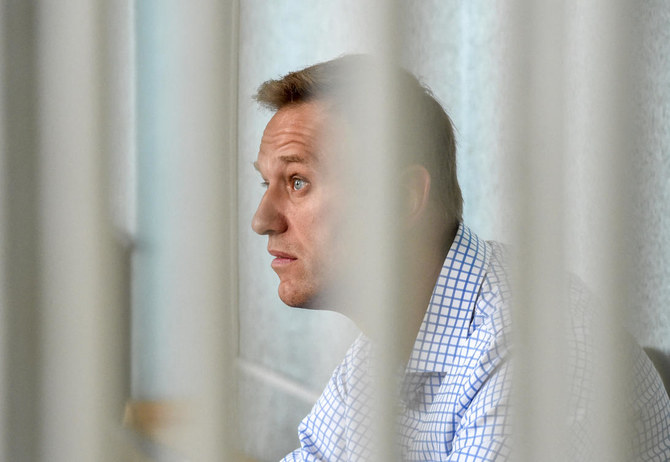
Navalny, the most adamant political foe of president Vladimir Putin, was arrested in January upon returning from Germany, where he spent five months convalescing after a nerve agent poisoning that he blames on the Kremlin — accusations that Russian officials reject. In February, Navalny was given a 2 1/2-year prison term for violating the terms of a suspended sentence from a 2014 embezzlement conviction that he dismissed as politically driven.
The court hearing on his organizations was held behind closed doors on the grounds that classified materials would be discussed.
Ivan Pavlov, who heads a team of defense lawyers in the case, said the court is expected to issue its verdict Wednesday. The judge has rejected a defense appeal to allow Navalny to take part in the hearings via a video link from prison and dismissed other motions by the defense.
“There is no talk about the equal representation of the parties in the case,” he said.
Navalny’s offices in dozens of Russian regions already shut down in April after the prosecutors issued an injunction to suspend their activities pending the court’s ruling, but the opposition leader’s associates have vowed to continue their work in different formats.
His foundation, started 10 years ago, has relentlessly targeted senior government officials with colorful and widely watched videos that detail corruption allegations against them. One of its latest productions, which has received 117 million views on YouTube, claimed that a lavish palace on the shores of the Black Sea was built for Putin through an elaborate corruption scheme. The Kremlin has denied any links to Putin.
Navalny also has relied on his offices across Russia to organize anti-Kremlin protests and implement his Smart Voting strategy — a project to support the candidates most likely to defeat those from the Kremlin’s dominant United Russia party in various elections.
During Wednesday’s hearing, prosecutors accused Navalny’s organizations of staging protests to overthrow the government.
Just as the Moscow court was considering the prosecutors’ request to outlaw Navalny’s organizations, Russian lawmakers have fast-tracked a new law that banned members of organizations declared extremist from running for public office. The law was signed by Putin last week — and combined with the expected court ruling will dash the hopes of several of Navalny’s associates who have declared their intention to run for the Russian parliament in the Sept. 19 election.
Ivan Zhdanov, a top Navalny associate who headed his foundation, said the court was waiting for the law to take effect to tag Navalny’s organizations as extremist. He vowed that the team will continue publishing exposes of corrupt officials and apply the Smart Voting strategy.
“Navalny’s team will not stop its activities, they shouldn’t hope for that,” Zhdanov, who lives abroad, told the independent Dozhd TV.
The September vote is widely seen as an important part of Putin’s efforts to cement his rule ahead of the 2024 Russian presidential election. The 68-year-old leader, who has been in power for more than two decades, pushed through constitutional changes last year that would potentially allow him to hold onto power until 2036.
The crackdown on Navalny and his associates is just one part of a multi-pronged government strategy to steamroll the opposition ahead of the vote. Last week, authorities also arrested Andrei Pivovarov, the head of another anti-Kremlin group that they have labeled “undesirable” — a designation used by the Kremlin to outlaw more than 30 groups.
Days before his arrest, Pivovarov announced the dissolution of his Open Russia movement to protect members from prosecution, but that didn’t stop authorities from pulling him off a Warsaw-bound plane at St. Petersburg’s airport last week. A court in southern Russia’s Krasnodar region ordered him to be held for two months pending an investigation.
Membership in “undesirable” organizations is a criminal offense under a 2015 law, and another bill now making its way through the Russian parliament increases the punishment for it, introducing prison terms of up to six years for their members.
Open Russia was financed by Russian tycoon Mikhail Khodorkovsky, who moved to London after spending 10 years in prison in Russia on charges widely seen as political revenge for challenging Putin’s rule. Khodorkovsky has described the ongoing crackdown on dissent as a reflection of authorities’ concern about the waning popularity of the main Kremlin-directed party, United Russia.
Another opposition activist, Dmitry Gudkov, a former Russian lawmaker who has aspired to run again for the parliament, was held for two days last week on financial charges that he and his supporters allege were trumped up. He went abroad after being released, saying that he had received a warning that he would be jailed if he didn’t leave the country.


![]()

Russia expected to outlaw opposition leader Navalny’s groups
Short Url
https://arab.news/cygy4
Russia expected to outlaw opposition leader Navalny’s groups
- Navalny, the most adamant political foe of president Vladimir Putin, was arrested in January upon returning from Germany
- Prosecutors accused Navalny’s organizations of staging protests to overthrow the government


Latest updates


© 2026 SAUDI RESEARCH & PUBLISHING COMPANY, All Rights Reserved And subject to Terms of Use Agreement.