

'Hero' family rushes to aid Pakistan train crash victims 

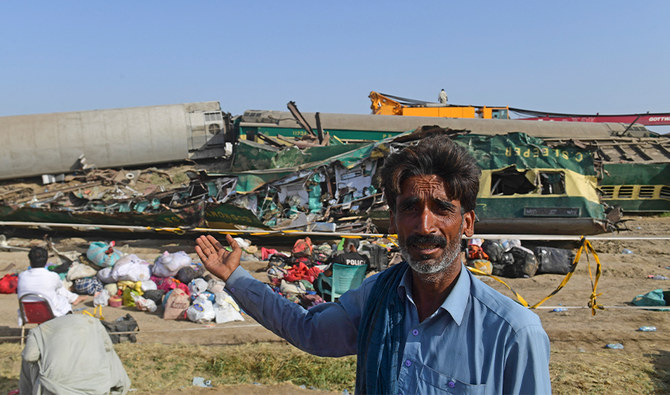
Farmer Ali Nawaz stands beside the wreckage of a train as he speaks during an interview with AFP in Daharki on June 8, 2021, a day after a packed inter-city train ploughed into another express that had derailed, killing at least 63 people. (AFP)
Short Url
Updated 09 June 2021
Follow

'Hero' family rushes to aid Pakistan train crash victims 

  • At least 63 people were killed Monday when a train crashed into derailed carriages of another train in Sindh
  • Hundreds of disorientated passengers emerged from the trains, slowly grasping the magnitude of the crash

Daharki, PAKISTAN: As an express train hurtled through farmland in Pakistan and smashed into the carriages of another service that had derailed minutes earlier, a family of nearby villagers was jolted awake.
“The blast of the collision was so loud that we woke up in panic,” said Ali Nawaz, describing the start of a frantic bid to help passengers from the wreckage of the double disaster.
“When we came out of the house we saw the train had halted, as we got closer to the scene we heard people calling for help.”
At least 63 people were killed, according to officials, with dozens more wounded.
With patchy mobile phone reception and a poor road network, it would be hours before emergency services could reach the site, some 25 kilometers (15 miles) from the nearest city of Daharki, deep in southern Sindh province.
Nawaz’s family of around a dozen people lives just 500 meters (550 yards) from the tracks.
The men raced to identify the most seriously wounded passengers to take to hospital by car while those who appeared more stable were loaded onto tractor trailers.
The first passenger, a mother that Nawaz’s cousin drove to the hospital, died in the back seat.
Back at the farmhouse, the women raced to fill water containers for the injured in the sweltering summer night.
“They made a chain — the women would carry water to the midway point from where the men would carry it to the passengers,” 63-year-old Nawaz told AFP, cows and calves roaming the courtyard of his single-story brick home.
Hundreds of disorientated passengers emerged from the trains, slowly grasping the magnitude of the crash, which destroyed six carriages.
They joined villagers in searching for survivors, clambering over the crumpled carriages to reach those trapped inside.
Seat benches from the trains were turned into beds to carry people away, and bodies lined up on the ground and respectfully covered with scarves.
“I kept working day and night — cooking meals, bread and tea — and my husband and other male members of the family kept supplying them to the victims and rescue workers,” said Habiba Mai, one of Nawaz’s two wives.

As dawn broke, an injured passenger and her three children staggered to the house.
“I milked my cow to feed her little daughter,” said 40-year-old Mai.
“The woman’s face was stained with dust so I washed it with water. She had no slippers on her feet so I gave her mine.”
Outside their home on Tuesday, army personnel were resting on traditional charpoy benches under neem trees.
An officer, who did not want to be named, pulled up to reward the family with 50,000 rupees for aiding the rescue effort.
“She’s a hero,” said Muneer Ahmed, Mai’s brother-in-law.
Mai stood next to her daughter, giving tea to the visitors still gathering outside the house in the evening, the walls blackened by smoke.
“My fingers have almost burnt sitting at the stove day and night,” she said, smiling.
“We did the best we could.”


Pakistan urges world to treat water insecurity as global risk, flags India treaty suspension

Updated 5 sec ago
Follow

Pakistan urges world to treat water insecurity as global risk, flags India treaty suspension

  • Pakistan says it is strengthening water management but national action alone is insufficient
  • India unilaterally suspended Indus Waters Treaty last year, leading to irregular river flows

ISLAMABAD: Pakistan on Tuesday urged the international community to recognize water insecurity as a “systemic global risk,” warning that disruptions in shared river basins threaten food security, livelihoods and regional stability, as it criticized India’s handling of transboundary water flows.

The call comes amid heightened tensions after India’s unilateral decision last year to hold the 1960 Indus Waters Treaty “in abeyance,” a move Islamabad says has undermined predictability in river flows and compounded climate-driven vulnerabilities downstream.

“Across regions, water insecurity has become a systemic risk, affecting food production, energy systems, public health, livelihoods and human security,” Pakistan’s Acting Permanent Representative to the United Nations, Ambassador Usman Jadoon, told a UN policy roundtable on global water stress.

“For Pakistan, this is a lived reality,” he said, describing the country as a climate-vulnerable, lower-riparian state facing floods, droughts, accelerated glacier melt, groundwater depletion and rapid population growth, all of which are placing strain on already stressed water systems.

Jadoon said Pakistan was strengthening water resilience through integrated planning, flood protection, irrigation rehabilitation, groundwater replenishment and ecosystem restoration, including initiatives such as Living Indus and Recharge Pakistan, but warned that domestic measures alone were insufficient.

He noted the Indus River Basin sustains one of the world’s largest contiguous irrigation systems, provides more than 80 percent of Pakistan’s agricultural water needs and supports the livelihoods of over 240 million people.

The Pakistani diplomat said the Indus Waters Treaty had for decades provided a framework for equitable water management, but India’s decision to suspend its operation, followed by unannounced flow disruptions and the withholding of hydrological data, had created an unprecedented challenge for Pakistan’s water security.

Pakistan has said the treaty remains legally binding and does not permit unilateral suspension or modification.

The issue has gained urgency as Pakistan continues to recover from last year’s monsoon floods, which killed more than 1,000 people and devastated farmland in Punjab, the country’s eastern breadbasket, in what officials described as severe riverine flooding.

Last month, Deputy Prime Minister Ishaq Dar said Pakistan had observed abrupt variations in river flows from India, creating uncertainty for farmers in Punjab during critical periods of the agricultural cycle.

“As we move toward the 2026 UN Water Conference, Pakistan believes the process must acknowledge water insecurity as a systemic global risk, place cooperation and respect for international water law at the center of shared water governance, and ensure that commitments translate into real protection for vulnerable downstream communities,” Jadoon said.