

Saudi startup Red Sea Farms secures $10m investment

1 / 2
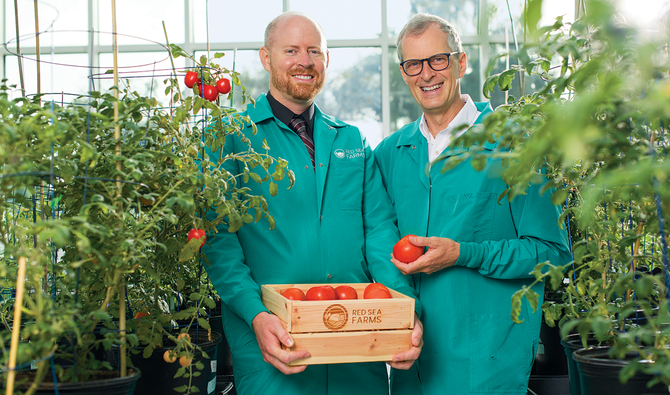
Mark Tester highlighted how KAUST provided the perfect environment for researchers to pursue their passion. (AN photo by Huda Bashatah)
2 / 2
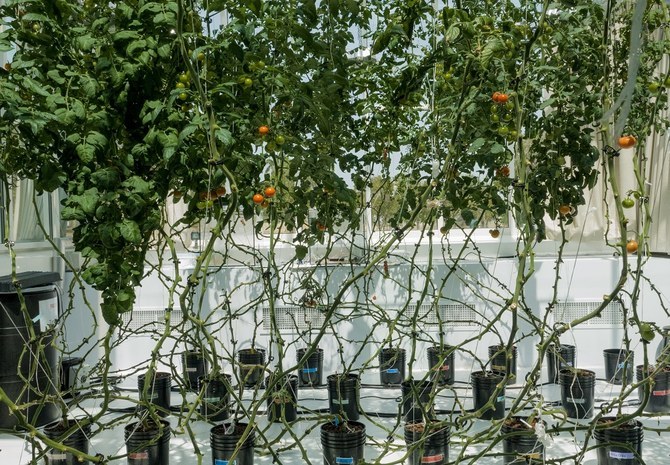
Red Sea Farms was established in 2018 with a vision to reduce food insecurity, carbon and freshwater use in the global and Gulf food sectors. (Supplied)
Short Url
Updated 08 June 2021
Follow

Saudi startup Red Sea Farms secures $10m investment

  • Firm is part of KSA’s $200-million organic farming action plan

RIYADH: Red Sea Farms, a Saudi Arabian agriculture technology (agtech) startup that uses saltwater to grow crops, has attracted $10 million in venture capital.

The investment in the agtech firm, which is based at King Abdullah University for Science and Technology (KAUST), is one of the sector’s biggest investments to date.

The funding is being led by a group of Saudi and UAE investors, including Saudi Aramco’s entrepreneurship arm Wa’ed, the nonprofit Future Investment Initiative Institute, KAUST and Global Ventures, a UAE venture capital group, Red Sea Farms said in an online briefing on Monday.

The company intends to have up to eight farming sites located in central and western Saudi Arabia and in Abu Dhabi, said Ryan Lefers, CEO of Red Sea Farms, adding that the startup was aiming to expand to the UAE by the end of the year.

Lefers believed there was strong demand for organic produce in the Kingdom, with the company looking to launch 15 snack products by the end of 2021, including peppers and cucumbers.

Red Sea Farms currently operates a saltwater pilot greenhouse at KAUST Research and Technology Park. “We are proud to have designed, developed and delivered one of the world’s most sustainable agricultural systems from our base in Saudi Arabia,” Lefers added. “The investment from our new partners will help us improve global food security while reducing the carbon and freshwater footprint.”

Wa’ed managing director, Wassim Basrawi, said: “The Red Sea Farms investment reflects our decade-long commitment to the Saudi startup sector, where Wa’ed has deployed more than $100 million in venture capital investments and loans to more than 100 entrepreneurs. Red Sea Farms is a good example of a game-changing startup whose innovations not only can transform markets but improve life for everyone in the Kingdom.”

The consortium reflects growing investor interest in the Gulf in sustainable farming solutions that can combat pandemics and global supply chain disruption. 

Food security was important for Gulf countries even before the onset of the coronavirus pandemic.

Red Sea Farms was established in 2018 with a vision to reduce food insecurity, carbon and freshwater use in the global and Gulf food sectors. Through a patented system of new, more efficient solar and growth monitoring technologies, saltwater replaces freshwater typically used to cool greenhouses and irrigate crops.

The startup’s growing systems can be quickly and easily scaled in climates such as the Gulf region, where conventional farming methods are not possible or cost-effective. It is initially using its technology to grow and sell tomatoes in Saudi Arabia, but ultimately plans to sell entire turn-key growing systems to buyers around the world.

Its tomatoes are grown in an environment-controlled, enclosed farm that primarily uses saltwater to cool greenhouses and irrigate crops. It aims to produce a ton of tomatoes by July, four by September and 10 by the end of the year.

To date, Red Sea Farms has raised $11.9 million. The firm received a $1.9 million investment in 2019 from the KAUST Innovation Fund and the Saudi-based Research Products Development Company.

Organic farming, a method of agricultural production for both plants and animals, depends on the use of natural materials to produce food without the use of chemical fertilizers, pesticides or genetically modified materials derived from them.

The Kingdom in 2018 unveiled its organic farming action plan and has allocated SR750 million ($200 million) to support it.

The plan aims to increase organic production by 300 percent. Its other objectives include providing safe food, and sustainable, highly profitable farming, which will be an important resource for the national economy.


PIF’s Humain invests $3bn in Elon Musk’s xAI prior to SpaceX acquisition

Updated 18 February 2026
Follow

PIF’s Humain invests $3bn in Elon Musk’s xAI prior to SpaceX acquisition

JEDDAH: Humain, an artificial intelligence company owned by Saudi Arabia’s Public Investment Fund, invested $3 billion in Elon Musk’s xAI shortly before the startup was acquired by SpaceX.

As part of xAI’s Series E round, Humain acquired a significant minority stake in the company, which was subsequently converted into shares of SpaceX, according to a press release.

The transaction reflects PIF’s broader push to position Saudi Arabia as a central hub in the global AI ecosystem, as part of its Vision 2030 diversification strategy.

Through Humain, the fund is seeking to combine capital deployment with infrastructure buildout, partnerships with leading technology firms, and domestic capacity development to reduce reliance on oil revenues and expand into advanced industries.

The $3 billion commitment offers potential for long-term capital gains while reinforcing the company’s role as a strategic, scaled investor in transformative technologies.

CEO Tareq Amin said: “This investment reflects Humain’s conviction in transformational AI and our ability to deploy meaningful capital behind exceptional opportunities where long-term vision, technical excellence, and execution converge, xAI’s trajectory, further strengthened by its acquisition by SpaceX, one of the largest technology mergers on record, represents the kind of high-impact platform we seek to support with significant capital.” 

The deal builds on a large-scale collaboration announced in November at the US-Saudi Investment Forum, where Humain and xAI committed to developing over 500 megawatts of next-generation AI data center and computing infrastructure, alongside deploying xAI’s “Grok” models in the Kingdom.

In a post on his X handle, Amin said: “I’m proud to share that Humain has invested $3 billion into xAI’s Series E round, just prior to its historic acquisition by SpaceX. Through this transaction, Humain became a significant minority shareholder in xAI.”

He added: “The investment builds on our previously announced 500MW AI infrastructure partnership with xAI in Saudi Arabia, reinforcing Humain’s role as both a strategic development partner and a scaled global investor in frontier AI.”

He noted that xAI’s trajectory, further strengthened by SpaceX’s acquisition, exemplifies the high-impact platforms Humain aims to support through strategic investments.

Earlier in February, SpaceX completed the acquisition of xAI, reflecting Elon Musk’s strategy to integrate AI with space exploration.

The combined entity, valued at $1.25 trillion, aims to build a vertically integrated innovation ecosystem spanning AI, space launch technology, and satellite internet, as well as direct-to-device communications and real-time information platforms, according to Bloomberg.

Humain, founded in August, consolidates Saudi Arabia’s AI initiatives under a single entity. From the outset, its vision has extended beyond domestic markets, participating across the global AI value chain from infrastructure to applications.

The company represents a strategic initiative by PIF to diversify the Kingdom’s economy and reduce oil dependence by investing in knowledge-based and advanced technologies.