

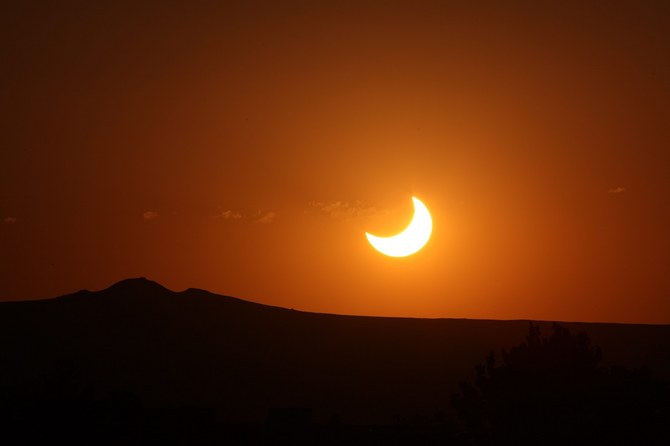
‘Ring of fire’ eclipse will not be seen in Arab region

The eclipse will last about five hours, from 11:12 am until 4:11 p.m. Riyadh time. (File/Shutterstock)
Short Url
Updated 07 June 2021
Follow

‘Ring of fire’ eclipse will not be seen in Arab region

  • Abu Zahra said that observers would be able to see the annual eclipse in the Russian far east, the North Pole, the west of Greenland, Canada and Russia

JEDDAH: Next week’s partial solar eclipse will be seen in parts of North America, Russia and Greenland in the first of two polar eclipses this year, but the phenomenon will not be seen in the Kingdom or Arab World.

Majed Abu Zahra, president of the Astronomical Society in Jeddah, said that the annual event is a type of solar eclipse that occurs at the start of the lunar month when the Moon covers most of the Sun, leaving only an outer part that looks like a ring surrounding the moon.

Abu Zahra said that observers would be able to see the annual eclipse in the Russian far east, the North Pole, the west of Greenland, Canada and Russia. However, the moon will not fully cover the sun as it will be far from Earth and its apparent size will not be large enough to achieve this effect. A luminous “ring of light” will surround the moon and the sun’s halo will not be visible.

The eclipse will last about five hours, from 11:12 am until 4:11 p.m. Riyadh time, and from 8:12 am until 1:11 p.m. Greenwich time.


1,965 Israeli violations recorded against Palestinians in February

Updated 3 sec ago
Follow

1,965 Israeli violations recorded against Palestinians in February

  • Head of Wall and Settlement Resistance Commission condemns attacks as a continuation of ‘terror’ against Palestinians
  • Violations included assaults, uprooting trees, burning fields and preventing olive pickers from accessing their lands

LONDON: Israeli forces and settlers carried out 1,965 attacks across Palestinian towns in the occupied West Bank in February, according to a report by the Palestinian Authority.

Muayyad Shaaban, head of the Wall and Settlement Resistance Commission, condemned the attacks as a continuation of the “terror” against the Palestinian people, their land and property.

The commission documented 1,454 attacks by Israeli forces and 511 by settlers, most of which were concentrated in the governorates of Hebron with 421 attacks, followed by Nablus with 340, Ramallah and Al-Bireh with 320, and East Jerusalem with 210 attacks.

Violations have included direct beatings of Palestinians, uprooting trees, burning fields, and preventing olive pickers from accessing their lands.

Israeli forces have seized land and demolished homes and agricultural facilities under the pretext of “security,” which has enabled settlers to expand their settlements, according to Wafa news agency.

Shaaban said: “What is taking place represents an organized methodology aimed at emptying the land of its owners and imposing an integrated racist colonial system.”

Israeli settlers have poisoned and uprooted a total of 1,314 trees, including 1,054 olive trees, in the areas of Ramallah, Bethlehem, Hebron, Nablus and Tulkarm. The olive groves have been a lifeline for Palestinians in the West Bank, with an estimated 80,000 to 100,000 families relying on the olive harvest for their livelihoods, according to the UN Human Rights Council.

In February, Israeli forces demolished 122 structures belonging to Palestinians, including 56 inhabited homes, nine uninhabited homes, 34 agricultural facilities and 18 sources of livelihood. More than one-third of these demolitions took place in Jerusalem, totaling 46 structures.