‘I’ll likely never see eye to eye with Trump on Jan. 6’, Pence tells Republican gathering

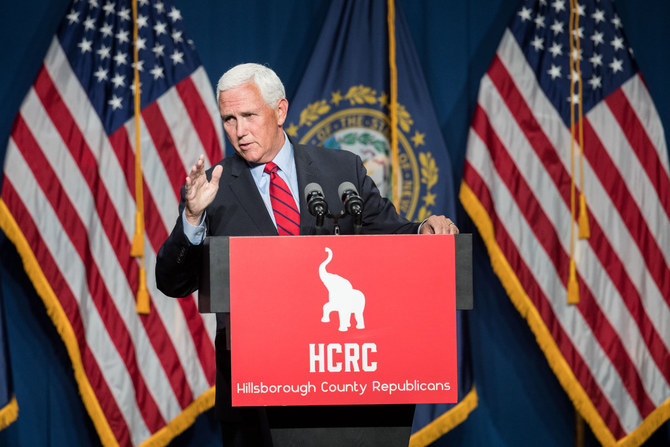
Former Vice President Mike Pence addresses the GOP Lincoln-Reagan Dinner on June 3, 2021 in Manchester, New Hampshire. (Scott Eisen/Getty Images/AFP)
Short Url
Updated 04 June 2021
Follow

‘I’ll likely never see eye to eye with Trump on Jan. 6’, Pence tells Republican gathering

  • Pence: “As I said that day, Jan. 6 was a dark day in history of the United States Capitol"
  • On that day, the Trump-inspired mob threatened Pence for refusing to do Trump's bidding of overturning Joe Biden's poll victory

MANCHESTER, New Hampshire: Former Vice President Mike Pence said Thursday that he wasn’t sure that he and former President Donald Trump would ever see “eye to eye” over what happened on Jan. 6 but that he would “always be proud of what we accomplished for the American people over the last four years.”
Pence, speaking at a Republican dinner in the early voting state of New Hampshire, gave his most extensive comments to date on the events of Jan. 6, when angry Trump supporters broke into the Capitol building, some chanting “Hang Mike Pence!” after the vice president said he did not have the power to overturn Democrat Joe Biden’s election victory.
“As I said that day, Jan. 6 was a dark day in history of the United States Capitol. But thanks to the swift action of the Capitol Police and federal law enforcement, violence was quelled. The Capitol was secured,” Pence said.
“And that same day, we reconvened the Congress and did our duty under the Constitution and the laws of the United States,” Pence continued. “You know, President Trump and I have spoken many times since we left office. And I don’t know if we’ll ever see eye to eye on that day.”
It was a rare departure for Pence, who spent four years standing loyally beside his boss amid controversy, investigation and impeachment. It comes as Pence considers his own potential 2024 White House run and as Republicans, some of whom were angry at Trump in the days after the Jan. 6 insurrection, have largely coalesced back around the former president.
Pence praised Trump several times during his nearly 35-minute speech at the Hillsborough County Republican Committee’s annual Lincoln-Reagan Awards Dinner in Manchester. He tried to turn the events of Jan. 6 back around on Democrats, saying they wanted to keep the insurrection in the news to divert attention from Biden’s liberal agenda.
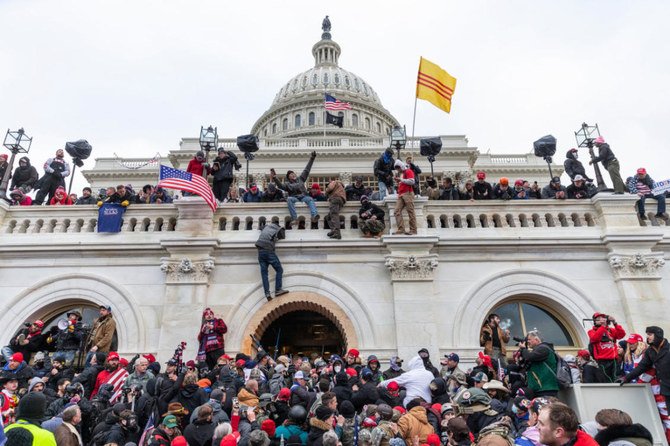


Right-wing insurrectionists fired up by then US President Donald Trump seizing the US Capitol on Jan. 6, 2021 as Congress gathered to formally declare the election victory of Democratic presidential candidate Joe Biden. (Shutterstock photo)

“I will not allow Democrats or their allies in the media to use one tragic day to discredit the aspirations of millions of Americans. Or allow Democrats or their allies in the media to distract our attention from a new administration intent on dividing our country to advance their radical agenda,” Pence said. “My fellow Republicans, for our country, for our future, for our children and our grandchildren, we must move forward, united.”
He accused Biden of campaigning as a moderate but becoming the most liberal president since President Franklin D. Roosevelt. He said the administration forced through Congress “a COVID bill to fund massive expansion of the welfare state” and was pushing a “so-called infrastructure bill” that was really a “thinly disguised climate change bill” funded with cuts in the military and historic tax increases.
“I just say enough is enough,” he said, adding that “we’re going to stand strong for freedom.”
Pence also hit upon several favorite themes of conservative Republicans, emphasizing the need for states to shore up voter integrity around the country. He praised law enforcement as heroes, saying, “Black lives are not endangered by police. Black lives are saved by police every day.”
He also pushed back against “critical race theory,” which seeks to reframe the narrative of American history.
Its proponents argue that federal law has preserved the unequal treatment of people on the basis of race and that the country was founded on the theft of land and labor. But Republicans have said concepts suggesting that people are inherently racist or that America was founded on racial oppression are divisive and have no place in the classroom.
“America is not a racist country,” he said, prompting one of several standing ovations and cheers during his speech.
“It is past time for America to discard the left-wing myth of systemic racism,” Pence said. “I commend state legislators and governors across the country for banning critical race theory from our schools.”
His choice of states, including an April appearance in South Carolina, is aimed at increasing his visibility as he considers whether to run for the White House in 2024.
Trump is increasingly acting and talking like he plans to make a run as he sets out on a more public phase of his post-presidency, beginning with a speech on Saturday in North Carolina.
Since leaving office in January, Pence has been doing work with the Heritage Foundation and Young America’s Foundation. His team said he plans more trips, including stops in Texas, California and Michigan.
Along with his visits to South Carolina and New Hampshire, Pence has been hitting the fundraising circuit. He is set to speak next week at another fundraiser hosted by House Minority Leader Kevin McCarthy, will travel to North Carolina for a Heritage Foundation donor event, and will then head to California, where he will take part in the Ronald Reagan Presidential Foundation and Institute’s speakers’ series, a Republican National Committee donor retreat and a Young America’s Foundation event, according to aides.
Among other prominent Republicans, former UN Ambassador Nikki Haley said in April that she would stand down if Trump decided to run in 2024. Former Secretary of State Mike Pompeo has undertaken an aggressive schedule, visiting states that will play a pivotal role in the 2024 primaries and signing a contract with Fox News Channel.


Rubio defends US ouster of Venezuela’s Maduro to Caribbean leaders unsettled by Trump policies

Updated 26 February 2026
Follow

Rubio defends US ouster of Venezuela’s Maduro to Caribbean leaders unsettled by Trump policies

BASSETERRE, St. Kitts and Nevis: US Secretary of State Marco Rubio on Wednesday defended the Trump administration’s military operation to capture Venezuela’s Nicolás Maduro, telling Caribbean leaders, many of whom objected to that move, that the country and the region were better off as a result.
Speaking to leaders from the 15-member Caribbean Community bloc at a summit in the country of St. Kitts and Nevis, Rubio brushed aside concerns about the legality of Maduro’s capture last month that have been raised among Venezuela’s island-state neighbors and others.
“Irrespective of how some of you may have individually felt about our operations and our policy toward Venezuela, I will tell you this, and I will tell you this without any apology or without any apprehension: Venezuela is better off today than it was eight weeks ago,” Rubio told the leaders in a closed-door meeting, according to a transcript of his remarks later distributed by the US State Department.
Rubio said that since Maduro’s ouster and the effective takeover of Venezuela’s oil sector by the United States, the interim authorities in the South American country have made “substantial” progress in improving conditions by doing “things that eight or nine weeks ago would have been unimaginable.”
The Caribbean leaders have gathered to debate pressing issues in a region that President Donald Trump has targeted for a 21st-century incarnation of the Monroe Doctrine meant to ensure Washington’s dominance in the Western Hemisphere. The Republican administration has declared a focus closer to home even as Washington increasingly has been preoccupied by the possibility of a US military attack on Iran.
Rubio downplays antagonism in US regional push
In his remarks to the group, America’s top diplomat tried to play down any antagonistic intent in what Trump has referred to as the “Donroe Doctrine.” Rubio said the administration wants to strengthen ties with the region in the wake of the Venezuela operation and ensure that issues such as crime and economic opportunities are jointly addressed.
“I am very happy to be in an administration that’s giving priority to the Western Hemisphere after largely being ignored for a very long time,” Rubio said. “We share common opportunities, and we share some common challenges. And that’s what we hope to confront.”
He said transnational criminal organizations pose the biggest threat to the Caribbean while recognizing that many are buying weapons from the United States, a problem he said authorities are tackling.
Rubio also said the US and the Caribbean can work together on economic advancement and energy issues, especially because many leaders at the four-day summit have energy resources they seek to explore. “We want to be your partner in that regard,” he said.
Rubio said the US recognizes the need for fair, democratic elections in Venezuela, which lies just miles away from Trinidad and Tobago at the closest point.
“We do believe that a prosperous, free Venezuela who’s governed by a legitimate government who has the interests of their people in mind could also be an extraordinary partner and asset to many of the countries represented here today in terms of energy needs and the like, and also one less source of instability in the region,” he said.
Rubio added: “We view our security, our prosperity, our stability to be intricately tied to yours.”
Trump plays up Maduro’s ouster
Trump, in his State of the Union address Tuesday night, called the operation that spirited Maduro out of Venezuela to face drug trafficking charges in New York “an absolutely colossal victory for the security of the United States.”
The US had built up the largest military presence in the Caribbean Sea in generations before the Jan. 3 raid. That has now been exceeded by the surge of American warships and aircraft to the Middle East as the administration pressures Iran to make a deal over its nuclear program.
In the Caribbean, Trump has stepped up aggressive tactics to combat alleged drug smuggling with a series of strikes on boats that have killed over 150 people and he has tightened pressure on Cuba. Regional leaders have complained about administration demands for nations to accept third-country deportees from the US and to chill relations with China.
One regional leader who has backed the US escalation is Trinidad and Tobago Prime Min­is­ter Kam­la Persad-Bisses­sar, whom Rubio thanked for her “public support for US military operations in the South Caribbean Sea,” the State Department said.
Persad-Bissessar told reporters that her conversation with Rubio focused on “Haiti; we talked about Cuba of course; we talked about engagements with Venezuela and the way forward.”
She was asked if she considered the latest US military strikes in Caribbean waters as extrajudicial killings: “I don’t think they are, and if they are, we will find out, but our legal advice is they are not.”
Rubio had other one-on-one meetings with heads of government, including from St. Kitts and Nevis, Haiti, Jamaica and Guyana.
Caribbean leaders point to shifting global order
Trump said during the State of the Union that his administration is “restoring American security and dominance in the Western Hemisphere, acting to secure our national interests and defend our country from violence, drugs, terrorism and foreign interference.”
Terrance Drew, prime minister of St. Kitts and Nevis and chair of the Caribbean Community bloc, said the region “stands at a decisive hour” and that “the global order is shifting.”
Drew and other leaders said Cuba’s humanitarian situation must be addressed.
“It must be clear that a prolonged crisis in Cuba will not remain confined to Cuba,” Jamaican Prime Minister Andrew Holness warned. “It will affect migration, security and economic stability across the Caribbean basin.”
The US Treasury Department on Wednesday slightly eased restrictions on the sale of Venezuelan oil to Cuba, which instituted austere fuel-saving measures in the weeks after the US raid in Venezuela.
That move came hours before Cuba’s government announced that its soldiers killed four people aboard a speedboat registered in Florida that had opened fire on officers in Cuban waters.